
Counterfactual Bootstrap for Robust Meta-Reinforcement Learning
Abstract
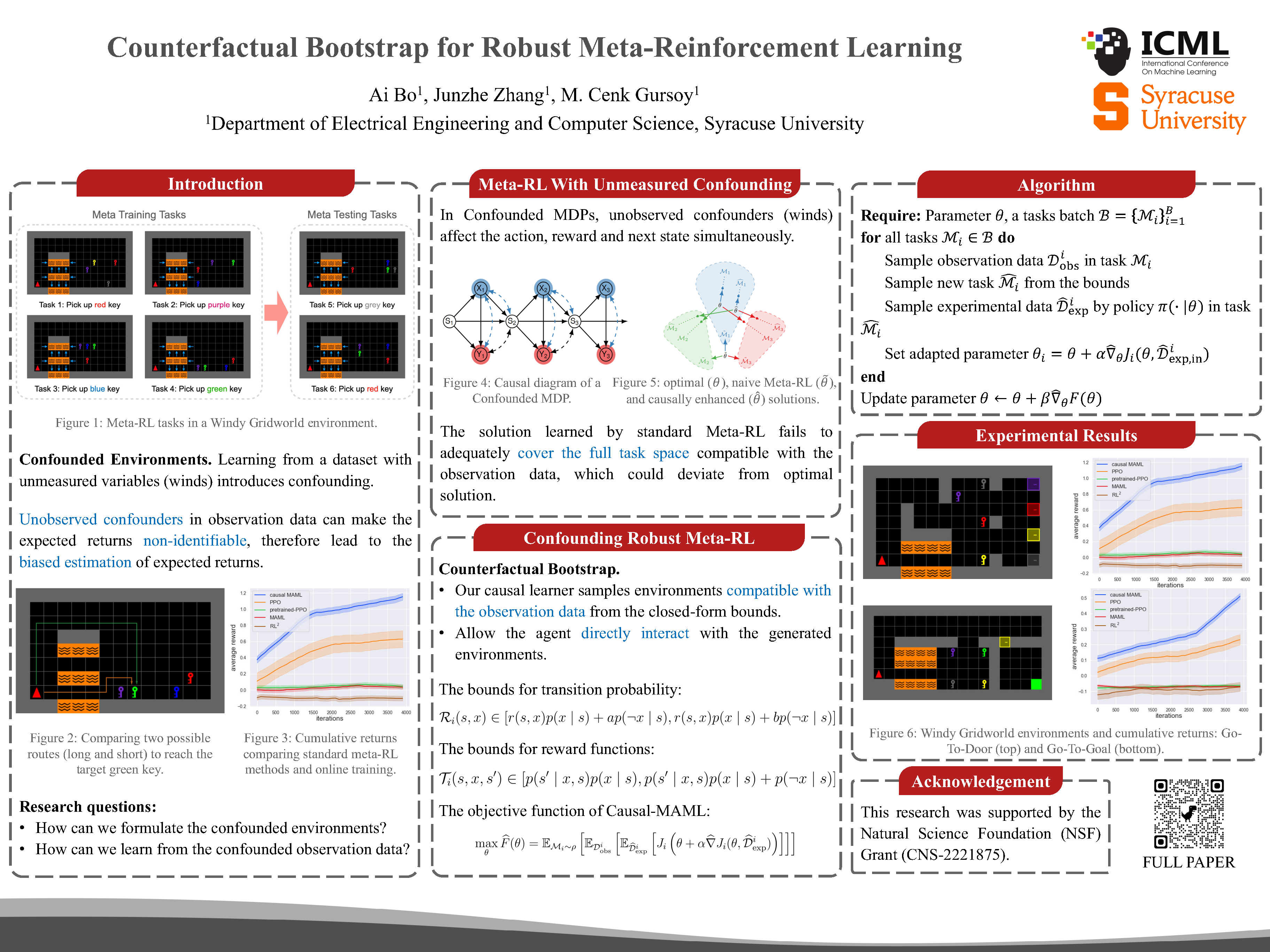
Meta-Reinforcement Learning (Meta-RL) focuses on training policies using data collected from a variety of diverse environments. This approach enables the policy to adapt to new settings with only a few training steps. While many Meta-RL methods have demonstrated success, they often rely on the assumption that unobserved confounders can be excluded a priori. This paper investigates robust Meta-RL in sequential decision-making, given confounded observational data collected across multiple heterogeneous environments. We introduce a novel augmentation procedure for standard Meta-RL algorithms (e.g., MAML), which employs partial identification methods to generate posterior counterfactual trajectories from candidate environments that align with the confounded observations. These counterfactual trajectories are then used to find a policy initialization that produces strong generalization performance in the target domain. Theoretical analysis reveals that our causal Meta-RL approach is guaranteed to yield a solution that minimizes generalization loss in future inference tasks.
Lay Summary
Many Meta-Reinforcement Learning (Meta-RL) methods struggle to adapt to decision-making problems in which actions and observations are influenced by hidden, unobserved factors—referred to as confounded environments. Such confounding can lead learning algorithms to draw incorrect conclusions from observational data. In this work, we investigate how to improve the reliability of Meta-RL systems when learning from confounded real-world data collected across diverse environments. We propose a causal learning framework that augments existing Meta-RL methods by generating alternative “what-if” training experiences consistent with the observed data. Rather than assuming the absence of hidden biases, our approach explicitly models them using causal inference techniques to construct plausible counterfactual environments. Our framework enhances the ability of AI systems to generalize and safely adapt to new situations, particularly when clean experimental data are unavailable. This capability is crucial for real-world applications such as robotics, healthcare decision support, and autonomous systems, where hidden biases are prevalent and robust adaptation is essential.