
Fix Before Search: Benchmarking Agentic Visual Query Pre-processing in Multimodal Retrieval-augmented Generation
Abstract
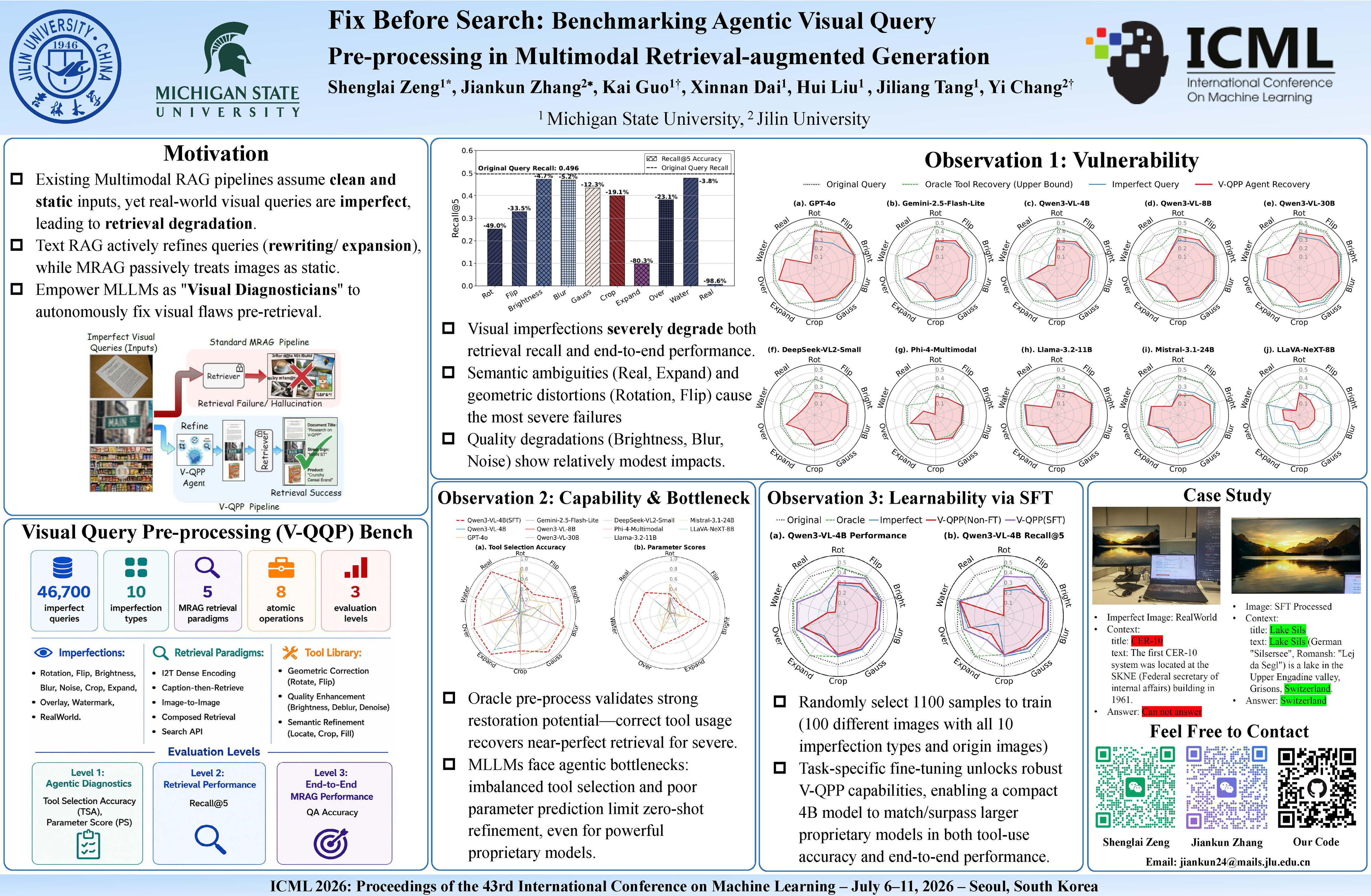
Multimodal Retrieval-Augmented Generation (MRAG) has emerged as a key paradigm for grounding MLLMs with external knowledge. While query pre-processing (e.g., rewriting) is standard in text-based RAG, existing MRAG pipelines predominantly treat visual inputs as static and immutable, implicitly assuming they are noise-free. However, real-world visual queries are often ``imperfect''---suffering from geometric distortions, quality degradation, or semantic ambiguity---leading to catastrophic retrieval failures. To address this gap, we propose V-QPP-Bench, the first comprehensive benchmark dedicated to Visual Query Pre-processing (V-QPP). We formulate V-QPP as an agentic decision-making task where MLLMs must autonomously diagnose imperfections and deploy perceptual tools to refine queries. Our extensive evaluation across 46,700 imperfect queries and diverse MRAG paradigms reveals three critical insights: (1) Vulnerability---visual imperfections severely degrade both retrieval recall and end-to-end MRAG performance; (2) Restoration Potential & Bottleneck---while oracle preprocessing recovers near-perfect performance, off-the-shelf MLLMs struggle with tool selection and parameter prediction without specialized training; and (3) Training Enhancement---supervised fine-tuning enables compact models to achieve comparable or superior performance to larger proprietary models, demonstrating the benchmark's value for developing robust MRAG systems The code is available at https://github.com/phycholosogy/VQQP_Bench
Lay Summary
In Multimodal Retrieval-Augmented Generation (MRAG), AI systems use images to search for external knowledge. Standard systems assume these images are perfect. However, real-world visual queries are often "imperfect"—they can be blurry, tilted, or cluttered with background noise. These imperfections cause the AI to fail at finding the right information, leading to incorrect or nonsensical answers. We propose V-QPP-Bench, the first benchmark dedicated to "cleaning up" these visual queries before the AI searches for answers. We treat this as an active decision-making task: the AI acts like a technician that must diagnose what is wrong with a photo and then use specific tools—such as cropping, deblurring, or rotating—to fix it. We evaluated 46,700 cases to see if AI can bridge the gap between a messy photo and a clear intent. Our findings show that while standard AI models struggle to fix these images, specialized training can significantly boost their performance. We demonstrate that even smaller, efficient models can learn to master these tools, outperforming much larger systems. This work provides a foundation for building more robust AI assistants that can accurately understand and respond to the imperfect images we take in everyday life.