
EMFormer: Efficient Multi-Scale Transformer for Accumulative Context Weather Forecasting
Abstract
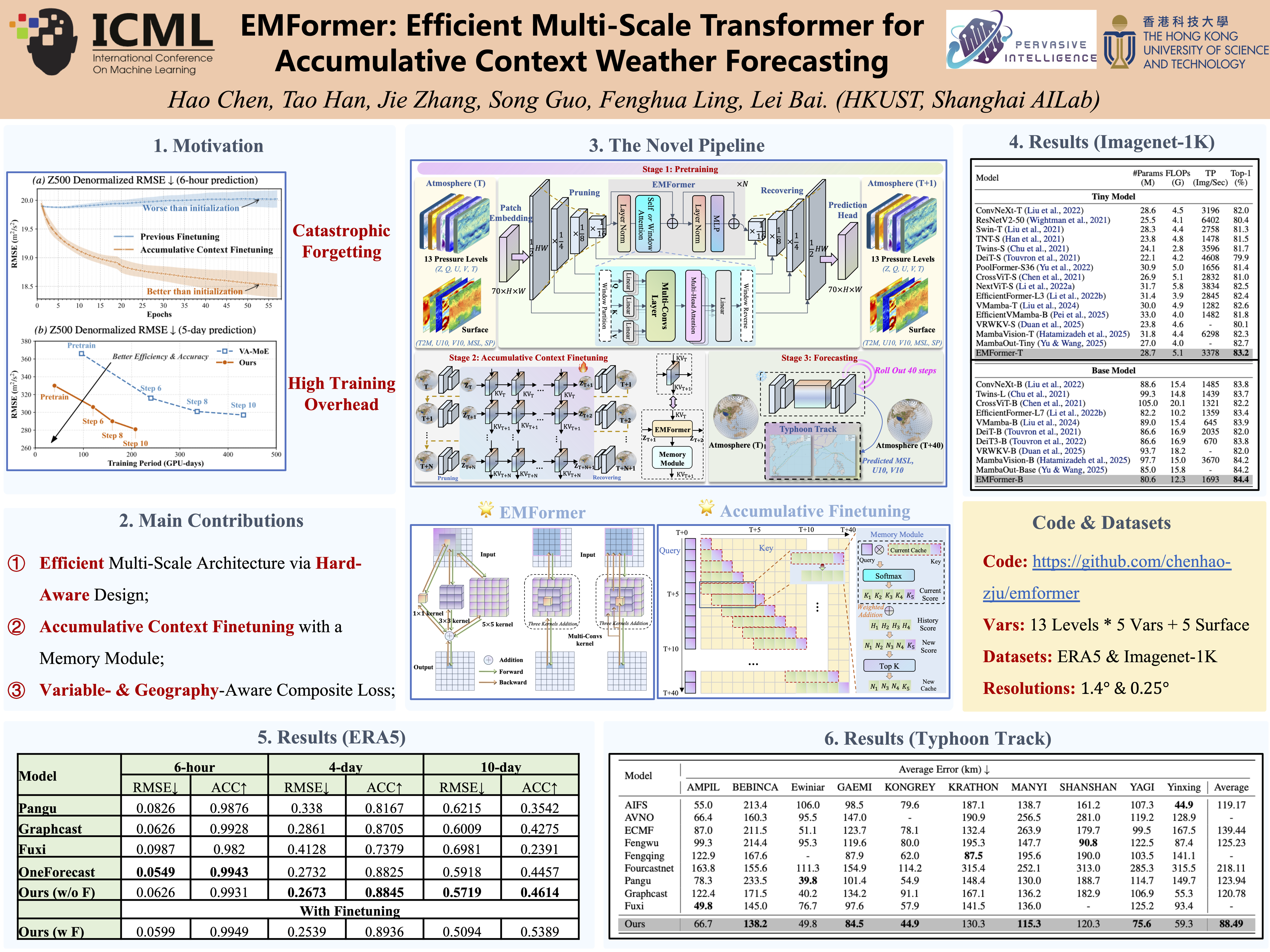
Long-term weather forecasting is critical for socioeconomic planning and disaster preparedness. While recent approaches employ finetuning to extend prediction horizons, they remain constrained by the issues of catastrophic forgetting, error accumulation, and high training overhead. To address these limitations, we present a novel pipeline across pretraining, finetuning and forecasting to enhance long‑context modeling while reducing computational overhead. First, we introduce an Efficient Multi‑scale Transformer (EMFormer) to extract multi‑scale features through a single convolution in both training and inference. Based on the new architecture, we further employ an accumulative context finetuning to improve temporal consistency without degrading short‑term accuracy. Additionally, we propose a composite loss that dynamically balances different terms via a sinusoidal weighting, thereby adaptively guiding the optimization trajectory throughout pretraining and finetuning. Experiments show that our approach achieves great performance in weather forecasting and extreme event prediction, substantially improving long-term forecast accuracy. Moreover, EMFormer demonstrates strong generalization on vision benchmarks (ImageNet-1K and ADE20K). Code: https://github.com/chenhao-zju/emformer
Lay Summary
Accurate long-term weather forecasting is essential for everything from daily planning to disaster preparation. Recently, artificial intelligence (AI) has shown great promise in predicting the weather much faster than traditional physics-based methods. However, when these AI models try to predict further into the future, tiny errors quickly pile up, they tend to "forget" important past weather conditions, and training them requires massive amounts of expensive computer power. To solve this, we developed a new AI system designed to be both highly accurate and computationally efficient. First, we created a smart model architecture (called EMFormer) that can simultaneously analyze weather patterns at different sizes, like zooming in on a local storm while still seeing global wind currents, without slowing down the computer. Second, we gave our model a specialized "memory." As it predicts further into the future, it selectively remembers crucial information from past time steps to keep its forecasts on track, while automatically discarding less important data to save computer memory. Finally, we introduced a tailored training method that helps the AI learn different weather elements (such as fast-changing temperatures versus slow-changing pressure systems) at the correct, natural pace. Our experiments show that this approach significantly improves long-term global weather forecasts and accurately predicts extreme events like the tracks of typhoons. Furthermore, the underlying technology works exceptionally well on general image recognition tasks, demonstrating its potential as a powerful, versatile tool for both Earth sciences and computer vision.