
Large-Scale Molecular Dynamics Simulations: Direct Interatomic Modeling with Dilated Message Passing
Abstract
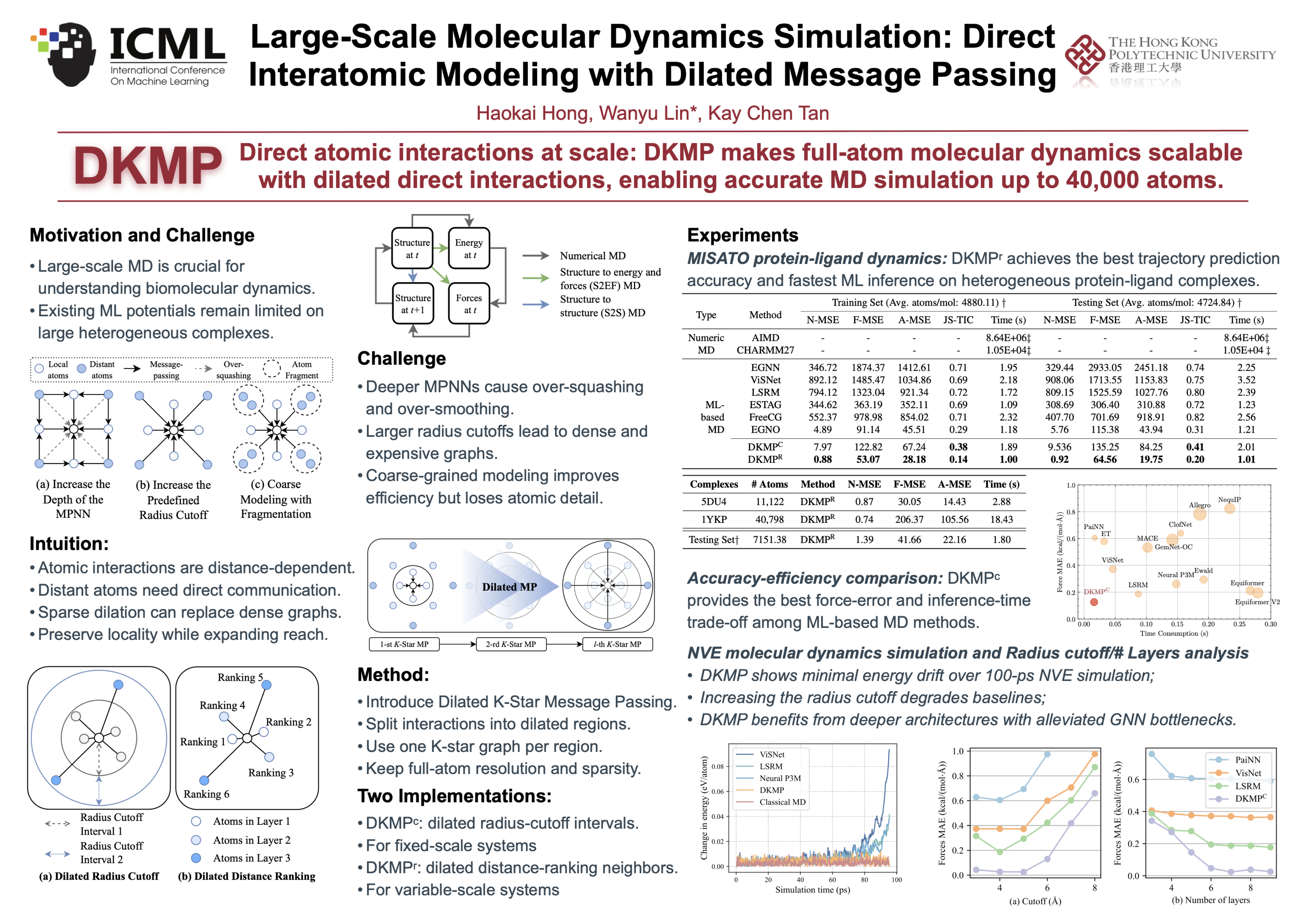
Large-scale molecular dynamics simulations are essential in understanding chemical and biological processes, necessitating the accurate and efficient modeling of interatomic interactions. Existing learning-based methods are generally based on message passing mechanisms; they are either not scalable or too coarse to offer accurate modeling. We propose a new message passing framework that can effectively and efficiently model interatomic interactions for simulating large-scale molecular dynamics at full atomic resolution. Specifically, our framework is stacked with a sequence of message passing neural network layers, each realizing the message passing over a distinct and dilated star-structured path. These star-structured paths are constructed progressively along dilated regions to capture the distance-dependent interactions. The crux of our framework is that it resolves the problem of dense interatomic interactions of large-scale atomic systems with sparser and region-based message passing graphs. We evaluate the framework on four benchmarks: MD22 (molecules with 42–370 atoms), Chignolin (a 166-atom protein featuring diverse conformations), the AdK dataset (a protein trajectory with up to 3,000 atoms), and the MISATO dataset (over 10,000 heterogeneous protein-ligand complexes with systems up to 40,000 atoms). Comprehensive evaluations demonstrate that our approach delivers state-of-the-art performance overall across various benchmarks. The code is provided on Github.
Lay Summary
Molecular dynamics simulations help scientists understand how atoms move in molecules, proteins, and drug-like complexes, but accurate simulations of large biological systems are extremely expensive. Machine learning offers a faster alternative, yet many existing models struggle when molecules contain thousands of atoms because they either pass information too slowly through local neighborhoods or simplify the system too much. We propose a new method called Dilated K-Star Message Passing, which lets atoms exchange information with both nearby and farther atoms through carefully designed sparse interaction paths. Instead of making the molecular graph very dense or stacking many inefficient layers, our method divides atomic interactions into distance-based regions and models them progressively. This allows the model to keep full atomic detail while remaining computationally efficient. Across several molecular dynamics benchmarks, including large protein-ligand systems, our method improves prediction accuracy and speed compared with strong machine learning baselines. This could help accelerate scientific studies in chemistry, biology, and drug discovery by making large-scale atomic simulations more practical.