
Spatial Deconfounder: Interference-Aware Deconfounding for Spatial Causal Inference
Abstract
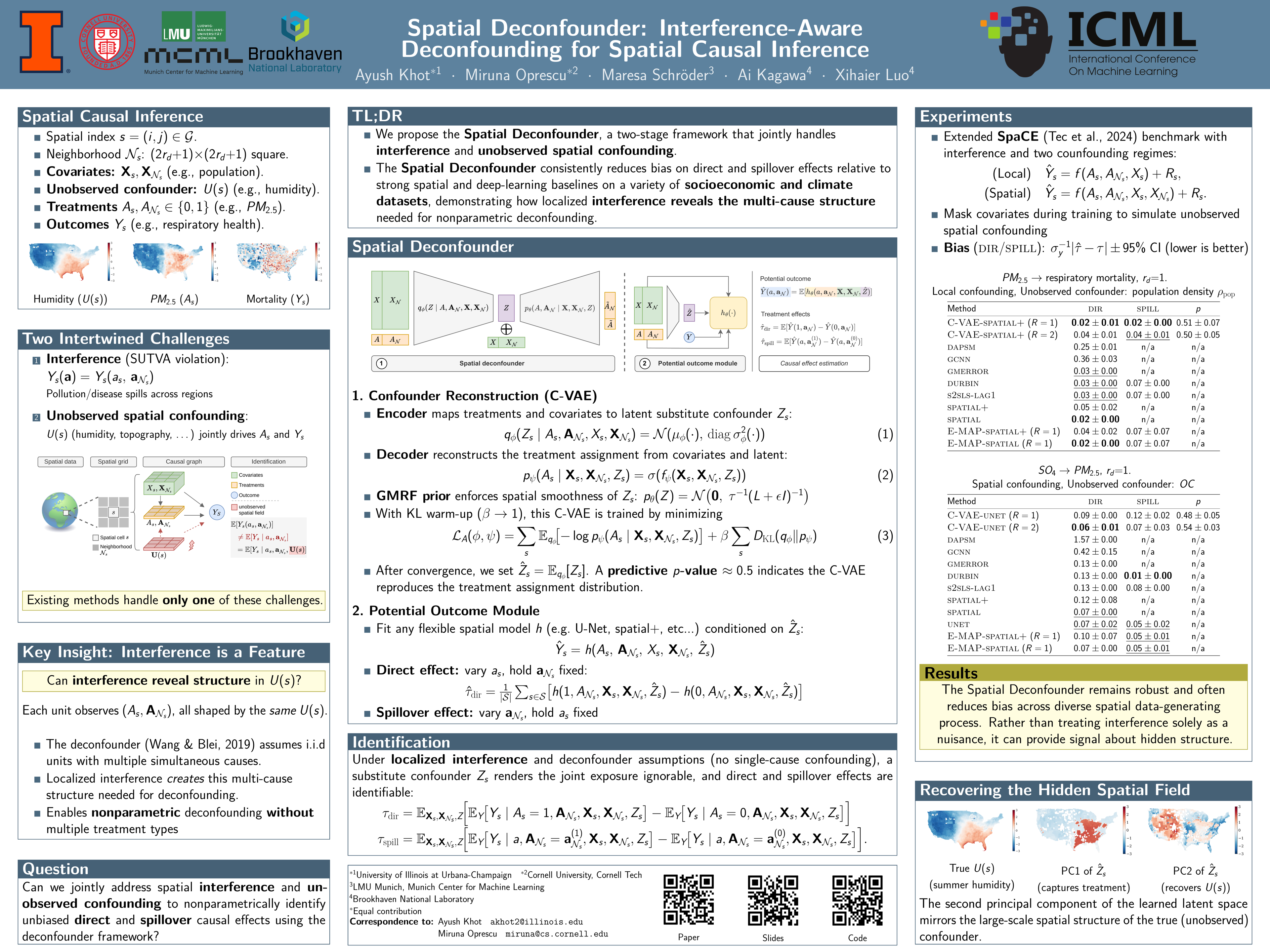
Causal inference in spatial domains faces two intertwined challenges: (1) unmeasured spatial factors, such as weather, air pollution, or mobility, that confound treatment and outcome, and (2) interference from nearby treatments that violate standard no-interference assumptions. While existing methods typically address one by assuming away the other, we show they are deeply connected: interference reveals structure in the latent confounder. Leveraging this insight, we propose the Spatial Deconfounder, a two-stage method that reconstructs a substitute confounder from local treatment vectors using a conditional variational autoencoder (C-VAE) with a spatial prior, then estimates causal effects with a flexible outcome model. We show that this enables nonparametric identification of direct and spillover effects under weak assumptions—without multiple treatment types or a known latent-field model. Empirically, we extend SpaCE, a benchmark suite for spatial confounding, to include treatment interference, and show that the Spatial Deconfounder consistently improves effect estimation across real-world environmental health and social science datasets. By turning local interference into a multi-cause proxy for latent spatial confounding, our framework advances robust causal inference for spatial data.
Lay Summary
Many scientific and policy decisions depend on estimating causal effects across space, such as the health impacts of air pollution or the effects of climate variables on sea ice. Answering these questions from observational data is difficult because important background factors (confounders), like weather or socioeconomic conditions, may be unmeasured, and because changes in one location can affect nearby locations (spillovers). This paper proposes the Spatial Deconfounder, a method for estimating causal effects in spatial data when both hidden confounders and spillover effects are present. The key idea is that nearby exposures can provide useful information: patterns among neighboring treatments can help reveal hidden spatial factors that affect a whole region. Our method learns a proxy for these hidden factors and uses it to estimate both local effects and spillover effects. We test the method on realistic environmental health and climate datasets, including air pollution, mortality, pollution components, and Arctic sea ice. The results suggest that spatial spillovers can be used not only as a complication to adjust for, but also as a signal that helps uncover hidden confounding.