
Learning Credal Ensembles via Distributionally Robust Optimization
Abstract
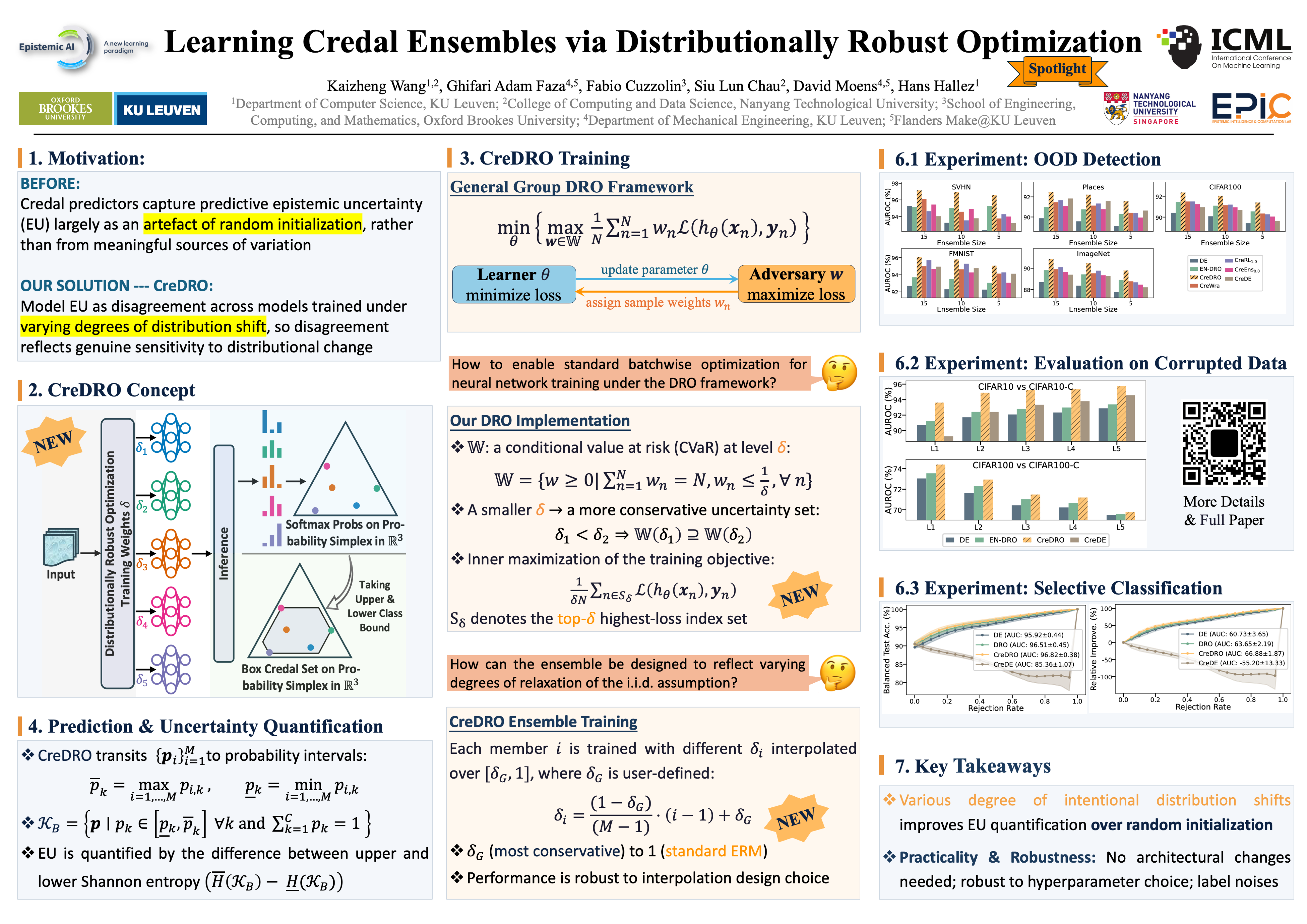
Credal predictors are epistemic-uncertainty-aware models that produce a convex set of probabilistic predictions. They provide a principled framework for quantifying predictive epistemic uncertainty (EU) and have been shown to improve model robustness across a range of settings. However, most state-of-the-art (SOTA) methods primarily define EU as disagreement induced by random training initializations, which mainly reflects sensitivity to optimization randomness rather than uncertainty from more substantive sources. In response, we formulate EU as disagreement between models trained under different degrees of relaxation of the i.i.d. assumption between the training and test distributions. Building on this idea, we propose CreDRO, which learns an ensemble of plausible models via distributionally robust optimization. As a result, CreDRO captures EU arising not only from training randomness but also from informative disagreement due to potential train–test distribution shifts. Empirically, CreDRO consistently outperforms SOTA credal approaches on downstream tasks, including out-of-distribution detection on extensive benchmarks and selective classification in medical settings.