
Fast Mixing Steady-State Control in Markov Decision Processes
Abstract
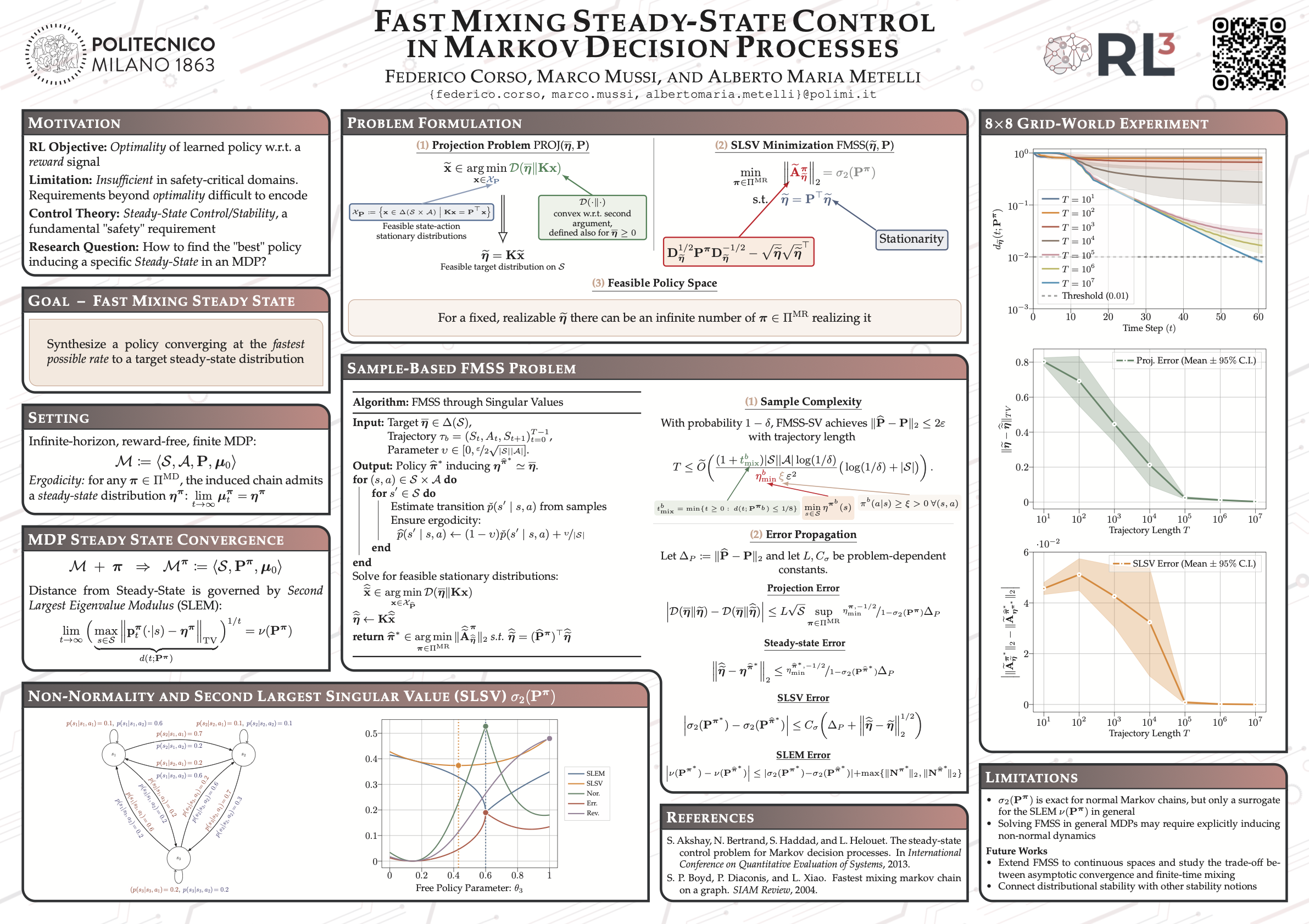
Stability is a property of fundamental importance in real-world systems. Although it has been widely studied and well understood in control theory (CT) for deterministic systems, it is largely overlooked in stochastic systems such as Markov decision processes (MDPs). In this paper, we aim to translate the steady-state control problem, well established in CT, where the goal is to synthesize a controller with prescribed asymptotic stability properties, into the MDP framework. To this end, we propose the novel fast-mixing steady-state (FMSS) problem. Given an ergodic MDP and a target steady-state distribution, the objective is to synthesize a Markovian policy that induces this distribution with the fastest possible convergence rate. Addressing this problem requires controlling the spectral properties of the induced Markov chain (MC) transition matrix, which generally leads to non-convex programs. Thus, we derive a tractable surrogate objective that leads to a convex program, whose properties we study in terms of approximation quality, feasibility, and computational complexity. We then move to the learning setting and propose an "offline" sample-based algorithm for FMSS (FMSS-SV), designed for tabular MDPs, in which the environment’s transition model is estimated from data. We quantify the impact of transition model estimation errors on both the objective value and the learned policy, and provide a finite-sample complexity analysis.
Lay Summary
Stability is a fundamental property for real-world systems in deterministic control theory, but it is frequently overlooked in stochastic sequential decision-making frameworks like reinforcement learning. While current algorithms typically prioritize maximizing cumulative rewards, deploying these systems safely in unpredictable environments requires strict guarantees of asymptotic stability to ensure they reliably converge to and maintain desired equilibrium states. To bridge this critical gap between control theory and reinforcement learning, we introduce the Fast-Mixing Steady-State (FMSS) control problem. Our approach synthesizes Markovian policies that not only induce a target equilibrium but do so with a fast convergence rate. Because directly optimizing the spectral properties governing this convergence is mathematically non-convex, we derive a tractable convex surrogate by minimizing the transition matrix's second-largest singular value. We also developed FMSS-SV, a data-driven offline model-based learning algorithm. Our framework represent a critical first step in addressing the challenge of designing stabilizing controllers for systems modeled as Markov Decision Processes.