
Measuring and Mitigating Post-Hoc Rationalization in Reverse Chain-of-Thought Generation
Abstract
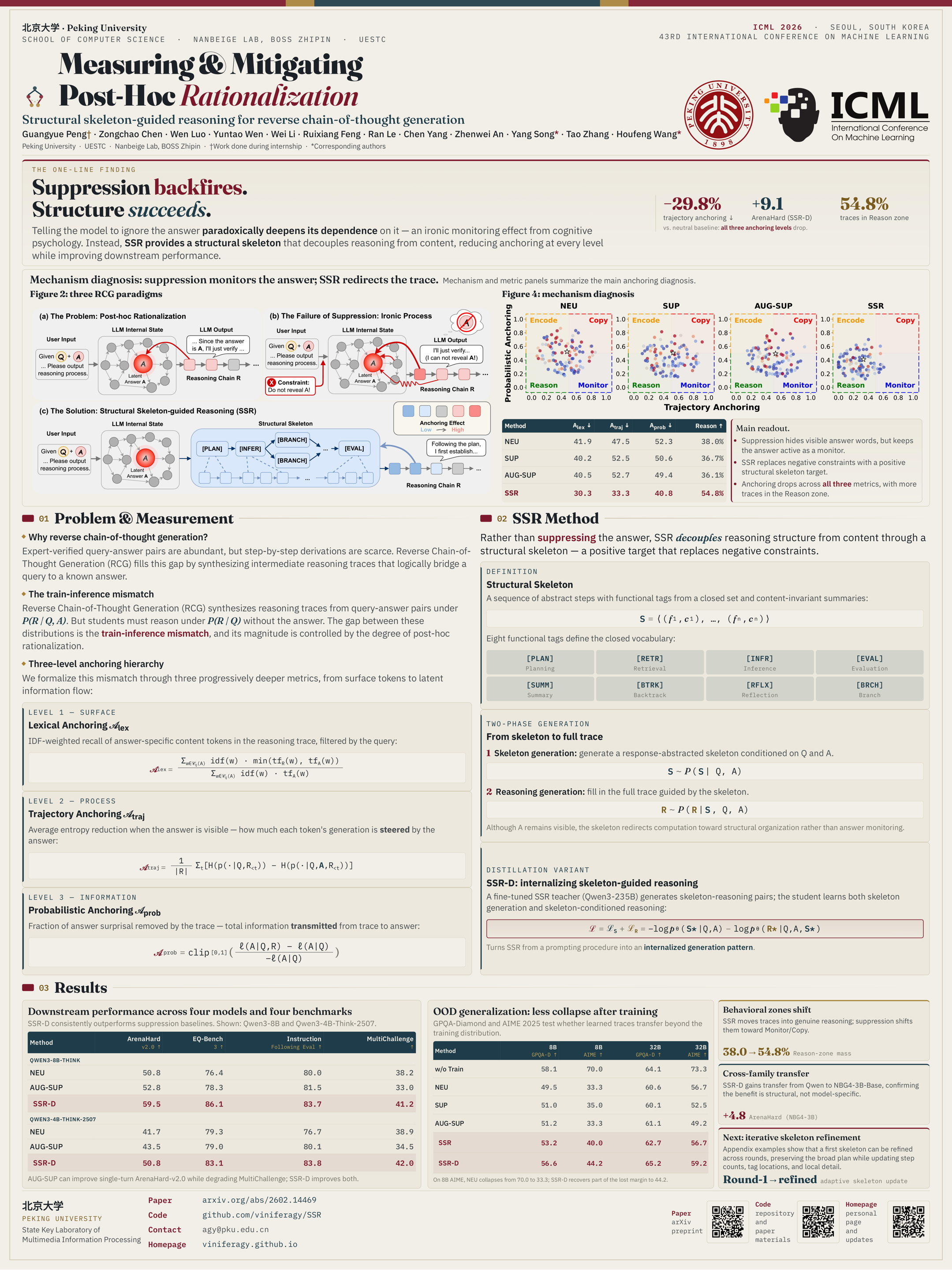
Reverse Chain-of-Thought Generation (RCG) synthesizes reasoning traces from query-answer pairs, but it risks producing post-hoc rationalizations: when models can see the answer during generation, the answer serves as a cognitive anchor that shapes the entire explanation. We formalize this phenomenon through a three-level measurement hierarchy: lexical, entropic, and probabilistic anchoring, which capture surface artifacts, entropy dynamics, and latent answer dependence, respectively. We analyze semantic suppression, the intuitive mitigation strategy that instructs models to ignore the answer, and find that it is counterproductive: while it reduces lexical overlap, it paradoxically increases entropic and probabilistic anchoring. We attribute this failure to active monitoring of the forbidden answer, which inadvertently deepens dependence on it. To break this cycle, we propose Structural Skeleton-guided Reasoning (SSR), whose core contribution is to replace answer suppression with structural decoupling: SSR first generates an answer-invariant functional skeleton and then uses it as a content-neutral target for full trace generation. Experiments across open-ended reasoning benchmarks show that SSR consistently mitigates anchoring, and that Distilled SSR (SSR-D), a distillation variant that internalizes skeleton-guided reasoning from teacher-generated traces, achieves up to 10\% improvement over suppression baselines while mitigating out-of-distribution (OOD) degradation.
Lay Summary
AI assistants often produce a final answer along with a step-by-step explanation. In many real settings, however, we may have good answers but not the reasoning that led to them, so researchers ask models to reconstruct explanations from the question and answer. This can be risky: when the answer is visible, the model may write a convincing story that justifies the answer instead of a reasoning path that could stand on its own. We introduce ways to measure this problem at three levels: copied words, unnatural uncertainty patterns during generation, and how much the explanation reveals the answer. We find that simply telling a model not to rely on the answer can make hidden dependence worse. Our method, Structural Skeleton-guided Reasoning, first asks the model to build an answer-neutral outline of the reasoning steps, then uses that outline to generate the full explanation. A distilled version trains models to follow this pattern more reliably. Across reasoning benchmarks, this produces explanations that are less tied to the answer and improves downstream performance, especially when models face unfamiliar tasks. The work helps make generated reasoning more useful for evaluating, debugging, and training AI systems.