
Credibility-Aware Weighting Federated Causal Discovery for Time Series
Abstract
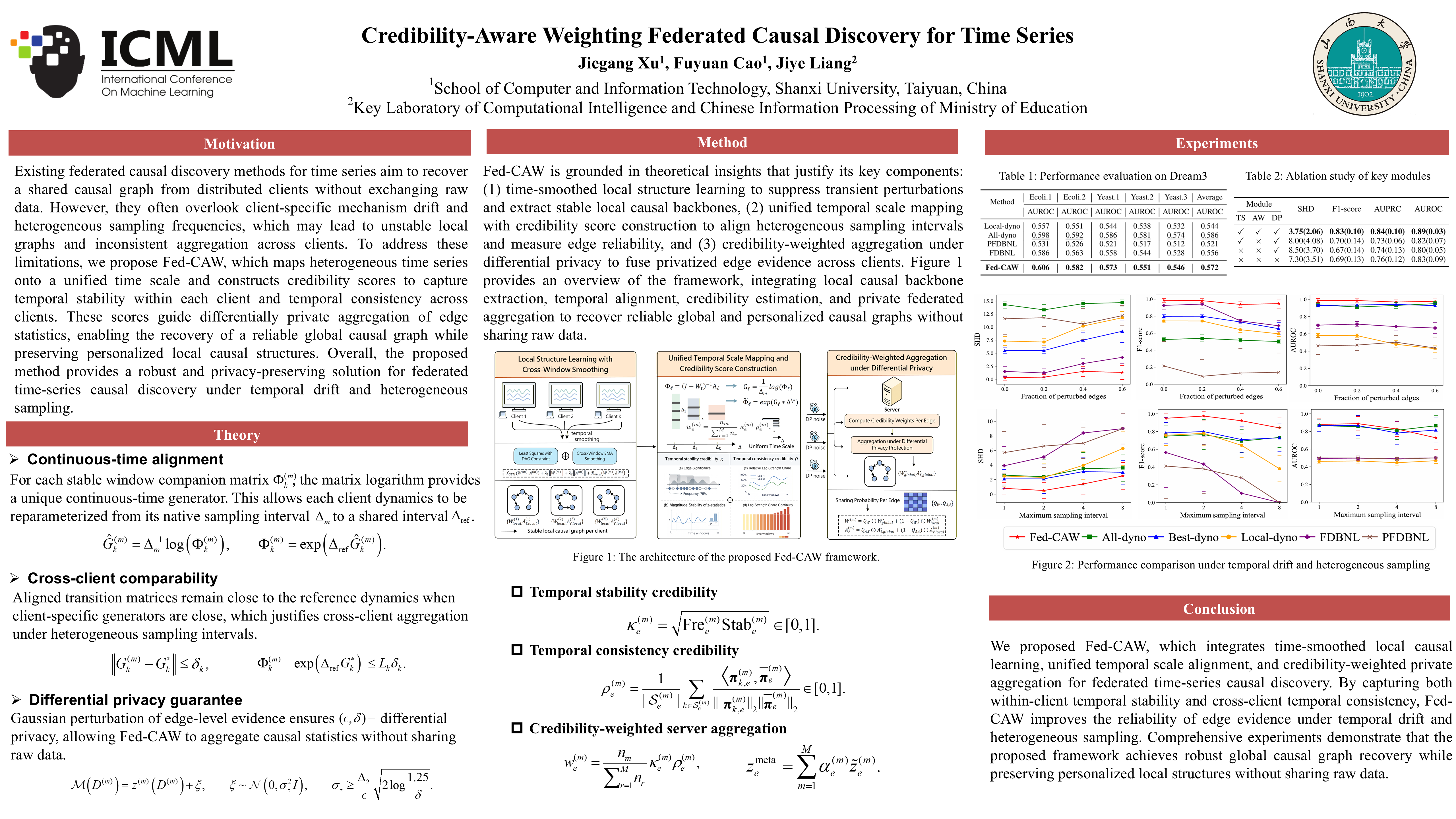
Federated causal discovery for time series is becoming increasingly important in many application domains. In practice, intervention policies on each client often change over time, causing the local underlying causal mechanisms to drift rather than remain fixed. Moreover, different sampling frequencies across clients yield incompatible time scales in the observed data, making the resulting local causal graphs naturally heterogeneous and difficult to aggregate consistently. Accordingly, we propose Fed-CAW, a Credibility-Aware Weighting Federated causal discovery framework for time series. Specifically, we define edge-level credibility scores that quantify per-edge reliability by summarizing (i) within-client temporal stability across windows and (ii) cross-client temporal consistency after mapping heterogeneous sampling frequencies onto a unified time scale. We then aggregate privatized edge statistics under differential privacy, treating credibility scores as weights to recover a global causal graph while preserving personalized local structures without sharing raw data. Theoretically, we demonstrate the rationale for the unified time scale mapping and establish rigorous differential privacy guarantees. Experimental results on synthetic and real-world datasets demonstrate the effectiveness of our proposed method.
Lay Summary
In many real world scenarios, time series data are collected by different clients, such as hospitals, industrial sensors and financial institutions. Learning causal relationships from these data helps understand how variables influence each other over time and supports reliable decision making. However, this task is challenging because raw data usually cannot be shared, local intervention policies may change over time, and different clients may record observations at different sampling frequencies. These issues make causal structures unstable and difficult to aggregate. To address this, we propose Fed-CAW, a federated causal discovery method for time series. Our approach learns stable local causal patterns, aligns causal evidence from different sampling rates onto a unified time scale, and gives higher weight to reliable edges. It then aggregates privatized edge evidence to recover global and personalized causal graphs without sharing raw data.