
What Reward Structure Enables Efficient Sparse-Reward RL? A Proof-of-Concept with Policy-Aware Matrix Completion
Abstract
Lay Summary
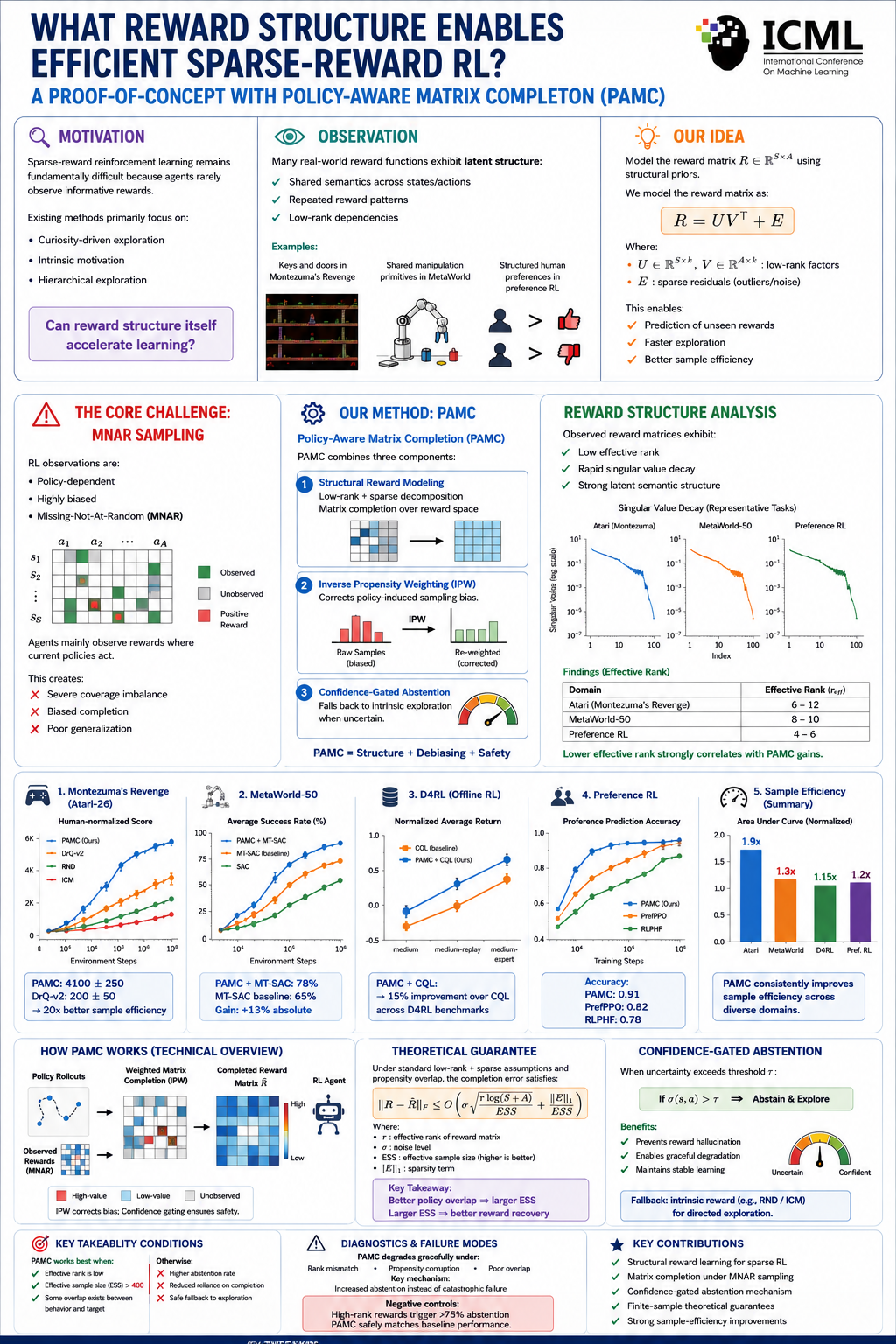
When an AI agent learns by trial and error, it usually needs frequent feedback to figure out which actions are good. But in many realistic settings, like a game where you only score points after finding a hidden key, or a robot that only succeeds after a long sequence of correct moves, feedback is extremely rare. Most existing methods try to solve this by pushing the agent to explore more, but they treat the underlying rewards as a complete mystery, ignoring the fact that rewards usually have hidden patterns. For example, in a classic exploration game, keys unlock doors in predictable ways across many rooms. We built a method called Policy Aware Matrix Completion that views the table of possible rewards like a partially filled spreadsheet and predicts the blanks by exploiting these hidden patterns. It also corrects for the fact that the agent tends to revisit the same places, which biases what it sees, and it refuses to use its guesses whenever it is not confident enough, falling back to ordinary exploration. Across a wide range of tasks, our approach learns dramatically faster than strong baselines, including a roughly twenty fold improvement on a notoriously hard exploration game, while adding only about eight percent extra computation. Just as importantly, when the hidden patterns are not really there, the method automatically recognizes this and steps aside rather than confidently making things worse, which matters in safety sensitive settings.