
On the Learnability of Test-Time Adaptation: A Recovery Complexity Perspective
Abstract
Lay Summary
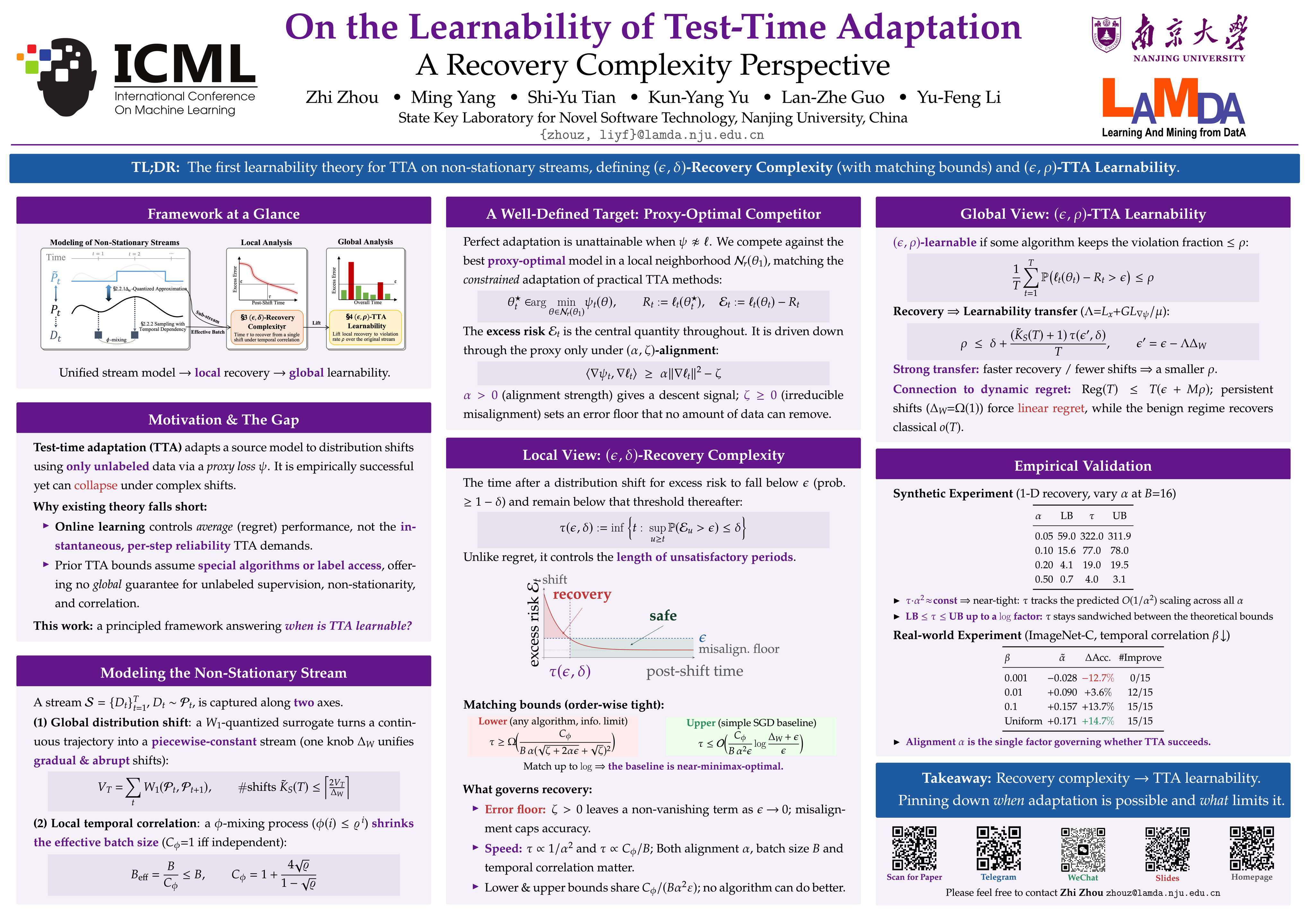
Machine learning models are often trained once and then deployed in real-world environments that continuously change. As a result, a model that works well at first may become less accurate once it is used in the real world. Test-time adaptation aims to help the model keep adjusting to new data on its own, without asking humans to provide new labels, so that it can continue to make reliable predictions. Although many test-time adaptation methods work well in experiments, we still do not fully understand when such adaptation is actually possible. In this work, we develop a theoretical framework to study this question. We introduce a way to measure how long a model needs to recover good performance after the test data changes, and whether it can remain reliable over a long, evolving stream of data. Our analysis covers both sudden and gradual changes. It reveals fundamental limits of test-time adaptation and identifies an important trade-off: faster adaptation requires sufficient useful information from the unlabeled test data. These results help explain when reliable adaptation can and cannot be expected, and provide a theoretical foundation for future work on test-time adaptation.