
Relative Entropy Estimation in Function Space: Theory and Applications to Trajectory Inference
Abstract
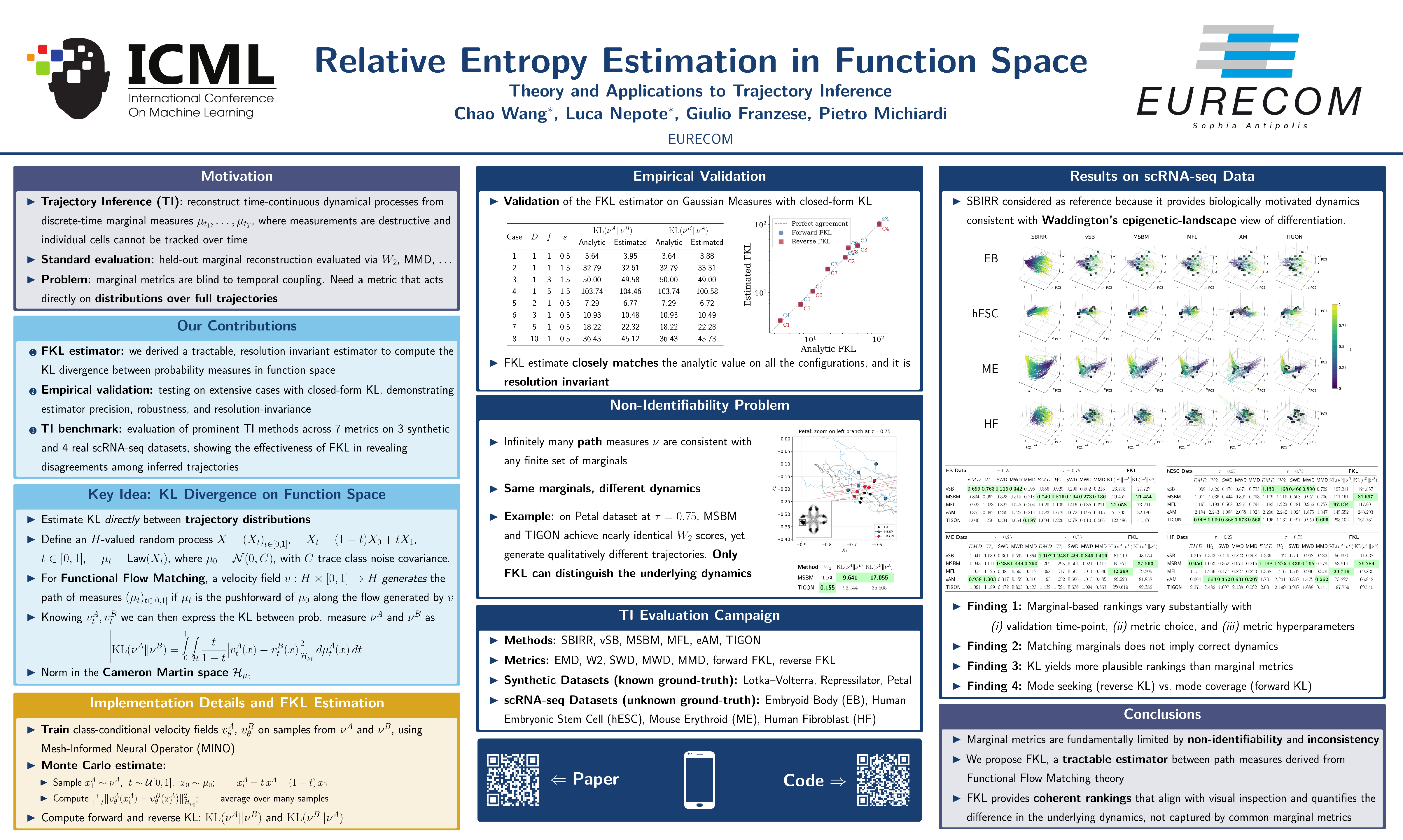
Trajectory Inference (TI) seeks to recover latent dynamical processes from snapshot data, where only independent samples from time-indexed marginals are observed. In applications such as single-cell genomics, destructive measurements make path-space laws non-identifiable from finitely many marginals, leaving held-out marginal prediction as the dominant but limited evaluation protocol. We introduce a general framework for estimating the Kullback–Leibler divergence (KL) between probability measures on function space, yielding a tractable, data-driven estimator that is scalable to realistic snapshot datasets. We validate the accuracy of our estimator on a benchmark suite, where the estimated functional KL closely matches the analytic KL. Applying this framework to synthetic and real scRNA-seq datasets, we show that current evaluation metrics often give inconsistent assessments, whereas path-space KL enables a coherent comparison of trajectory inference methods and exposes discrepancies in inferred dynamics, especially in regions with sparse or missing data. These results support functional KL as a principled criterion for evaluating trajectory inference under partial observability. Code available here: https://github.com/eurecom-probai/functional-kl.
Lay Summary
Methods for Trajectory Inference aim to recover the correct path from a few training snapshots, like creating a movie from just a few images of a scene. Existing evaluation metrics are limited to frame-level reconstruction, but two different movies can look identical at evaluation frames. Instead of testing a model at a given test time (i.e., frame-level), we developed an estimator that considers the full trajectory (i.e., the entire movie) as the main object to test. The result? A metric where highly similar ”movies” yield a lower error score, accurately reflecting a better model. The estimator is called Functional KL (FKL), and it can be used to better evaluate existing methods and build increasingly precise models for trajectory inference... and beyond!