
Improving CLIP Adaptation by Breaking Tail Alignment for Source-Free Cross-Domain Few-Shot Learning
Abstract
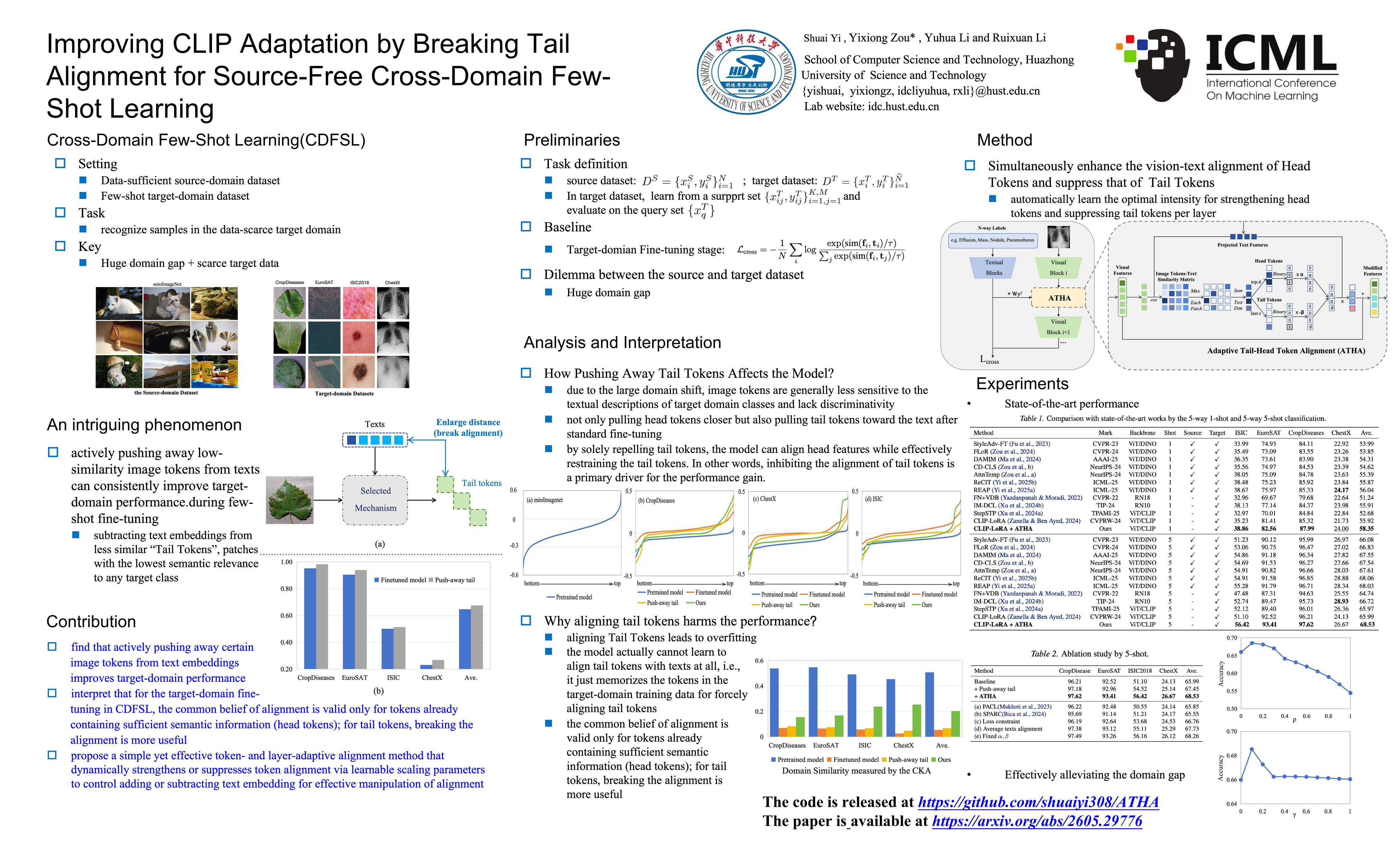
Vision-Language Models (VLMs) such as CLIP demonstrate strong zero-shot generalization, but their performance significantly degrades in cross-domain scenarios with scarce target-domain training data (Cross-Domain Few-Shot Learning, CDFSL). In this paper, we focus on the target-domain few-shot finetuning in the CLIP-based CDFSL task. Prevailing finetuning paradigms uniformly align all image patch tokens with their corresponding textual embeddings. However, we find a counterintuitive phenomenon: actively pushing away certain low-similarity image tokens, termed “tail tokens”, from their textual embeddings consistently improves target-domain performance. We delve into this phenomenon and provide a novel interpretation: under great domain shifts and scarce training data, the model can hardly extract semantic information from visual inputs; therefore, the common belief of alignment is valid only for tokens already containing sufficient semantic information; for tail tokens, forcing the alignment would lead to excessive overfitting to the scarce training, while breaking the alignment is more useful. Motivated by this, we propose Adaptive Tail-Head Alignment (ATHA), a novel fine-tuning strategy for CLIP that transforms the conventional uniform alignment paradigm to an adaptive alignment paradigm, with both alignment strengthening and weakening. Extensive experiments on four challenging CDFSL benchmarks validate our state-of-the-art performance. Our code is available at https://github.com/shuaiyi308/ATHA.
Lay Summary
We find a phenomenon that in target-domain finetuning of CDFSL: actively pushing away certain image tokens from text embeddings improves target-domain performance, challenging the prevailing uniform alignment paradigm. We delve into it for an interpretation and propose a method based on it for CDFSL.