
Contrastive Representation Regularization for Vision-Language-Action Models
Abstract
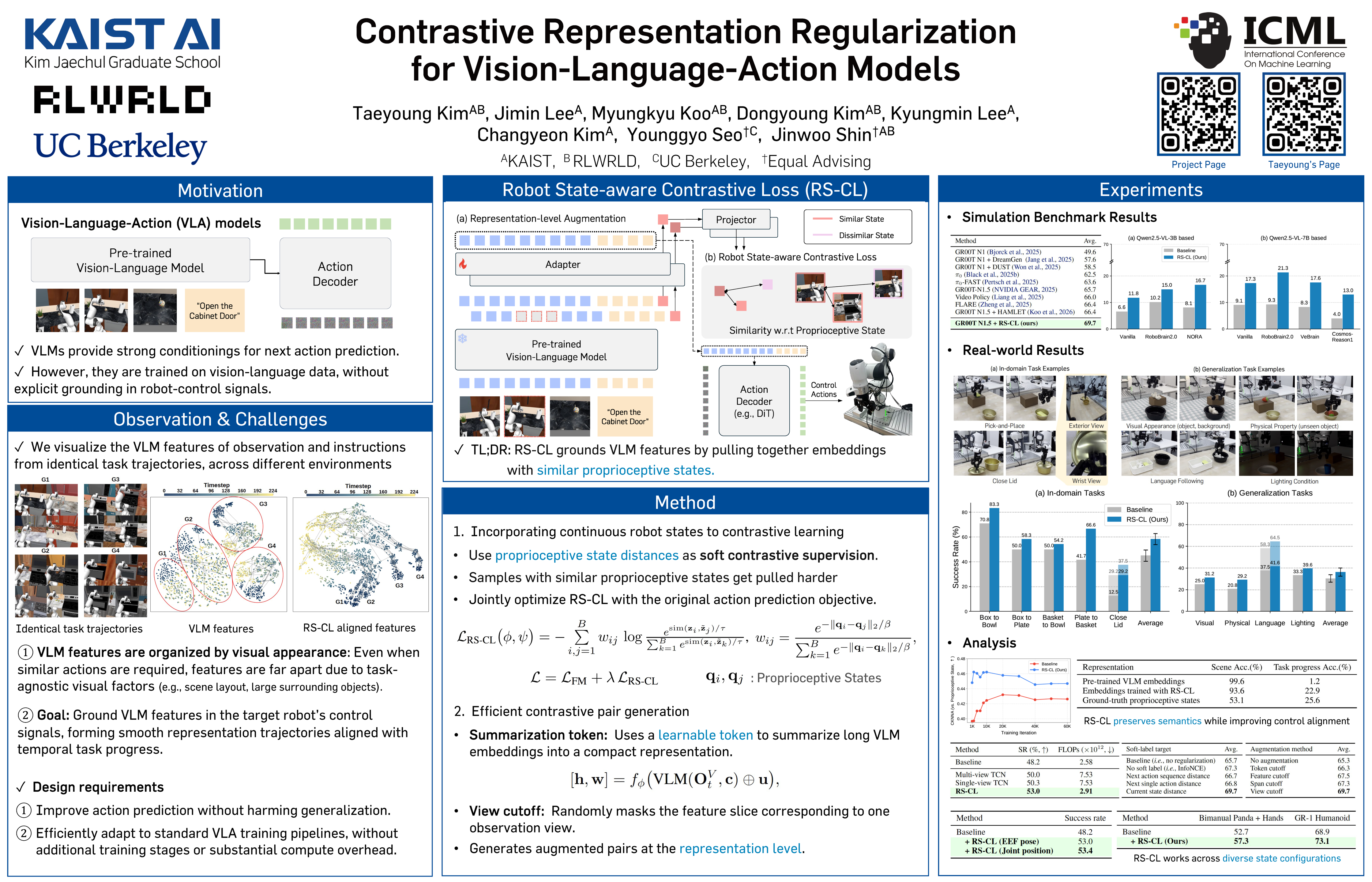
Vision-Language-Action (VLA) models have shown strong capabilities in robot manipulation by leveraging rich representations from pre-trained Vision-Language Models (VLMs). However, their representations arguably remain suboptimal, lacking sensitivity to robotic signals such as control actions and proprioceptive information. To address the issue, we introduce Robot State-aware Contrastive Loss (RS-CL), a simple and effective representation regularization for VLA models, designed to bridge the gap between VLM representations and robotic signals. In particular, RS-CL aligns the representations more closely with the robot's proprioceptive states by using relative distances between the states as soft supervision. Complementing the original action prediction objective, RS-CL enhances control-relevant representation learning, while being lightweight and fully compatible with standard VLA training pipelines. Our empirical results demonstrate that RS-CL substantially improves the performance of state-of-the-art VLA models; it pushes the prior art to 69.7% achieving the state-of-the-art performance on the RoboCasa-Kitchen benchmark, and boosts success rates from 45.0% to 58.3% on challenging real-robot manipulation tasks.
Lay Summary
Vision-Language-Action (VLA) models have shown strong capabilities in robot manipulation by leveraging rich representations from pre-trained Vision-Language Models (VLMs), which are trained on vast amounts of internet images and text. However, VLMs have never been exposed to the physical signals of a robot, such as where its body is positioned in space. Their representations therefore tend to be organized by visual appearance, like surrounding furniture or background objects, rather than by what actually matters for control, such as how the robot is currently posed. We propose Robot State-aware Contrastive Loss (RS-CL), a lightweight training technique that reshapes a VLA model's representations to be grounded in the robot's own proprioceptive state. The key idea is to use the distance between proprioceptive states as a soft guide for organizing the model's internal representations. RS-CL offers a lightweight yet effective way to boost the performance of VLA models without additional data or training stages. More broadly, our work highlights the value of physically grounded representations for building robot foundation models.