
Spherical Procrustes Alignment for Reliable Medical Audio Diagnosis
Abstract
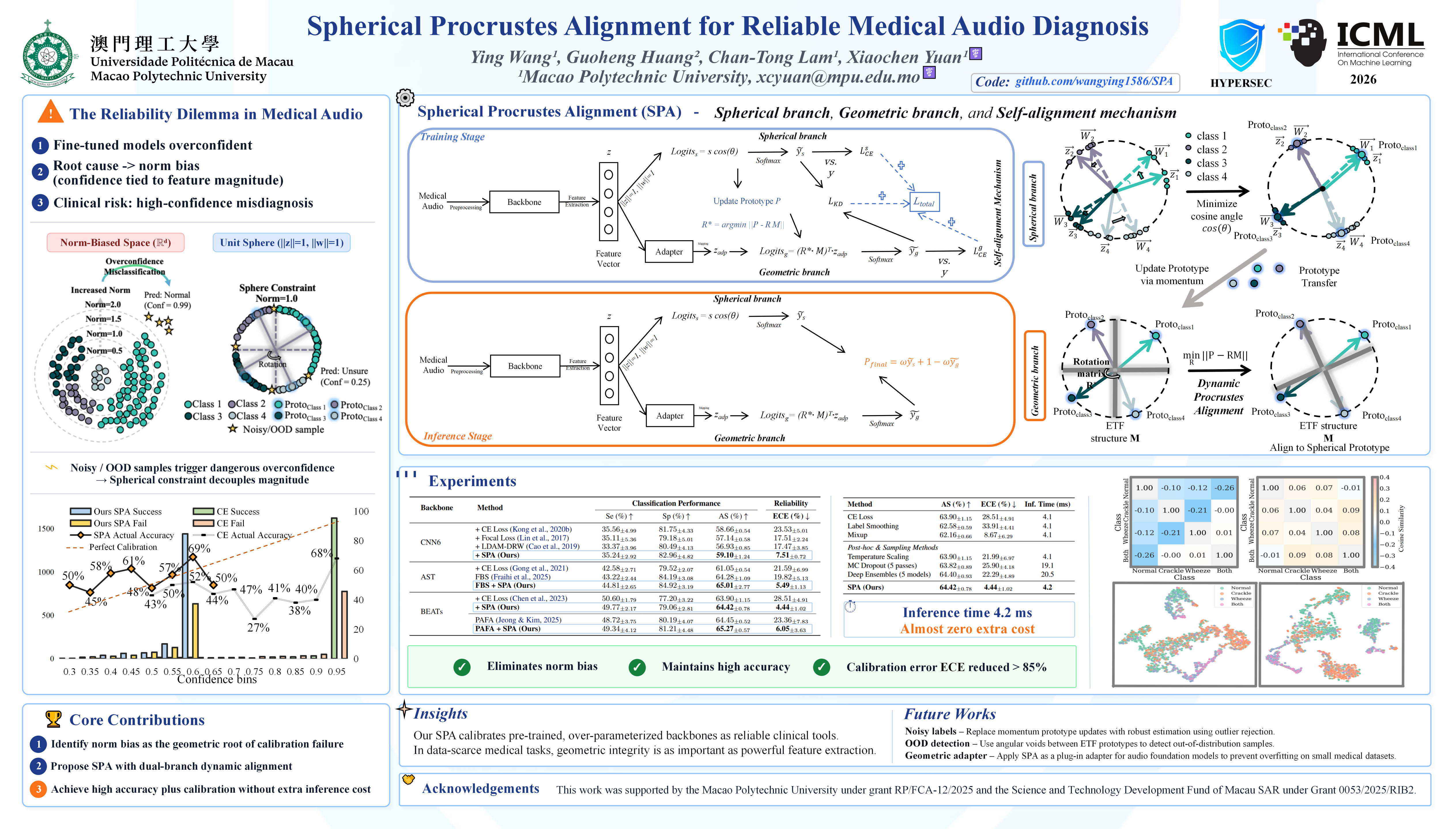
Reliable medical audio diagnosis requires models that are both accurate and honest about their uncertainty. However, fine-tuned models on small, imbalanced datasets often become overconfident due to norm bias, where predictions rely on feature magnitude rather than semantic alignment. The Equiangular Tight Frame (ETF) provides a theoretical optimum for class separation and is effective for imbalanced and calibration tasks due to its maximal angular separability and geometric fairness, but existing ETF-based methods perform poorly on noisy medical data because gradient rotation is unstable and fixed ETFs cannot adapt to drifting prototypes. To address this, we propose Spherical Procrustes Alignment (SPA), which combines spherical constraints with dynamic ETF alignment. SPA uses a Spherical branch to eliminate norm bias via normalization and a Geometric branch to adapt features and align a fixed ETF with drifting prototypes via dynamic Procrustes alignment, while a self-alignment mechanisms fuses the two branches to jointly optimize logits. Experiments on ICBHI 2017 and CirCor DigiScope show that SPA achieves state-of-the-art performance and transforms pre-trained models into reliable and efficient clinical tools without extra inference cost.
Lay Summary
When doctors use AI to listen to heart or lung sounds, they need the AI to be not only accurate but also honest about when it’s unsure. Unfortunately, standard AI models tend to be overconfident—they give high-confidence wrong answers, especially on rare diseases or noisy recordings. We discovered the root cause: models rely on the magnitude of features rather than true medical meaning. To fix this, we developed a method called SPA. It forces the model to focus only on the semantic meaning by projecting them onto a sphere, removing the harmful effect of magnitude. Then, it dynamically aligns a mathematically ideal class-separation structure with the model’s real-world, noisy data using a stable alignment technique. This dual-branch design improves both accuracy and calibration. Our work turns powerful but overconfident audio backbones into trustworthy clinical tools that say "I don’t know" when they should.