
OmniAID: Decoupling Semantic and Artifacts for Universal AI-Generated Image Detection in the Wild
Abstract
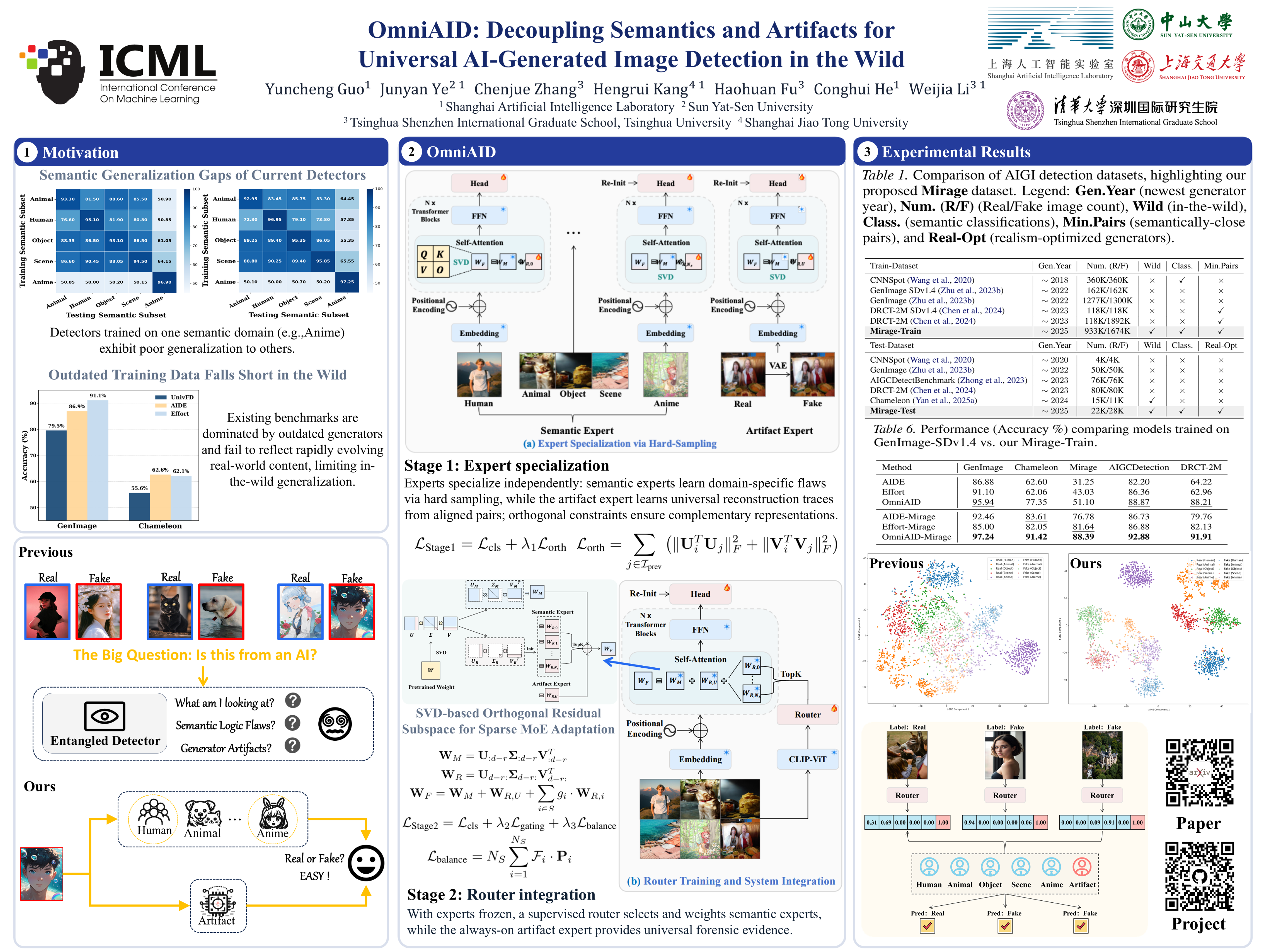
A truly universal AI-Generated Image (AIGI) detector must simultaneously generalize across diverse generative models and varied semantic content. Current methods learn a single, entangled forgery representation, conflating content-dependent flaws with content-agnostic artifacts, and are further constrained by outdated benchmarks. We propose OmniAID, a novel framework centered on a decoupled Mixture-of-Experts (MoE) architecture that separates: (1) semantic flaws across distinct content domains via Routable Specialized Semantic Experts, and (2) content-agnostic universal artifacts from content-dependent flaws via a Fixed Universal Artifact Expert. A two-stage training strategy first specializes experts independently with domain-specific hard-sampling, then trains a lightweight gating network for effective input routing. By explicitly decoupling "what is generated'' (content-specific flaws) from "how it is generated'' (universal artifacts), OmniAID achieves robust generalization. We also introduce Mirage, a large-scale, contemporary dataset comprising a modern training set and a challenging test set. Extensive experiments demonstrate that OmniAID surpasses existing detectors, establishing a new standard for AIGI detection against modern, in-the-wild threats.
Lay Summary
AI image generators have become so powerful that their outputs are often indistinguishable from real photographs, raising serious concerns about misinformation and digital trust. Current detectors typically use a single, one-size-fits-all approach that mixes together different types of clues—such as unnatural facial features and subtle technical fingerprints left by AI—into one tangled representation. This makes them fragile: a detector trained on one type of content (e.g., animals) often fails on another (e.g., architecture), and models trained on older generators struggle with newer ones. We introduce OmniAID, a detection system that separates these clues by design. It uses a team of specialized modules: some focus on content-specific errors within particular visual domains (e.g., people, animals, scenes), while a dedicated module captures universal technical traces shared across all AI-generated images regardless of their content. A lightweight routing mechanism automatically directs each image to the most relevant specialists. This separation allows each module to become highly effective at its own task without interfering with others. To address the problem of outdated evaluation standards, we also construct Mirage, a large-scale modern training set and a challenging new benchmark built from the latest generation of AI image models. Experiments show that OmniAID substantially outperforms existing detectors on both traditional benchmarks and our new Mirage test set, demonstrating robust detection against modern AI-generated images encountered in real-world settings.