
Topological Active Inference for Task Disambiguation
Abstract
Lay Summary
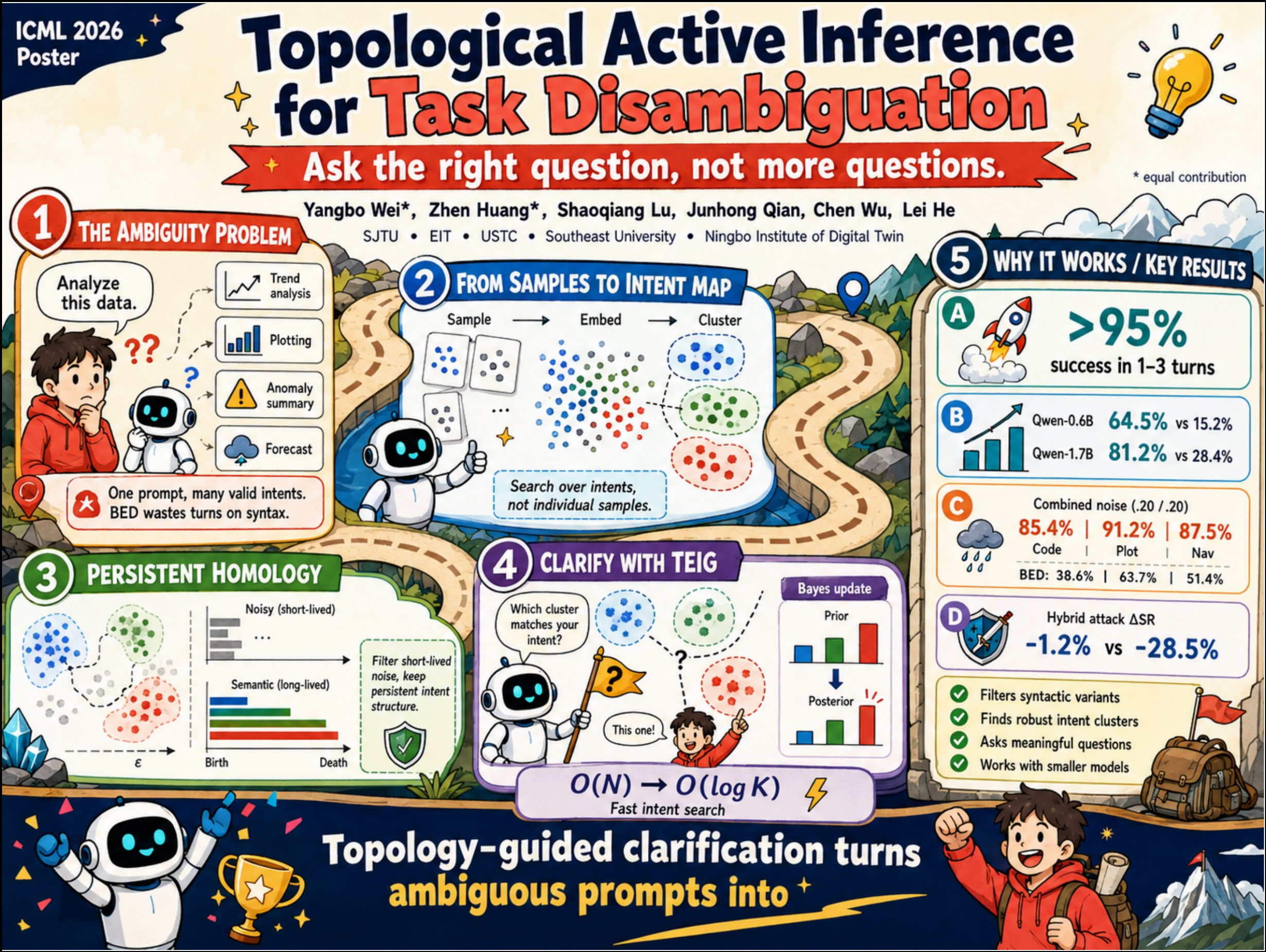
People often give AI assistants instructions that are incomplete or ambiguous. For example, a user may ask an assistant to “analyze this data” or “write a solution” without specifying the exact goal, format, constraints, or preferred approach. In such cases, an AI system may choose one possible interpretation too early and produce an answer that looks reasonable but does not match what the user actually wanted. This paper proposes TAI, a method that helps AI assistants clarify ambiguous tasks more effectively. Instead of treating every possible answer as completely separate, TAI groups possible answers according to their underlying meaning. It then asks clarification questions that separate genuinely different user intentions, rather than wasting questions on small wording or formatting differences. Experiments on coding, visualization, and navigation tasks show that TAI can identify the user’s intent with fewer interaction turns than standard methods. It is also more reliable when user feedback is noisy or uncertain, and it remains useful even with smaller language models. Overall, this work aims to make AI assistants better at asking the right questions before acting, reducing misunderstandings and improving reliability in interactive use.