
Proteo-R1: Reasoning Foundation Models for De Novo Protein Design
Abstract
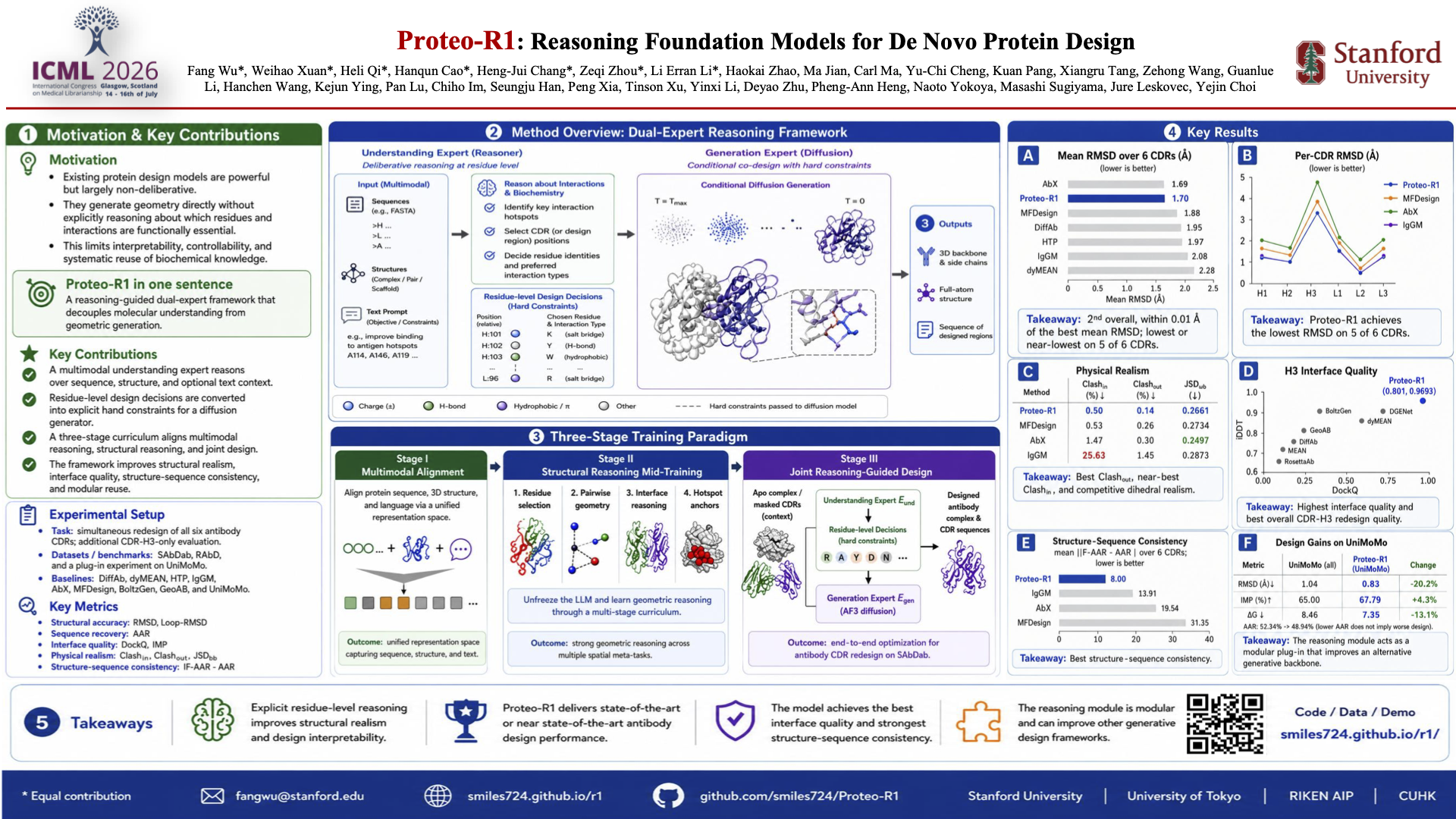
Deep learning in de novo protein design has achieved atomic-level fidelity. However, existing models remain largely non-deliberative: they directly synthesize molecular geometries without explicitly reasoning about which residues or interactions are functionally essential. As a result, design decisions are entangled with continuous sampling dynamics, limiting interpretability, controllability, and systematic reuse of biochemical knowledge. We introduce Proteo-R1, a reasoning-guided protein design framework that explicitly decouples molecular understanding from geometric generation. Proteo-R1 adopts a dual-expert architecture, where a multimodal large language model (LLM) serves as an understanding expert, analyzes protein sequences, structures, and textual context to identify key functional residues that govern binding and specificity. These residue-level decisions are then passed to a separate diffusion-based generation expert, which performs conditional co-design while respecting the fixed interaction anchors. This factorization mirrors how human experts approach molecular engineering: first, reasoning about critical interactions, then optimizing geometry subject to those constraints. By operationalizing reasoning as explicit residue-level commitments rather than latent textual guidance, Proteo-R1 achieves stable, interpretable, and modular integration of LLM reasoning with advanced geometric generative models. Code and demos are at https://proteor1.github.io.
Lay Summary
Proteins are essential building blocks of life, and designing new proteins could accelerate the development of medicines such as antibodies for cancer, infectious diseases, and autoimmune disorders. Recent AI systems can generate realistic protein structures, but they often behave like “black boxes”: they produce designs directly without explaining which molecular interactions are important or why certain residues were chosen. We introduce Proteo-R1, a reasoning-guided AI framework for protein design. Instead of generating proteins in a single step, Proteo-R1 separates the process into two stages. First, a multimodal language model analyzes protein sequences, structures, and biological context to identify key interaction residues that are likely critical for binding and function. Second, a diffusion-based generative model designs the remaining protein structure while respecting these important interaction “anchors.” This mirrors how human protein engineers reason about molecular design problems. We evaluate Proteo-R1 on antibody design tasks and show that it produces proteins with improved structural accuracy, better physical realism, and stronger predicted binding quality compared to existing generative approaches. More broadly, our work suggests a new direction for combining reasoning-based AI systems with scientific generative models to create more interpretable and controllable tools for molecular discovery.