
Towards Understanding the Dynamics of Low-Rank Adaptation
Abstract
Lay Summary
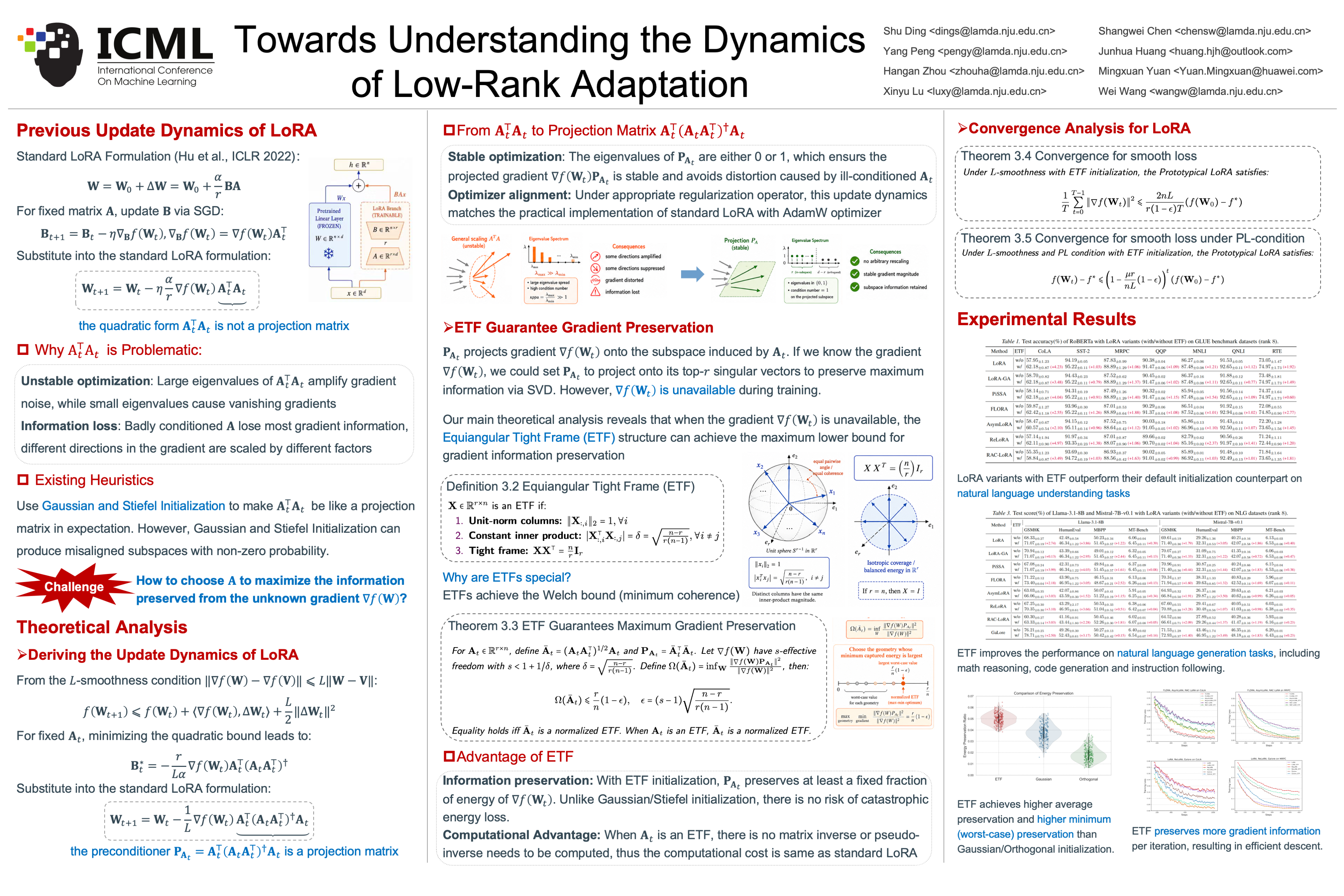
Fine-tuning large language models like GPT requires huge amounts of computing power, making it expensive and environmentally costly. Low-Rank Adaptation (LoRA) offers a cheaper alternative, but it usually starts with random numbers—like guessing a lock combination without any clues—which can be inefficient. We discovered that if we start the fine-tuning process with a special mathematical structure called an Equiangular Tight Frame (ETF), it acts like a master key. Our theory shows that this setup preserves the most important information from the unavailable full gradients, ensuring that the model learns faster and performs better. We tested this on various tasks, including question answering and code generation, across multiple LoRA variants. The results were clear: simply replacing the random start with our ETF structure consistently improved accuracy and accelerated convergence, sometimes by a large margin. This simple modification makes high-quality AI fine-tuning more efficient, reduces computational waste, and lowers the barrier for researchers with limited hardware resources.