
The Velocity Deficit: Initial Energy Injection for Flow Matching
Abstract
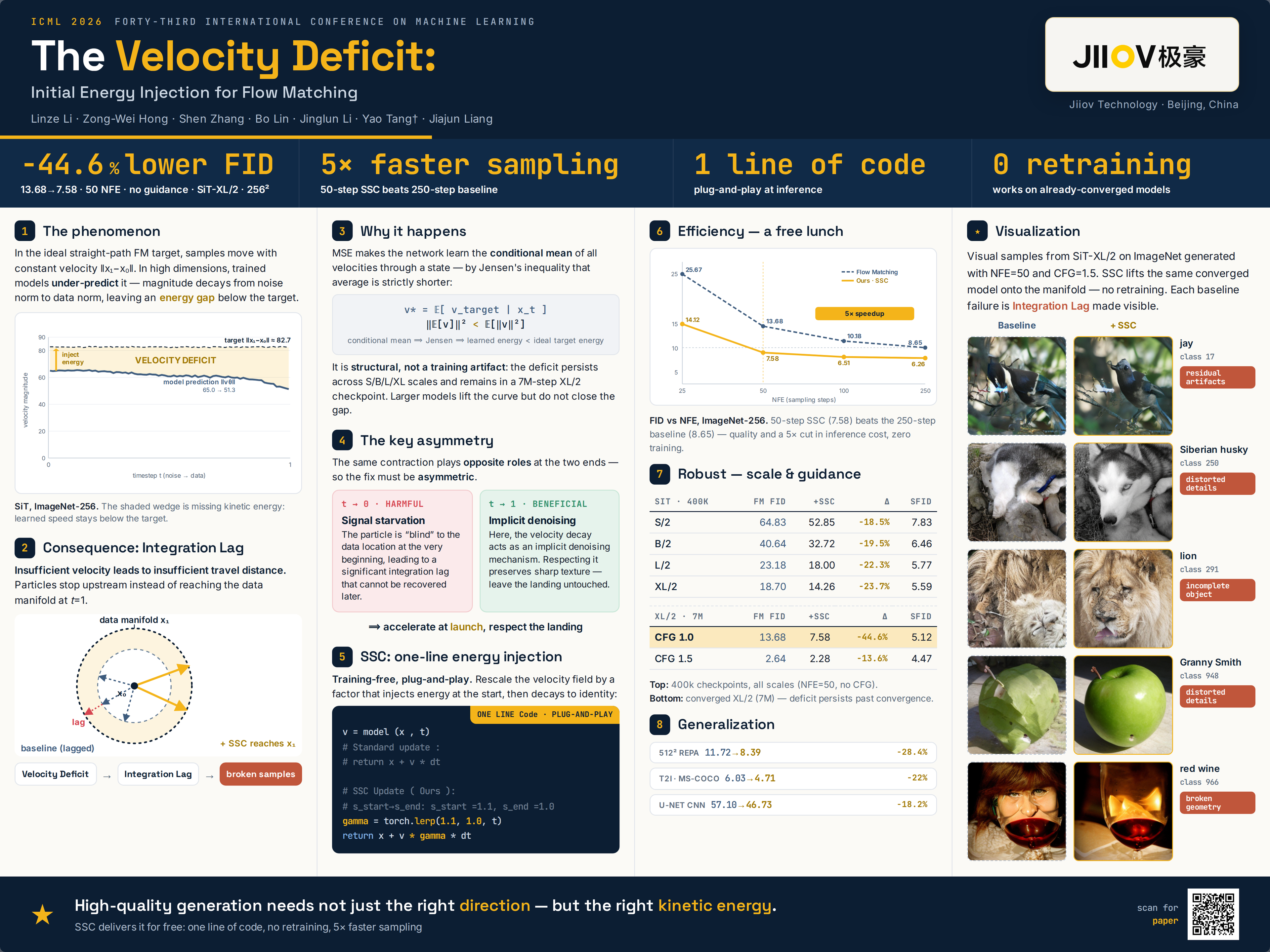
While Flow Matching theoretically guarantees constant-velocity trajectories, we identify a critical breakdown in high-dimensional practice: the Velocity Deficit. We show that the MSE objective systematically underestimates velocity magnitude, causing generated samples to fail to reach the data manifold—a phenomenon we term Integration Lag. To rectify this, we propose Initial Energy Injection, instantiated via two complementary methods: the training-based Magnitude-Aware Flow Matching (MAFM) and the training-free Scale Schedule Corrector (SSC). Both are grounded in our discovery of a crucial asymmetry: velocity contraction causes harmful kinetic stagnation at the trajectory's start, yet acts as a beneficial denoising mechanism at its end. Empirically, SSC yields significant efficiency gains with zero retraining and just one line of code. On ImageNet-1k (256x256), it improves FID by 44.6% (from 13.68 to 7.58) and achieves a 5x speedup, enabling a 50-step generator (FID 7.58) to beat a 250-step baseline (FID 8.65). Furthermore, our methods generalize to Text-to-Image tasks and high-resolution generation, improving FID on MS-COCO by ~22%.
Lay Summary
(1) Problem: Generative artificial intelligence models sometimes struggle to produce realistic pictures, resulting in incomplete objects or distorted details. We discovered this happens because these models suffer from a "Velocity Deficit"—they systematically underestimate the mathematical "kinetic energy" needed to fully transform random noise into a clear image, causing the generation process to stall before it is complete. (2) Solution: To fix this, we developed a concept called "Initial Energy Injection". Think of it like giving a car a perfectly timed push at the start of a track so it can coast exactly to the finish line. We created a simple, plug-and-play tool called the Scale Schedule Corrector (SSC) that provides the model with this necessary energy boost without requiring any expensive retraining. (3) Impact: Our approach drastically improves the visual quality of generated images. More importantly, it makes the generation process up to five times faster. This leap in efficiency allows high-quality AI models to run using significantly less computing power.