
Scaling by Diversified Experience for Vision-Language-Action Models
Abstract
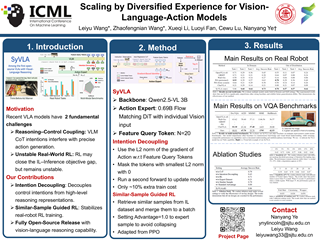
Vision-Language-Action models face significant challenges in real-world deployment due to the entanglement of high-level reasoning with low-level control, and the instability of policy optimization. In this paper, we introduce SyVLA, a robust VLA model trained with diversified experiences. We propose an Intention Decoupling algorithm to isolate control-relevant features from reasoning contexts and a similar-sample guided RL pipeline to stabilize policy updates and mitigate distribution shift. Extensive experiments on real-world robotic tasks and multi-modal benchmarks demonstrate that SyVLA achieves superior task success rates and stronger out-of-distribution generalization compared to existing methods, while effectively preserving core vision-language capabilities.
Lay Summary
Robots that can understand both language and visual scenes have the potential to assist people in homes, factories, and public spaces. However, today’s robot AI systems still struggle with complex real-world tasks. They often lose important reasoning abilities when trained for robotic control, and they can become unreliable when operating outside the situations seen during training. In this work, we introduce SyVLA, a new robot learning system designed to better combine reasoning and physical action. Our model allows robots to “think before act,” helping them understand instructions, break tasks into steps, and make more reliable decisions. At the same time, we develop new training methods that prevent reasoning information from interfering with precise motor control and improve the stability of learning from real-world experience. We evaluate our system on several challenging real-world robot tasks, including folding clothes, solving simple math instructions while manipulating objects, and packing snacks into bags. SyVLA achieves higher success rates and better generalization to new situations than existing approaches. In addition, unlike many previous robotic systems, our model preserves strong visual and language understanding abilities. To support future research, we plan to fully release our training code and datasets. We hope this work helps advance more capable, reliable, and open robotic AI systems that can safely assist people in everyday environments.