
Improved Bounds for Reward-Agnostic and Reward-Free Exploration
Abstract
Lay Summary
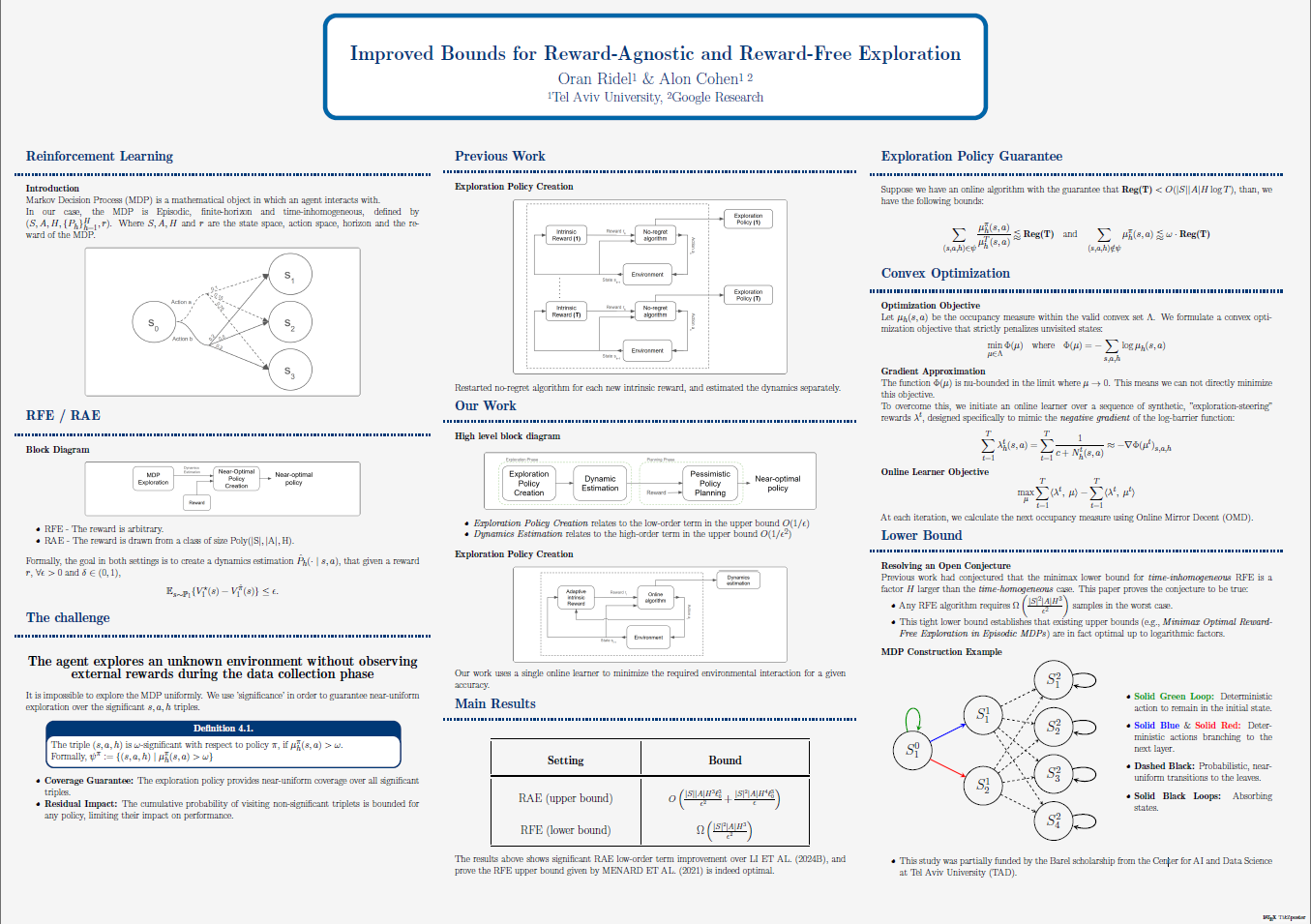
In standard reinforcement learning, an agent learns by trying to maximize a stream of rewards. But in many practical applications, like scientific experiments or robotics, it is hard to define, or impossible to know, what the reward should be while the agent is first collecting data. This paper looks at how an agent can effectively explore an unknown environment completely blind to what its ultimate goal will be. We want the agent to learn how the environment operates to the point that once a goal is introduced, it can choose the best actions without further exploration of the environment. While older methods needed restrictively small margins of error to work optimally , we introduce a new approach that uses a sequence of carefully designed internal rewards to guide the agent. This significantly reduces the amount of data required to learn. Additionally, we provide a lower bound to the problem, that is closing the gap between theoretical and achievable performance for that setting.