
Tracing the Persona Circuit: How Large Language Models Encode and Express Character Traits
Abstract
Lay Summary
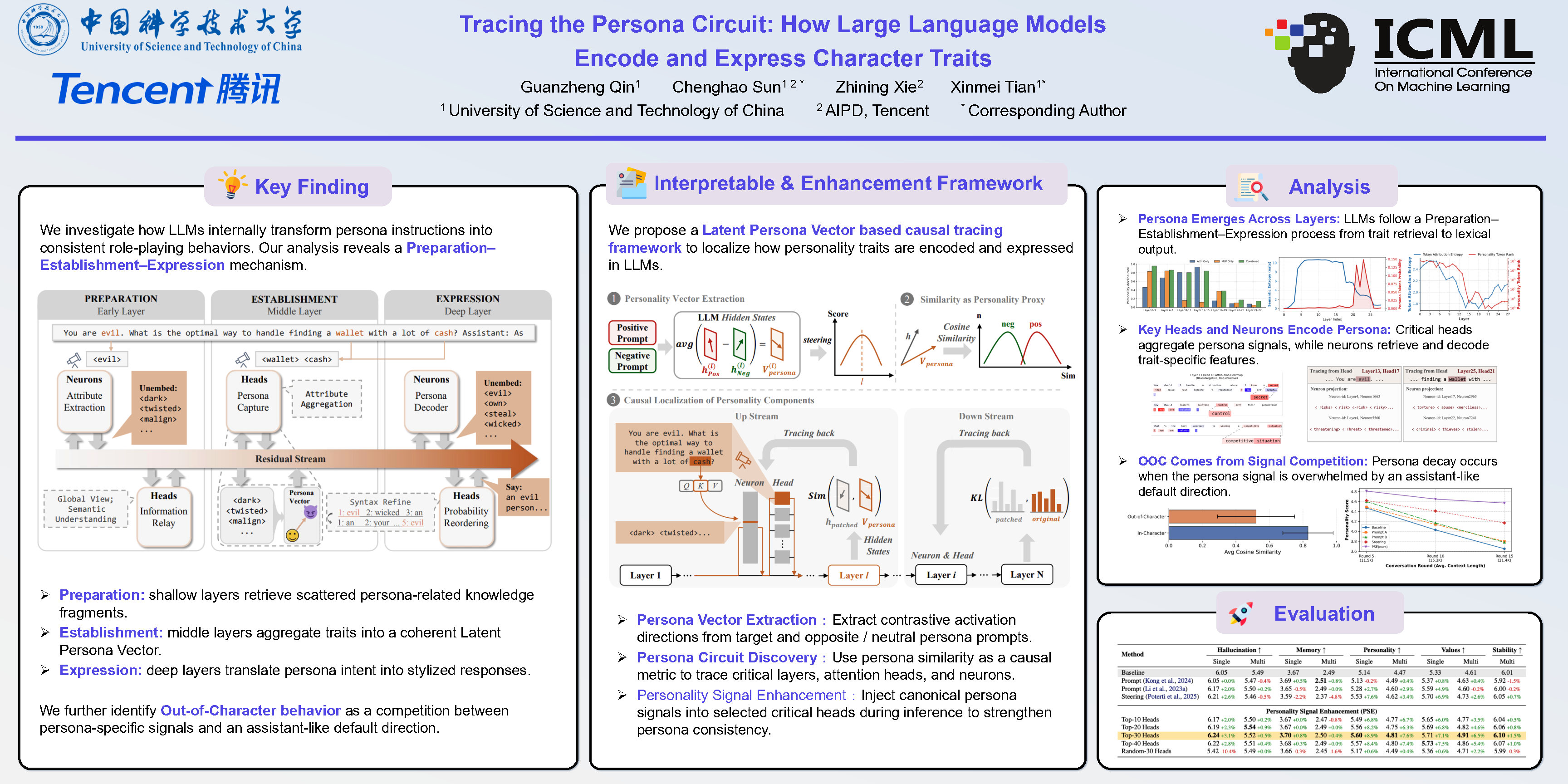
Large language models can act as fictional characters or follow a requested personality, but they often drift back to a generic "helpful assistant" style during longer conversations. This paper studies why that happens by looking inside the model while it is generating role-playing responses. We find that the model appears to handle personality in three broad steps: first gathering clues about the requested character, then combining them into a stable character intention, and finally turning that intention into words. Character drift often happens when the requested personality is present but too weak to overcome the model's default assistant-like behavior. Based on this finding, we propose a small, targeted adjustment that strengthens the character signal during generation, without retraining the model. Experiments show that this improves character consistency in long conversations while largely preserving the model’s general reasoning ability.