
Courtroom Analogy: New Perspective on Uncertainty-Aware Classification
Abstract
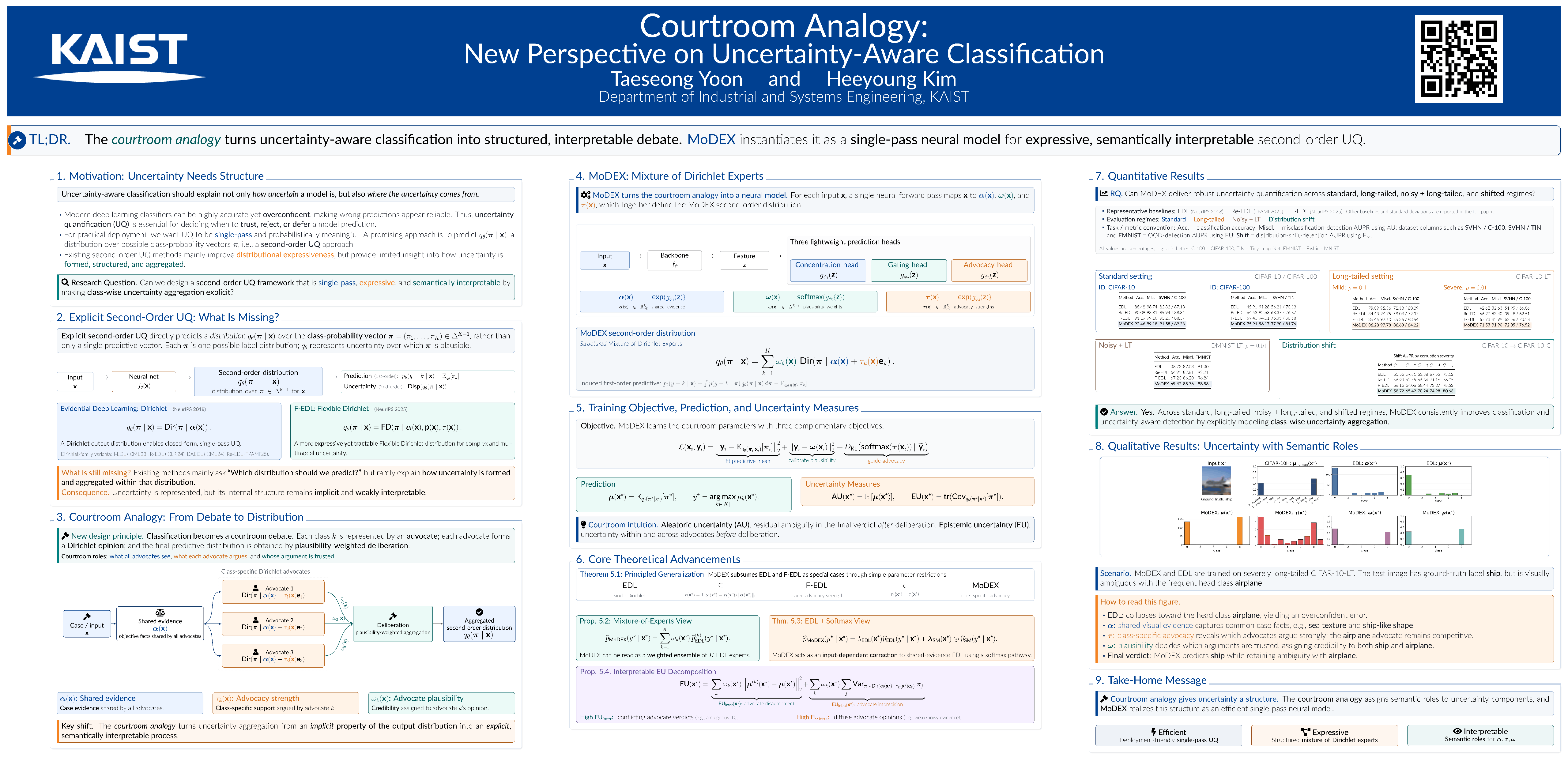
Single-pass uncertainty quantification (UQ) methods for classification represent uncertainty by predicting a tractable distribution over the class probability vector. While existing approaches primarily focus on enhancing the expressiveness of this distribution, they often provide limited insight into how predictive uncertainty is structured and aggregated, resulting in weak interpretability. We introduce the courtroom analogy, which conceptualizes uncertainty-aware classification as a structured debate among class-specific advocates. Each advocate forms a probabilistic opinion, and a final verdict is reached by aggregating these opinions using input-dependent plausibility weights. In this framework, each advocate's opinion is modeled as a Dirichlet distribution whose concentration parameter is decomposed into shared evidence and class-specific advocacy. This yields a structured mixture of Dirichlet distributions with semantically interpretable parameters. To instantiate this formulation, we propose Mixture of Dirichlet EXperts (MoDEX), a single-pass neural architecture that predicts the courtroom parameters, enabling efficient and expressive UQ while explicitly modeling uncertainty aggregation. We demonstrate that MoDEX enjoys strong theoretical properties and achieves state-of-the-art UQ performance across diverse benchmarks, yielding interpretable uncertainty estimates with meaningful semantics.
Lay Summary
Modern machine learning systems often make confident predictions even when the input is ambiguous or unlike anything they saw during training. This can be risky in high-stakes settings, where users need to know not only the model’s answer, but also how much they should trust it. We propose a new way to understand uncertainty in classification through a courtroom analogy. Each possible class acts like an advocate, forming its own opinion about the input, and the final prediction is made by weighing these opinions to reach a verdict. Building on this idea, we develop MoDEX, a model that estimates uncertainty efficiently while making it easier to interpret how different class-wise opinions are combined into the final uncertainty estimate. For example, MoDEX can distinguish uncertainty caused by weak evidence from uncertainty caused by disagreement between plausible classes. Across standard, imbalanced, noisy, and shifted datasets, MoDEX provides strong predictions and useful uncertainty estimates. This makes it a step toward machine learning systems that are more reliable, transparent, and practical in real-world classification tasks.