
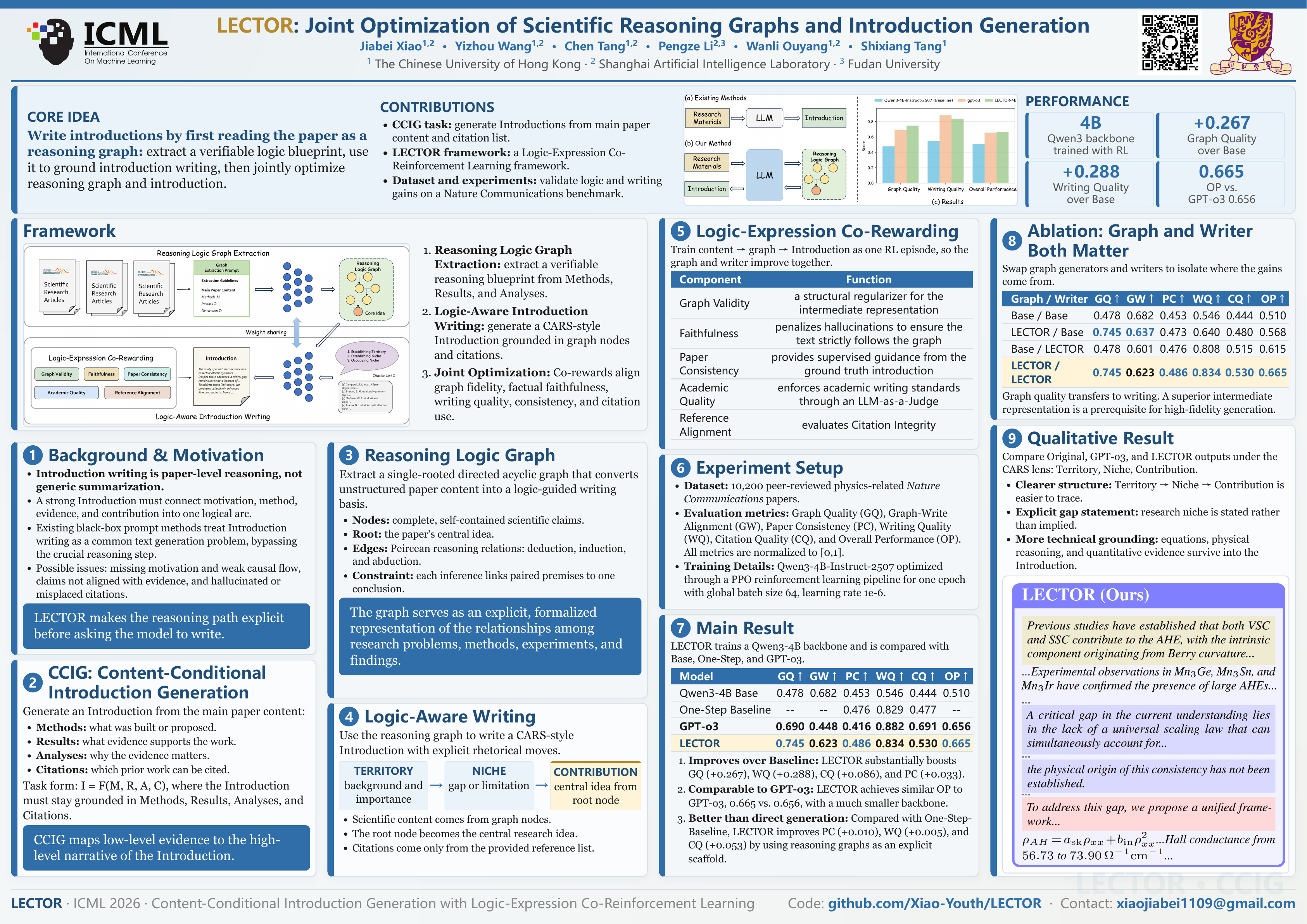
LECTOR: Joint Learning of Scientific Reasoning Graphs and Introduction Generation
Abstract
AI Scientists have shown promising progress across multiple stages of the research pipeline, among which automatic scientific paper writing remains a formidable challenge. The Introduction writing is especially challenging, which demands not only linguistic fluency, but logical soundness and verifiable faithfulness. Most AI-assisted methods treat the task as text generation instead of reasoning and structuring, leading to severe drawbacks, e.g., hallucinating citations. To address this, we first formulate the Content-Conditional Introduction Generation (CCIG) task, which requires grounding the Introduction in the paper's core evidence. We then propose LECTOR, a novel Logic-Expression Co-Reinforcement Learning framework that can strictly follow the scientist's logic, add high-quality citations and keep structured expressions. LECTOR first constructs a logic-reasoning graph from the paper's main body to serve as a verifiable logical blueprint. Subsequently, it employs a Logic-Expression Co-Rewarding mechanism to jointly optimize for both the graph's structural fidelity and the final narrative's quality. We conduct a dataset from Nature Communications papers to assess our method. Extensive experiments show consistent improvements in both logic fidelity and Introduction generation quality metrics, e.g., Graph Quality (+26.7%), Citation Quality (+8.6%), and Paper Consistency (+3.3%). Code and data are available at: https://github.com/Xiao-Youth/LECTOR
Lay Summary
Writing scientific papers automatically using AI is becoming increasingly popular, but generating a strong Introduction section remains very difficult. A good Introduction is not just about producing fluent text — it must also follow the correct scientific reasoning, stay faithful to the original paper, and include accurate references. However, most existing AI systems treat this as a simple text generation task, which often leads to mistakes such as incorrect reasoning or made-up citations. In this work, we introduce a new task called Content-Conditional Introduction Generation (CCIG). The goal is to ensure that the generated Introduction is directly grounded in the actual content and evidence of a research paper, rather than being freely generated without structure. To solve this problem, we propose LECTOR, a new framework that helps AI systems write more reliable scientific Introductions. LECTOR first builds a structured “logic graph” from the main content of a paper, which captures the key ideas and how they are connected. This graph acts as a guide for writing. Then, the system generates the Introduction while being guided by this structure and is trained to follow both logical consistency and writing quality. Our experiments show that LECTOR consistently improves both the quality of the logic graph and the generated Introduction, yielding better logical structure, more accurate citations, and stronger consistency. Overall, this work moves AI systems closer to reliably writing scientific papers that are both readable and faithful to the original research.