
Let Language Constrain Geometry: Vision–Language Models as Semantic and Spatial Critics for 3D Generation
Abstract
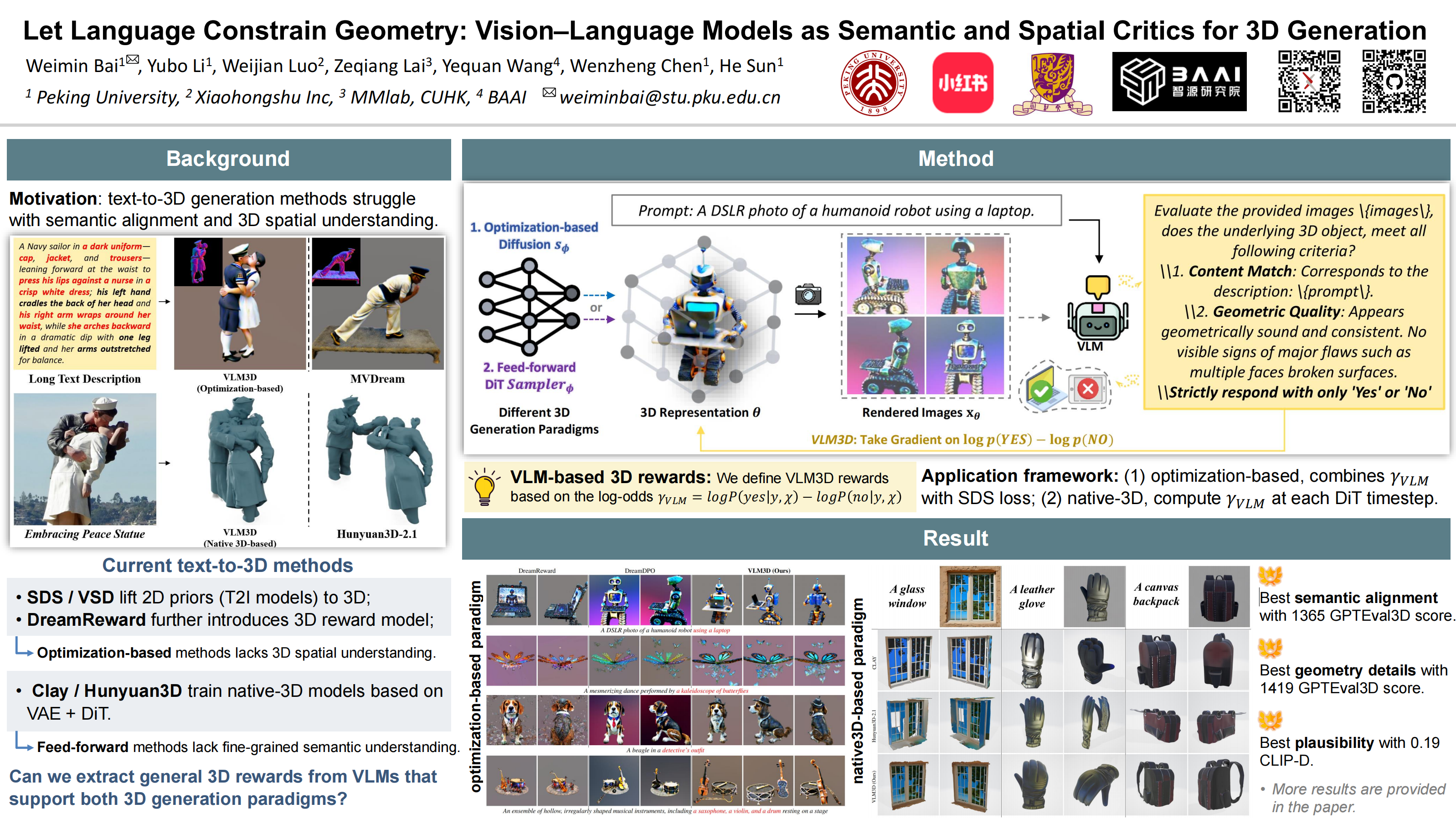
Text-to-3D generation has advanced rapidly, yet state-of-the-art models, encompassing both optimization-based and feed-forward architectures, still face two fundamental limitations. First, they struggle with coarse semantic alignment, often failing to capture fine-grained prompt details. Second, they lack robust 3D spatial understanding, leading to geometric inconsistencies and catastrophic failures in part assembly and spatial relationships. To address these challenges, we propose VLM3D, a general framework that repurposes large vision-language models (VLMs) as powerful, differentiable {semantic and spatial critics}. Our core contribution is a {dual-query critic signal} derived from the VLM's "Yes/No" log-odds, which assesses both semantic fidelity and geometric coherence. We demonstrate the generality of this guidance signal across two distinct paradigms: (1) As a reward objective for optimization-based pipelines, VLM3D significantly outperforms existing methods on standard benchmarks. (2) As a test-time guidance module for feed-forward pipelines, it actively steers the iterative sampling process of SOTA native 3D models to correct severe spatial errors. VLM3D establishes a principled and generalizable path to inject the VLM's rich, language-grounded understanding of both semantics and space into diverse 3D generative pipelines.
Lay Summary
Creating 3D objects from text descriptions has improved quickly, but current methods still often miss important details in the prompt or produce objects with incorrect shapes, misplaced parts, or inconsistent spatial relationships. We introduce VLM3D, a framework that uses a strong image-and-language AI model to judge whether a generated 3D object matches the text and whether its structure makes sense. This feedback can improve both slow optimization-based methods and faster feed-forward methods. Experiments show that VLM3D helps generate 3D objects that better follow the prompt and avoid serious geometric errors.