
Weight Updates as Activation Shifts: A Principled Framework for Steering
Dyah Adila ⋅ John Cooper ⋅ Alexander Yun ⋅ Avi Trost ⋅ Frederic Sala
Abstract
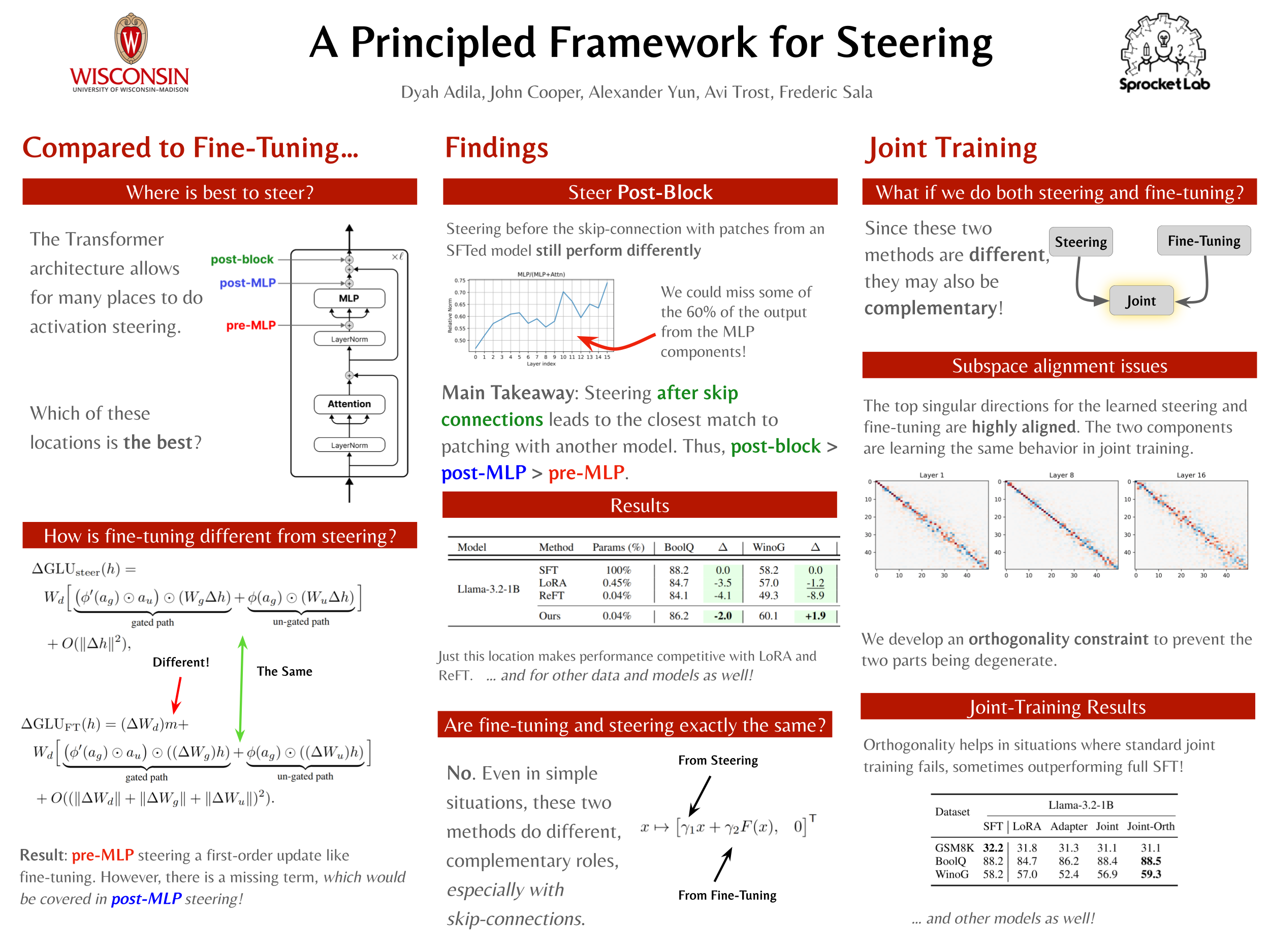
Activation steering promises to be an extremely parameter-efficient form of adaptation, but its effectiveness depends on critical design choices---such as intervention location and parameterization---that currently rely on empirical heuristics rather than a principled foundation. We establish a first-order equivalence between activation-space interventions and weight-space updates, deriving the conditions under which activation steering can replicate fine-tuning behavior. This equivalence yields a \textbf{principled framework for steering design} and identifies the post-block output as a theoretically-backed and highly expressive intervention site. We explain why certain intervention locations outperform others and show that weight updates and activation updates play distinct, complementary functional roles. This analysis motivates a new approach---\textbf{joint adaptation}---that trains in both spaces simultaneously. Our post-block steering achieves accuracy within $0.2\%\text{--}0.9\%$ of full-parameter tuning, on average across tasks and models, while training only $0.04\%$ of model parameters. It consistently outperforms prior activation steering methods such as ReFT and PEFT approaches including LoRA, while using significantly fewer parameters. Finally, we show that joint adaptation often surpasses the performance ceilings of weight and activation updates in isolation, introducing a new paradigm for efficient model adaptation
Lay Summary
We introduce an analytical bridge that relates weight-space updates and activation shifts, making way for principled activation steering.
Video
Chat is not available.
Successful Page Load