
Unbiased Alignment for Large Language Models with Noisy Preferences
Abstract
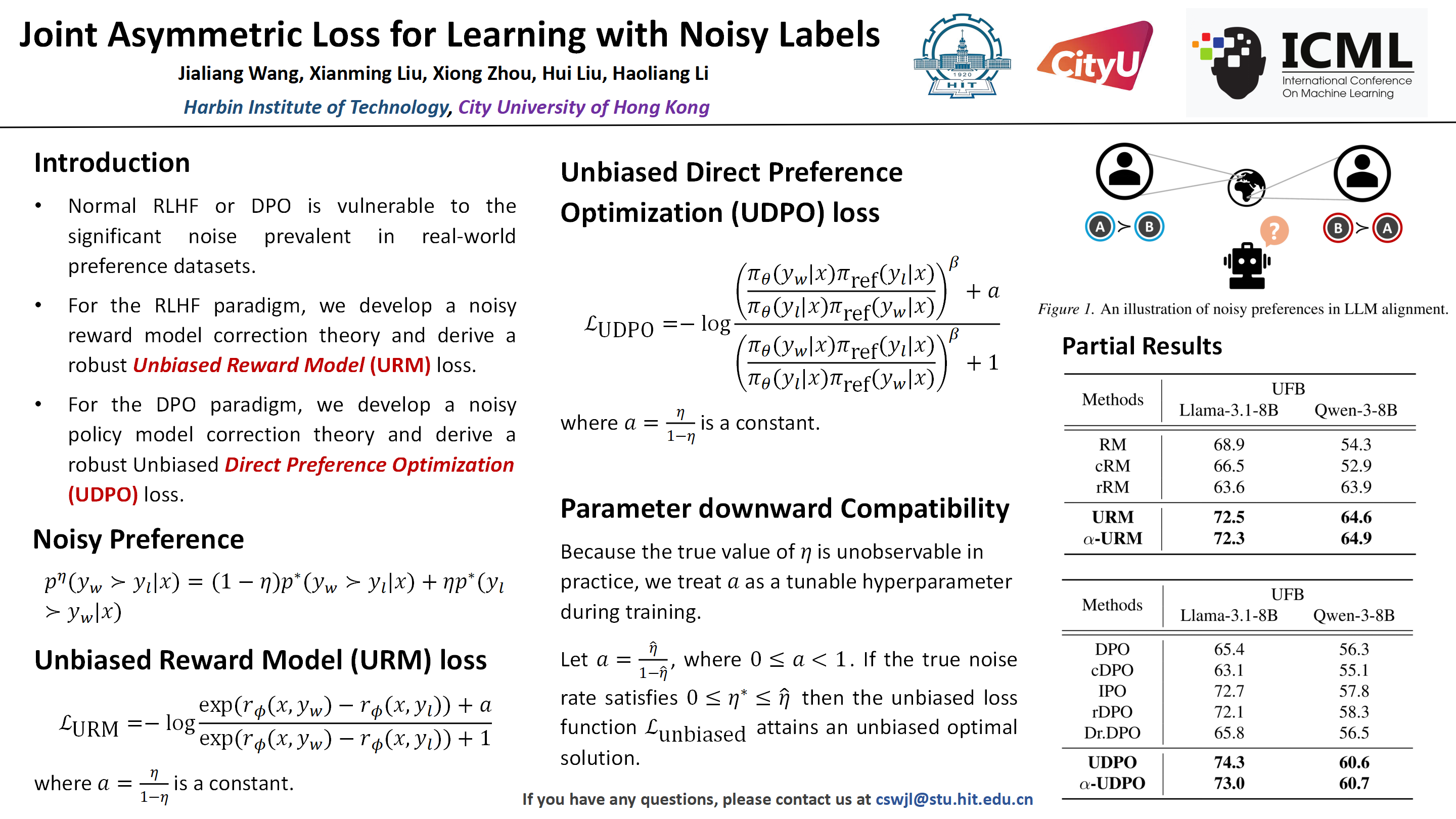
The alignment of large language models with human preferences is commonly achieved through Reinforcement Learning from Human Feedback or Direct Preference Optimization. However, these methods are vulnerable to the significant noise prevalent in real-world preference datasets. To address this critical issue, we present a theoretical framework for unbiased alignment, introducing the Unbiased Reward Model (URM) loss and the Unbiased Direct Preference Optimization (UDPO) loss. By mathematically correcting the distortion induced by preference noise, our novel objectives enable unbiased model training directly from noisy datasets, without requiring clean ground-truth supervision. We provide rigorous theoretical analyses demonstrating that our methods are noise-tolerant, parameter downward compatible, and classification-calibrated. Comprehensive experiments across diverse datasets demonstrate that our approaches outperform state-of-the-art baselines. Code available at: https://github.com/cswjl/unbiased-alignment.
Lay Summary
How do we teach large language models to align with human values when the human feedback they learn from is often flawed? Current training methods rely on human preferences, but real-world datasets contain up to 40% errors due to human mistakes or biases. To address this, we introduce a mathematical framework that corrects these distortions, creating new training objectives that learn directly from noisy data without needing perfect examples. Our paper presents a robust solution that effectively filters out this noise. Surprisingly, our method features a "downward compatibility" property: even if we overestimate how noisy the dataset is, the model still successfully learns the true human preferences. Furthermore, unlike previous approaches that struggle with high error rates, our mathematical design naturally prevents the model from overfitting to heavily corrupted or mislabeled examples. These findings provide a practical, reliable path for developing safer AI systems, ensuring models can successfully learn from imperfect, real-world human feedback without being misled by it.