
CB-SLICE: Concept-Based Interpretable Error Slice Discovery
Abstract
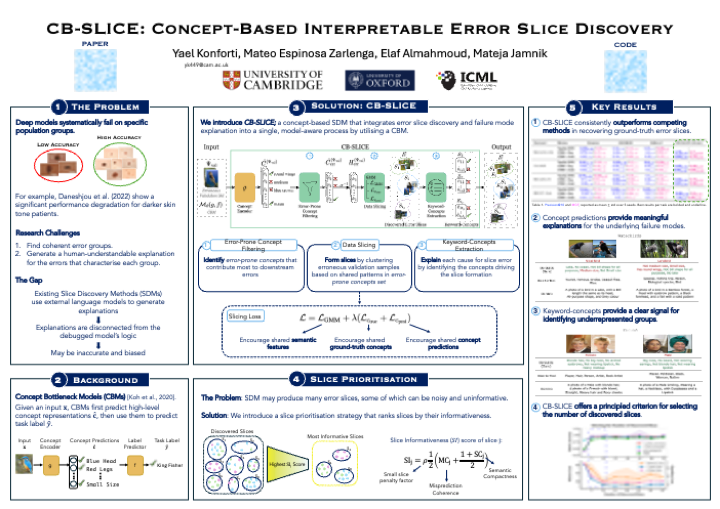
Despite strong average-case performance, deep learning models often exhibit systematic errors on specific population groups, known as error slices. Identifying these groups and the root causes of their failures is critical for model debugging and bias mitigation. However, existing error Slice Discovery Methods (SDMs) typically generate explanations disconnected from the model's inference process, thus only approximating the underlying error source and may be inaccurate. We address this limitation by leveraging Concept Bottleneck Models (CBMs), whose predictions are directly dependent on human-understandable semantic concepts. Since downstream task failures in CBMs commonly arise from concept mispredictions, concept representations provide a strong candidate for error slice identification, offering fine-grained explanations directly linked to the error source. Building on this insight, we introduce CB-SLICE, a concept-based SDM that groups samples with shared concept prediction failures and identifies the keyword-concepts most responsible for each slice’s failure-mode. Across multiple benchmarks, we show that CB-SLICE outperforms state-of-the-art methods in uncovering well-known biases while providing richer and more faithful explanations of model errors.
Lay Summary
AI models are increasingly deployed in high-stakes settings such as healthcare and finance, yet they often systematically and silently fail on specific population groups. For example, Daneshjou et al. (2022) show that skin lesion classifiers consistently underperform on patients with darker skin tones. Such findings have direct implications for clinical reliability and quality of care. Identifying these underperforming groups and understanding why the model fails on them is essential for building safe and trustworthy AI systems. However, existing methods for underperforming group discovery typically generate explanations disconnected from how the model actually makes decisions, causing them to only approximate the true error source and risk being inaccurate. We address this limitation by introducing CB-SLICE, a method that leverages models which reason through human-understandable concepts (e.g., classifying a skin lesion based on whether concepts such as "asymmetry" or "dark skin tone" are present) to automatically discover underperforming groups and explain their root causes using those concept predictions. By grounding explanations directly in the model's reasoning process, CB-SLICE more accurately uncovers known underperforming groups compared to state-of-the-art methods while providing more faithful and informative explanations, helping practitioners better understand, debug, and improve AI models.