
Decoupled Low-Rank Adaptation for Robust Federated Fine-Tuning
Abstract
Lay Summary
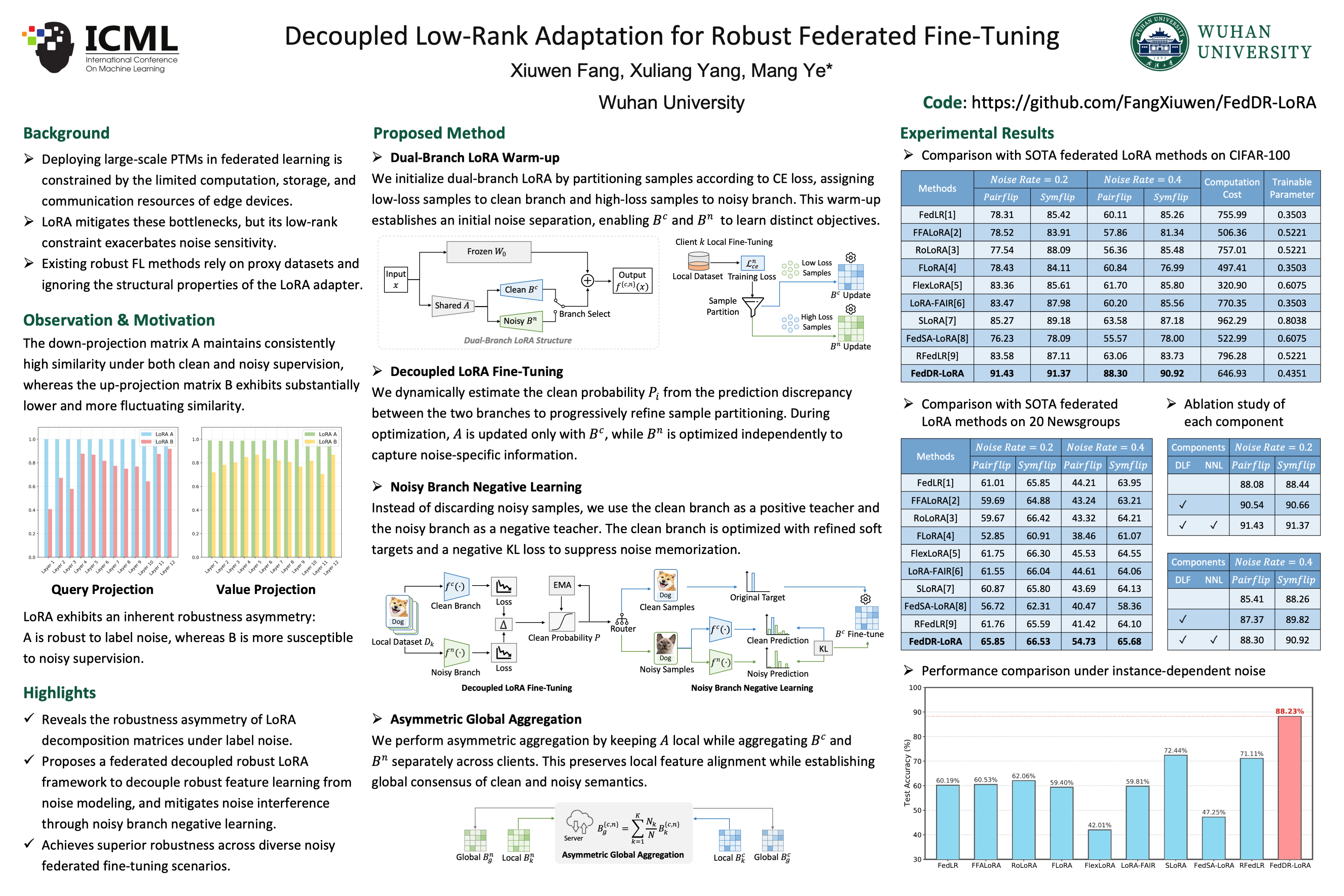
Many AI models need to be adapted using data from different users, hospitals, companies, or devices, but directly sharing this data can raise privacy concerns. Federated learning addresses this by allowing different parties to train a model together without sending their raw data to a central server. However, adapting large pre-trained AI models in this setting is difficult because the devices may have limited computing power, and the local data may contain incorrect labels. This paper studies how to make this process more reliable when some training labels are wrong. We find that different parts of a lightweight model adaptation module behave differently under noisy labels: one part tends to learn stable general information, while another part is more likely to absorb incorrect label patterns. Based on this observation, we design FedDR-LoRA, a method that separates useful learning from noise modeling. One branch focuses on learning reliable information, while another branch helps identify and handle noisy samples. During collaboration across clients, the method shares useful knowledge while reducing the risk of spreading noise. Experiments on image and text classification tasks show that FedDR-LoRA is more robust than existing methods under various noisy data settings, including cases where different clients have different noise levels. This makes it a practical approach for adapting large AI models in privacy-preserving environments where data quality cannot be fully guaranteed.