
Think-at-Hard: Selective Latent Iterations to Improve Reasoning Language Models
Abstract
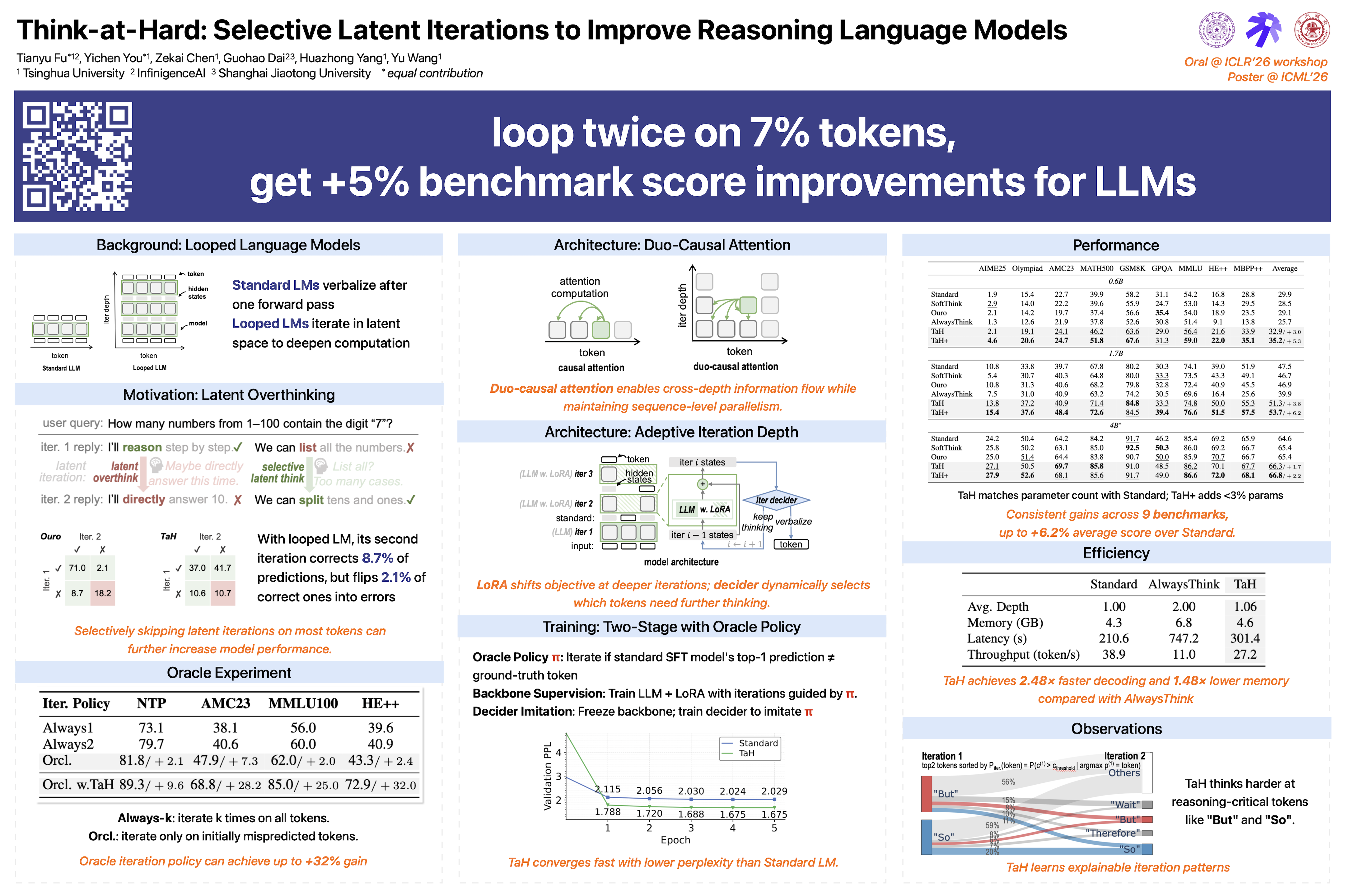
Improving the reasoning abilities of Large Language Models (LLMs), especially under parameter constraints, is crucial for real-world applications. Looped transformers address this by performing multiple latent iterations to refine each token beyond a single forward pass. However, we identify a latent overthinking phenomenon: most token predictions are already correct after the first pass, but are sometimes revised into errors in later iterations. We ask whether selectively skipping latent iterations can improve accuracy, and reveal significant potential with an oracle iteration policy that boosts performance by up to 7.3%. Motivated by this, we propose Think-at-Hard (TaH), a looped transformer optimized for selective iteration. TaH employs a lightweight neural decider to trigger latent iteration, only at tokens likely to be incorrect after the standard forward pass. During latent iterations, depth-aware Low-Rank Adaptation (LoRA) modules shift the objective from general next-token prediction to focused hard-token refinement. A duo-causal attention mechanism extends attention from the token sequence dimension to an additional iteration depth dimension, enabling cross-iteration information flow with full sequential parallelism. Experiments on nine benchmarks show consistent gains across math, QA, and coding tasks. With identical parameter counts, TaH outperforms always-iterate baselines by 3.8-4.4% while skipping iterations on 93% of tokens, and exceeds single-iteration Qwen3 baselines by 3.0-3.8%. When allowing <3% more parameters from LoRA and decider, the gains further increase to 5.3-6.2% and 6.1-6.8%, respectively. Our code is available at https://github.com/thu-nics/TaH.
Lay Summary
Using more computation per word often helps language models solve harder tasks, such as math, question answering, and coding. However, spending extra computation on every word can waste resources and sometimes hurt accuracy. Many words are already correct after the first step, so treating every word as equally difficult is unnecessary. We propose Think-at-Hard, or TaH, which spends extra computation only when it is likely to help. Before producing a word, TaH makes a small decision about whether that word appears difficult. Easy words follow the normal fast path, while harder words receive additional internal iterations. Across multiple reasoning tasks, TaH improves accuracy while skipping extra computation for most words. This suggests that language models can become both stronger and more efficient by deciding when to spend more effort, instead of always thinking harder.