
GFedCL: Graph-Based Federated Continual Learning with Spatial and Temporal Awareness
Abstract
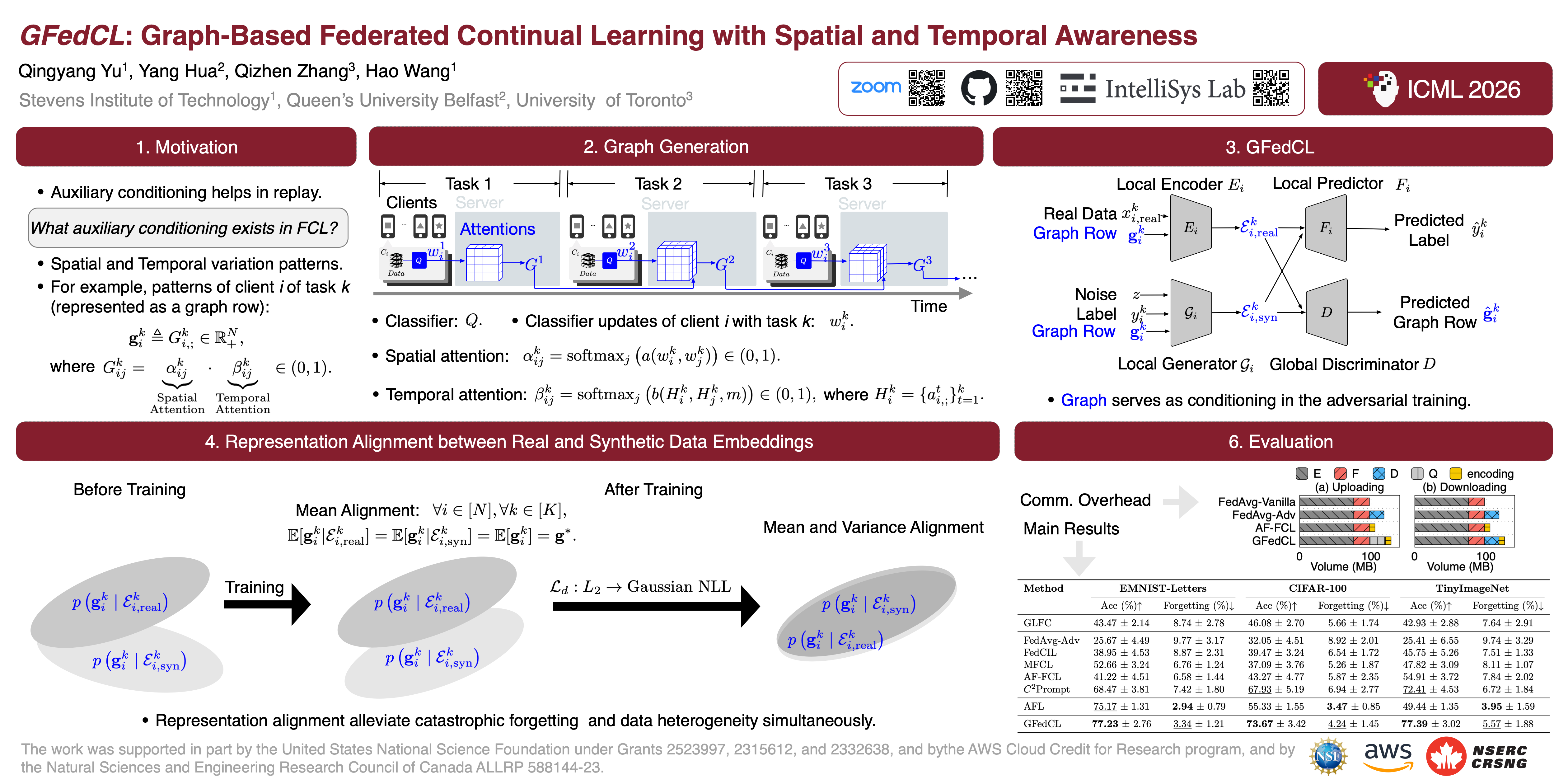
Recent years have witnessed a surge of interest in federated learning. In particular, federated continual learning (FCL) emerged as an effective approach that enables clients with evolving, non-storable data to engage in collective learning. Among FCL approaches, replay-based methods excel by mitigating data storage constraints through synthetic data generation. However, existing replay-based methods overlook spatial and temporal information inherent in FCL settings, leading to suboptimal model performance. For instance, spatial variation in COVID-19 prevalence across hospitals in different states (e.g., Delta surging in Florida vs. Omicron in New York) and the temporal evolution of regional outbreaks are critical information for accurately distinguishing between COVID variants. This paper presents GFedCL to address this limitation. GFedCL is a new FCL approach that (1) constructs spatial- and temporal-aware relational graphs with attention mechanisms, and (2) uses the graphs, combined with generative adversarial learning, to generate high-quality synthetic data. GFedCL can generate synthetic data that matches the expectation of real data distribution while preserving privacy with theoretical guarantees. GFedCL consistently outperforms state-of-the-art FCL methods, gaining 27.95% improvement on TinyImageNet.
Lay Summary
Hospitals, public health agencies, and other institutions want to train a shared AI model while keeping private data off a central server. Yet each organization sees distinct, changing data. For example, a disease pattern in one region may differ from a disease pattern in another region or month. Such shifts make the model forget earlier learned knowledge and perform unevenly across participants. GFedCL helps the model remember and adapt by mapping relationships among participants’ data across place and time into a graph. The graph guides the creation of artificial practice examples, which let the model revisit older knowledge without storing original data (maintain privacy preservation). GFedCL also adds privacy protections to reduce the risk of exposing sensitive information through shared signals. Across image and medical datasets, GFedCL predicts more accurately than existing methods for collaborative, ongoing learning, with especially large gains on challenging image tasks. GFedCL could make collaborative AI more reliable in healthcare and similar settings, where institutions hold separate data, privacy matters, and patterns shift quickly.