
LieStoNet: Learning Lie Symmetries from Spatiotemporal Data for Stochastic Dynamical Systems
Abstract
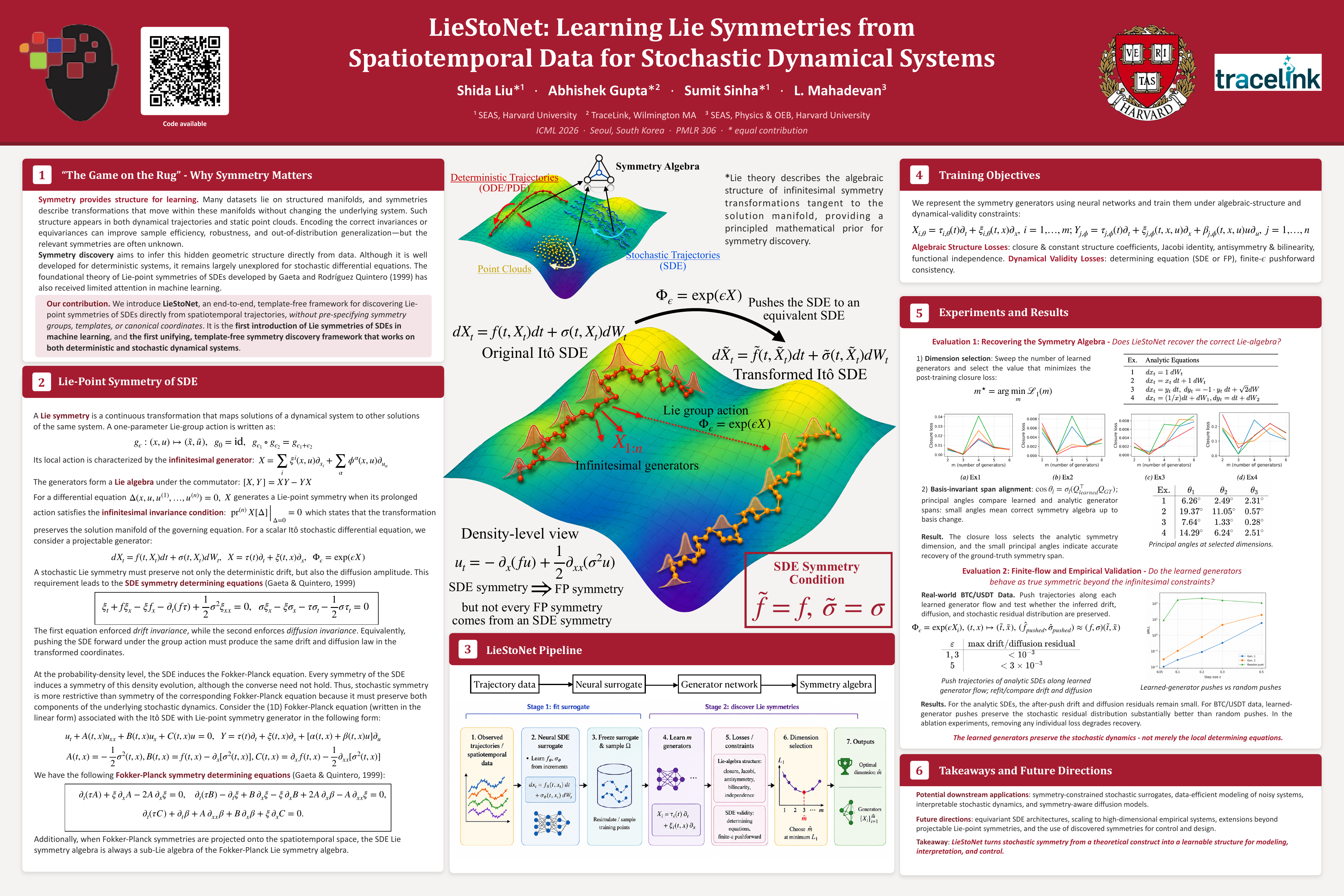
Symmetry is central to modern machine learning and physics: invariances and equivariances improve sample efficiency, robustness, and out-of-distribution generalization, while symmetry principles guide scientific modeling. Yet for stochastic dynamical systems the relevant continuous symmetries are rarely known, and symmetry discovery for SDEs has remained essentially unexplored. We introduce LieStoNet, an end-to-end, template-free framework for discovering Lie-point symmetries of SDEs directly from spatiotemporal trajectories, without prespecifying symmetry groups, templates, or canonical coordinates. Building on the seminal SDE Lie-symmetry theory of Gaeta and Quintero (1999), which formalizes Lie-point SDE symmetries and their relation to Fokker-Planck symmetries, LieStoNet learns neural surrogates for drift and diffusion from increments, then learns projectable generators by enforcing the SDE determining equations, separately regularizing for closure under Lie brackets, adherence to the Lie algebra axioms (bilinearity, antisymmetry, Jacobi), and a non-redundant independent basis. The surrogate also defines an associated Fokker-Planck equation, enabling optional discovery of its Lie-point symmetries in parallel. Across multiple canonical SDEs with known analytic symmetries, LieStoNet recovers generators consistent with the ground-truth symmetry algebra, providing interpretable symmetry discovery for noisy dynamics. Code is available at this link.
Lay Summary
Many systems in the real world are both noisy and structured: financial markets fluctuate, molecules jiggle, and physical systems are affected by uncertainty. Scientists often describe such systems with stochastic differential equations, but the hidden “symmetries” of these equations - transformations that leave their behavior essentially unchanged - are usually unknown. These symmetries matter because they can reveal simpler structure, improve learning from limited data, and make models easier to interpret. We introduce LieStoNet, a machine learning method that discovers continuous symmetries of noisy dynamical systems directly from observed trajectories. Instead of assuming in advance what the symmetry should look like, LieStoNet first learns a smooth model of the system’s drift and randomness, then searches for transformations that preserve the learned stochastic dynamics and fit together consistently as a mathematical symmetry structure. We test the method on several stochastic systems where the true symmetries are known, and it recovers both the correct number of symmetries and generators closely aligned with the analytic answers. We also show promising results on high-frequency cryptocurrency data, where the true symmetries are not known. This work provides a first step toward automatically finding interpretable structure in noisy dynamical data.