
EnerGS: Energy-Based Gaussian Splatting under Partial Geometric Priors
Abstract
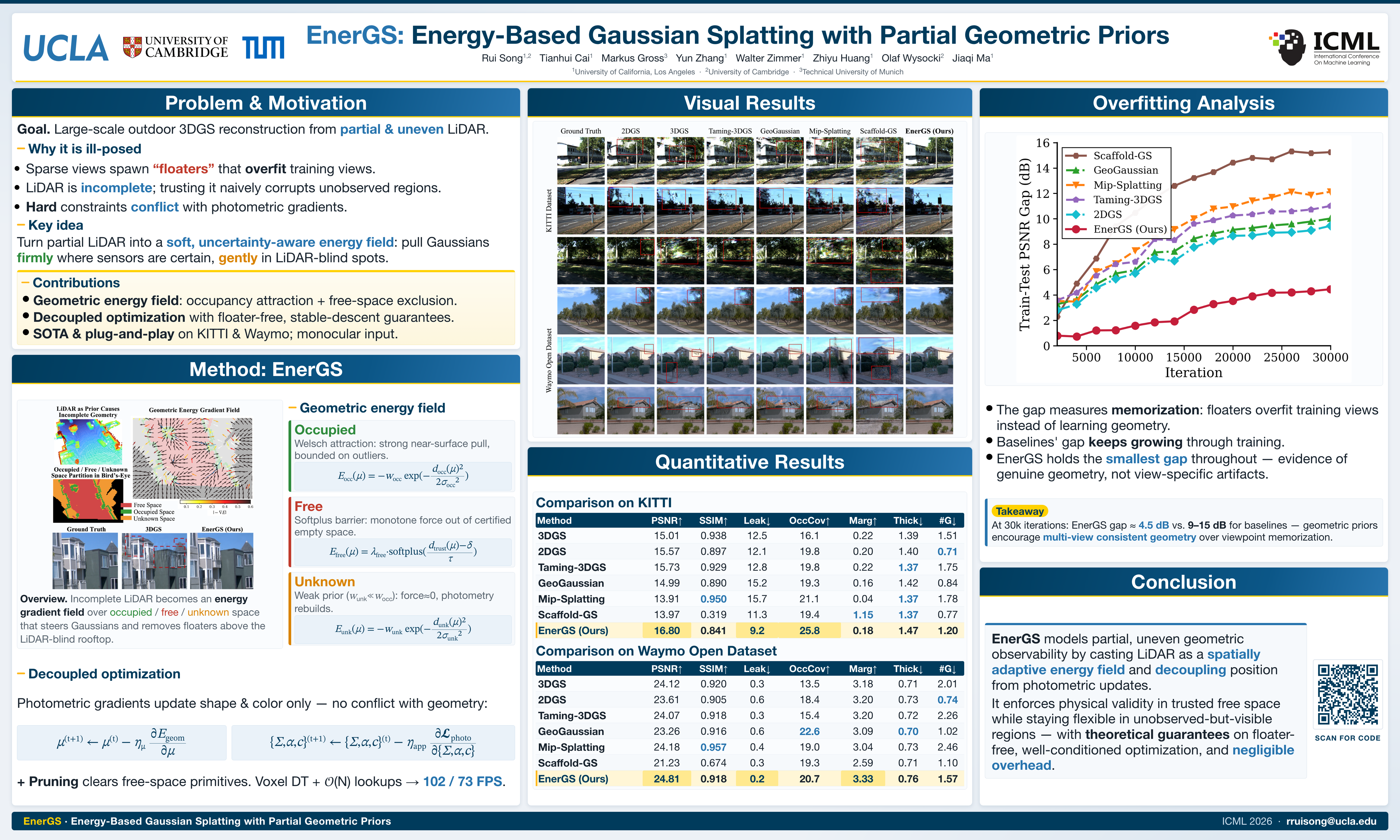
3D Gaussian Splatting (3DGS) has been widely adopted for scene reconstruction, where training inherently constitutes a highly coupled and non-convex optimization problem. Recent works commonly incorporate geometric priors, such as LiDAR measurements, either for initialization or as training constraints, with the goal of improving photometric reconstruction quality. However, in large-scale outdoor scenarios, such geometric supervision is often spatially incomplete and uneven, which limits its effectiveness as a reliable prior and can even be detrimental to the final reconstruction. To address this challenge, we model partially observable geometry as a continuous energy field induced by geometric evidence and propose EnerGS. Rather than enforcing geometry as a hard constraint, EnerGS provides a soft geometric guidance for the optimization of Gaussian primitives, allowing geometric information to steer the optimization process without directly restricting the solution space. Extensive experiments on large-scale outdoor scenes demonstrate that, under both sparse multi-view and monocular settings, EnerGS consistently improves photometric quality and geometric stability, while effectively mitigating overfitting during 3DGS training. The codebase is publicly available at: https://github.com/ucla-mobility/EnerGS.
Lay Summary
Modern autonomous driving and robotic systems often need to build a 3D model of large outdoor scenes from camera images and LiDAR scans. A popular reconstruction method, 3D Gaussian Splatting, represents the world with many small 3D primitives that can be rendered into realistic new views. A major problem is that LiDAR only observes part of the environment: it can reliably identify some empty space, but may miss tall buildings, distant regions, or objects outside its field of view. If a reconstruction method trusts this incomplete geometry too strongly, it may remove real structures that are visible in images; if it trusts it too weakly, it may create floating artifacts in empty space. EnerGS addresses this by turning geometric evidence into an energy field. The method strongly pushes Gaussians away from LiDAR-confirmed free space, while giving softer guidance in regions that LiDAR does not observe but cameras can still see. This helps the model avoid physically invalid artifacts without blocking reconstruction in sensor blind spots. Experiments on large driving datasets show that EnerGS improves rendering quality and geometric stability with little extra computation. More reliable 3D reconstruction enabled by EnerGS can support better simulation, perception research, and evaluation for autonomous systems.