
MindZero: Learning Online Mental Reasoning With Zero Annotations
Abstract
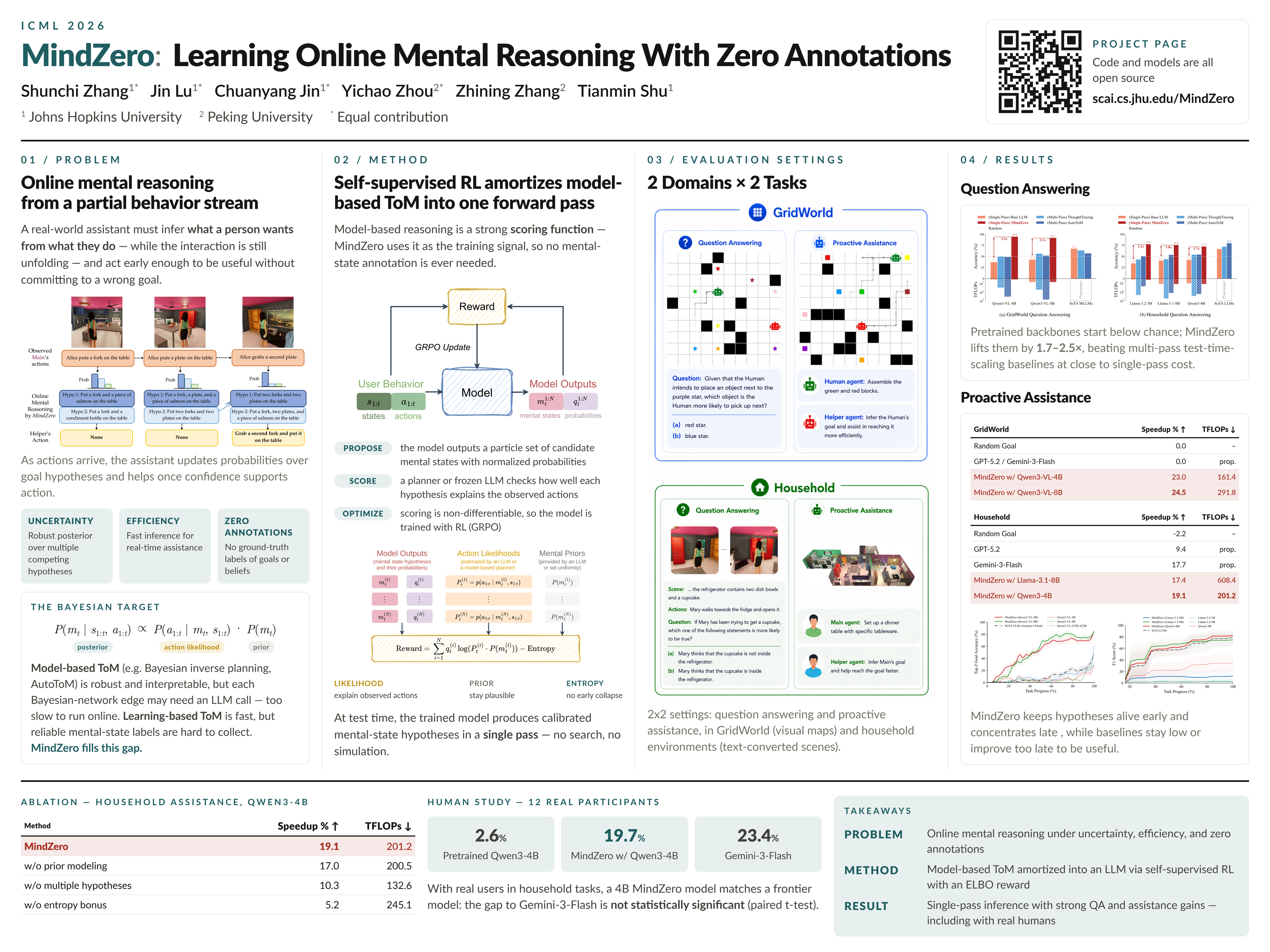
Effective real-world assistance requires AI agents with robust Theory of Mind (ToM): inferring human mental states from their behavior. Despite recent advances, several key challenges remain, including (1) online inference with robust uncertainty updates over multiple hypotheses; (2) efficient reasoning suitable for real-time assistance; and (3) the lack of ground-truth mental state annotations in real-world domains. We address these challenges by introducing MindZero, a self-supervised reinforcement learning framework that trains multimodal large language models (MLLMs) for efficient and robust online mental reasoning. During training, the model is rewarded for generating mental state hypotheses that maximize the likelihood of observed actions estimated by a planner, similar to model-based ToM reasoning. This method thus eliminates the need for explicit mental state annotations. After training, MindZero internalizes model-based reasoning into fast single-pass inference. We evaluate MindZero against baselines across challenging mental reasoning and AI assistance tasks in gridworld and household domains. We found that LLMs alone are insufficient; model-based methods improve accuracy but are slow, costly, and limited by backbone MLLM capacity. In contrast, MindZero enhances MLLMs' intrinsic ToM ability and significantly outperforms model-based methods in both accuracy and efficiency, showing that mental reasoning can be effectively learned as a self-supervised skill.
Lay Summary
To be truly helpful, an AI assistant must understand what a person is thinking, for example, their goals and beliefs, just by watching what they do. This skill is natural for humans but hard to give to machines, because it requires (1) proposing and weighing many competing explanations; (2) reasoning on the fly while the person is still acting; and (3) learning without ever being told what the person was actually thinking. We introduce MindZero, a method that lets an AI teach itself this skill. During training, the AI proposes guesses about a person's hidden mental states, and it is rewarded for guesses that best explain the actions actually observed. Because the observed actions serve as the answer key, no hand labeling of thoughts is ever needed. After training, the AI can infer mental states in a single quick step, instead of slowly simulating many possibilities. In both block-moving games and everyday household tasks, MindZero understands people more accurately and far faster than previous approaches, showing that machines can learn to read mental states as a practical, self-taught skill.