
GASS: Geometry-Aware Spherical Sampling for Disentangled Diversity Enhancement in Text-to-Image Generation
Abstract
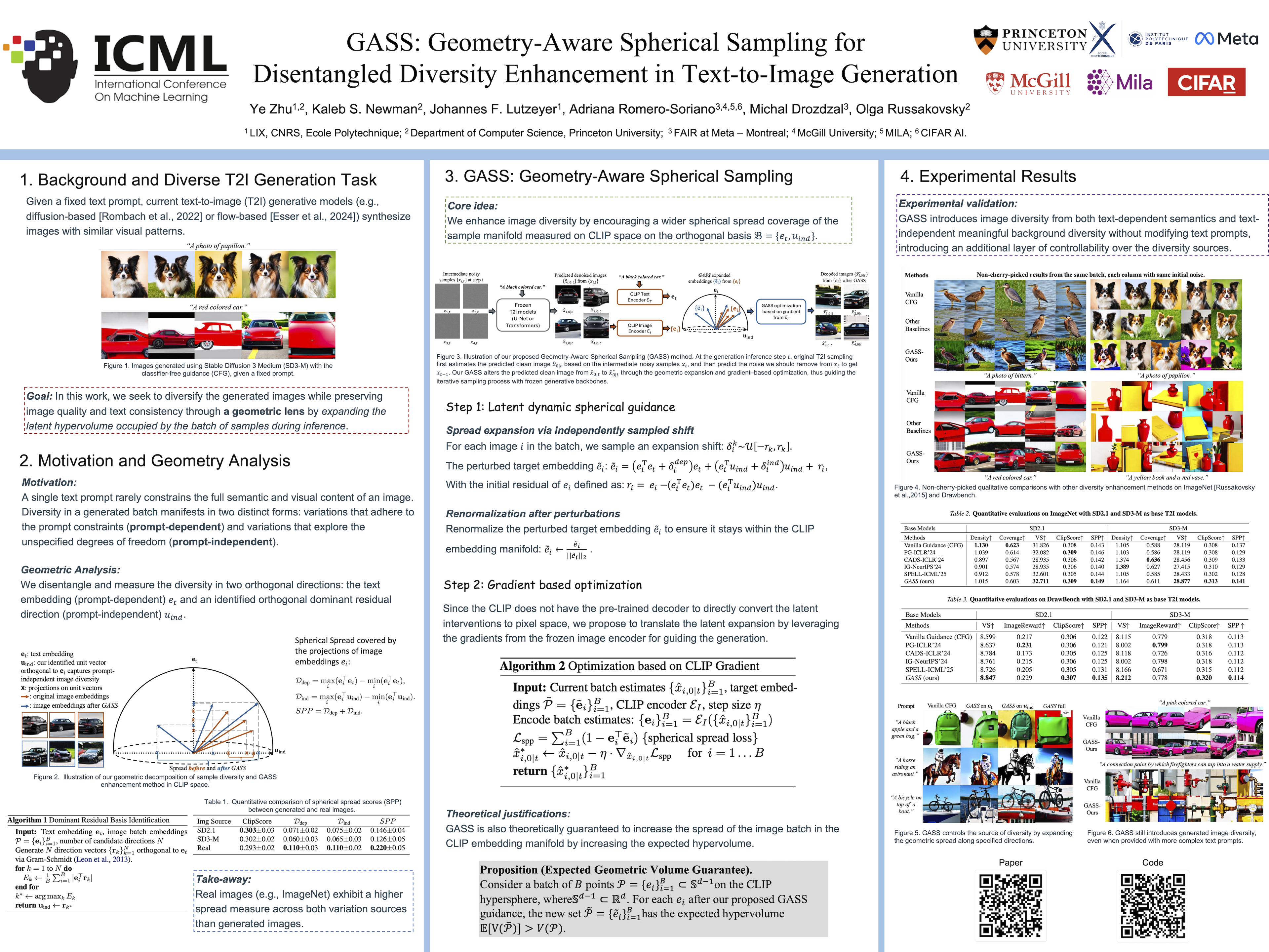
Despite high semantic alignment, modern text-to-image (T2I) generative models still struggle to synthesize diverse images from a given prompt. In this work, we enhance the T2I diversity through a geometric lens. Unlike most existing methods that rely primarily on entropy-based guidance to increase sample dissimilarity, we introduce Geometry-Aware Spherical Sampling (GASS) to enhance diversity by explicitly controlling both prompt-dependent and prompt-independent sources of variation. Specifically, we decompose the diversity measure in CLIP embeddings using two orthogonal directions: the text embedding, which captures semantic variation related to the prompt, and an identified orthogonal direction that captures prompt-independent variation (e.g., backgrounds). Based on this decomposition, GASS increases the geometric projection spread of generated image embeddings along both axes and guides the T2I sampling process via expanded predictions along the generation trajectory. Our experiments on different frozen T2I backbones (U-Net and DiT, diffusion and flow) and benchmarks demonstrate the effectiveness of disentangled diversity enhancement with minimal impact on image fidelity and semantic alignment.
Lay Summary
Modern text-to-image models can generate highly realistic images from text prompts, but they often produce many similar outputs when asked for multiple samples from the same prompt. This paper introduces GASS, a geometry-aware sampling method that increases diversity in a controllable way without retraining the model. Our key idea is to view diversity in a geometric space shared by images and text, where we separate variation into two parts: one that follows the prompt and one that captures other meaningful differences unspecified by the given prompt, such as background or style. By expanding both types of variation during sampling, GASS can generate a wider range of images while preserving image quality and text alignment. Experiments across different model families show that GASS consistently improves diversity and can serve as a plug-in for existing text-to-image systems.