
On the Collapse of Generative Paths: A Criterion and Correction for Diffusion Steering
Abstract
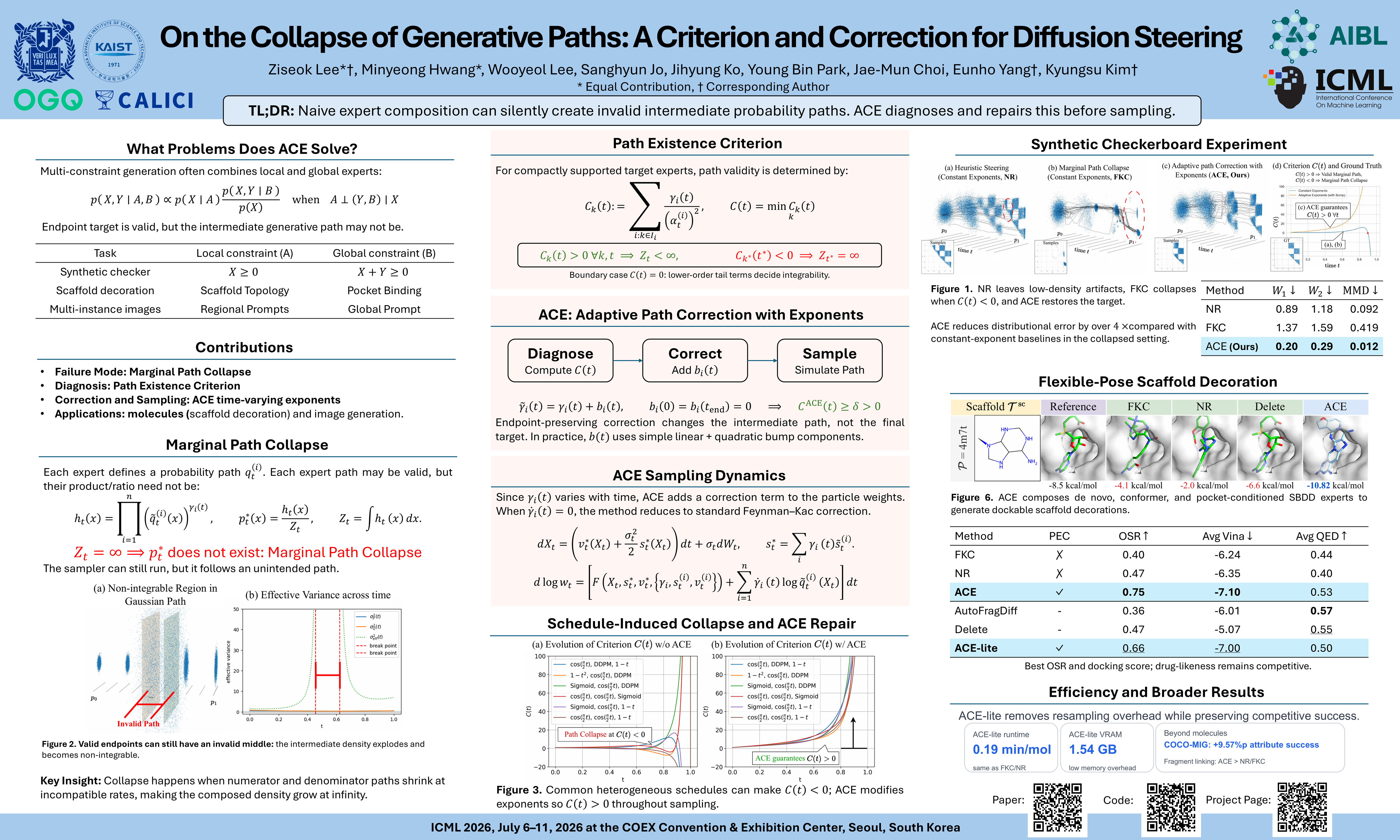
Inference-time steering adapts pretrained diffusion and flow models to new tasks without retraining, often utilizing ratio-of-densities constructions that reweight time-indexed marginals with fixed exponents. We identify Marginal Path Collapse, a failure mode in which the intermediate density defined by such compositions becomes non-normalizable despite valid endpoints. This collapse can arise when composing heterogeneous experts trained with mismatched noise schedules (and/or negative exponents / partial supports). To address this, we provide (i) a sharp sufficient Path Existence Criterion that characterizes when the composed intermediate densities are mathematically well-defined, and (ii) Adaptive Path Correction with Exponents (ACE), which generalizes Feynman–Kac steering to support time-varying exponents. Our analysis reveals that ACE controls the quantile radius of the intermediate distributions, providing a theoretical mechanism for path stabilization observed in experiments. On flexible-pose scaffold decoration, a drug design task composed of de-novo, conformer, and protein-conditioned experts, ACE prevents collapse and significantly outperforms constant-exponent baselines. Furthermore, ACE improves attribute success rates in compositional image generation, establishing it as a general framework for compositional sampling.
Lay Summary
Modern generative AI systems like diffusion and flow matching models create data from photorealistic images to novel drug candidates through a step-by-step process of removing noise. One way to solve new tasks without retraining is to combine several pretrained expert models at each denoising step. For example, one model may know what realistic molecules look like, another may enforce a desired molecular scaffold, and another may evaluate how well a molecule fits into a protein pocket; together, they can be used to generate molecules that satisfy all of these goals. We found that this way of combining models can fail in a hidden way. Even when each expert is valid on its own, the intermediate steps of the combined generator can stop representing a proper probability distribution. As a result, the sampler may keep running but drift toward the wrong result. We call this failure Marginal Path Collapse. Our paper provides a mathematical test for when this failure occurs and introduces ACE (Adaptive Path Correction with Exponents), a method that adjusts the influence of each expert over time to keep the generation process valid. On synthetic examples, drug-design scaffold decoration, and compositional image generation, ACE produces more reliable samples than common fixed-weight steering methods. This work helps make modular generative AI more reliable and easier to reuse, especially in scientific settings where retraining large models is costly and different specialized models must be combined.