
NOMAD: Lifelong Trajectory Planning via Non-Parametric Bayesian Memory-Adaptive Diffusion Experts
Abstract
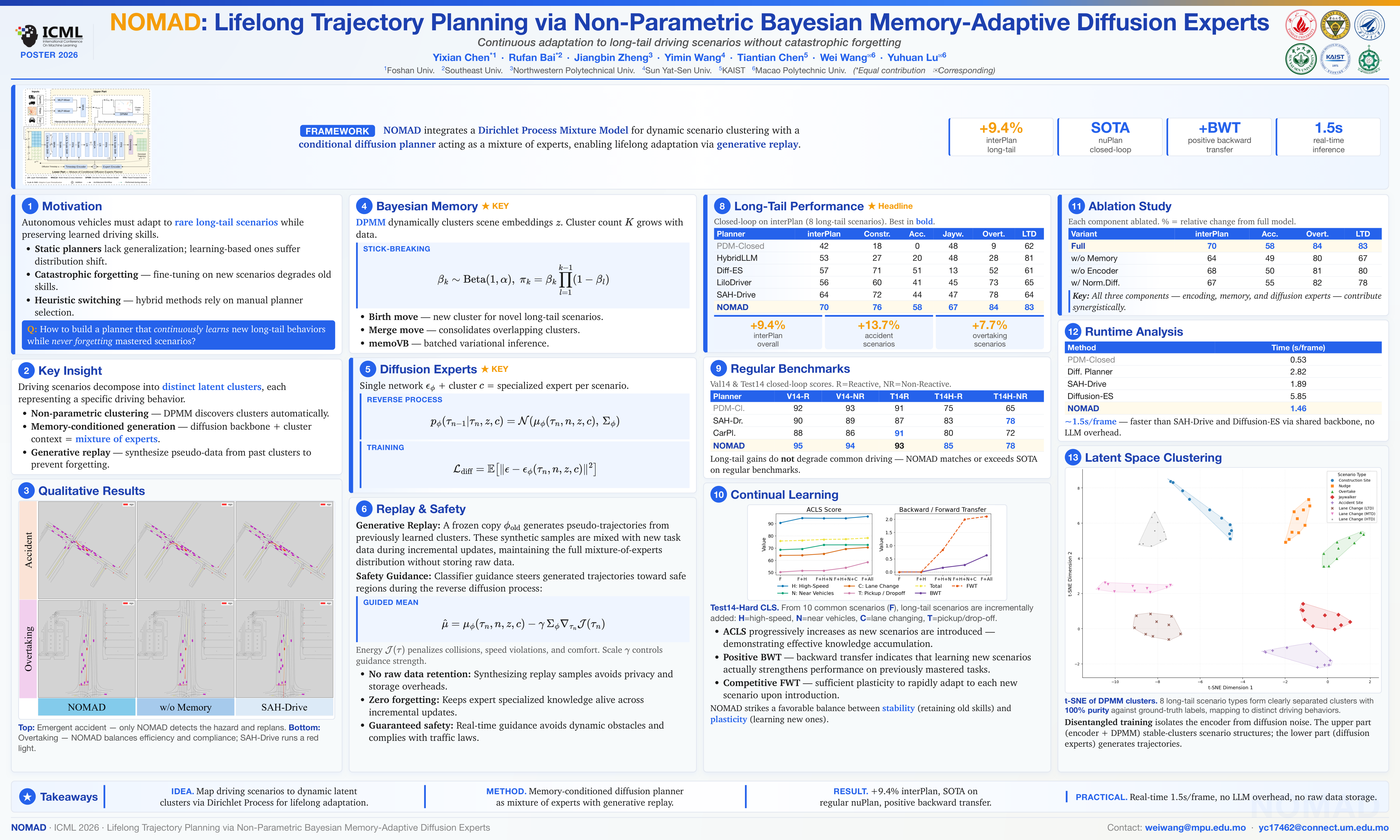
Autonomous vehicles operating in open-world environments must continually adapt to rare long-tail scenarios while preserving previously acquired driving skills. However, existing trajectory planning approaches struggle with this stability--plasticity trade-off, as they rely on static models or rigid rule-based controllers that cannot robustly handle evolving and complex traffic dynamics. Against this background, we propose NOMAD, a lifelong trajectory planning framework that integrates non-parametric Bayesian memory with diffusion-based trajectory generation, enabling continuous adaptation to long-tail scenarios without catastrophic forgetting. Our method maps growing scene contexts to a dynamically growing set of discrete memory clusters, which guide a conditional diffusion model to function as a mixture of experts specialized for diverse driving behaviors. To retain past knowledge during incremental learning, we introduce a generative replay mechanism that synthesizes pseudo-experiences from previously learned memory clusters. Extensive closed-loop evaluations on the nuPlan benchmark demonstrate that our approach achieves state-of-the-art performance on long-tail scenarios, improving the interPlan score by 9.4% over the strongest baseline, while maintaining competitive performance on regular driving benchmarks. Moreover, our method exhibits robust continual learning capability, achieving the highest average closed-loop score with positive backward transfer when adapting to sequentially introduced long-tail scenarios.
Lay Summary
Driving on real roads is full of rare situations that a self-driving car may not have seen during training, such as accidents, construction areas, jaywalkers, or unusual lane changes. These cases are difficult because the car needs to learn how to handle them while still keeping its existing driving skills. This paper presents NOMAD, a trajectory planning system designed to keep learning over time. NOMAD builds a memory of different driving situations and uses that memory to guide how it plans the car's future path. When it sees a new type of scene, it can add it to memory instead of forcing it into an old category. To avoid forgetting past skills, NOMAD also recreates examples from earlier situations and trains with them, together with new data. In driving simulations, NOMAD performs well on rare and difficult scenarios while still maintaining strong results on regular driving tasks. This makes it a step toward autonomous driving systems that can adapt more safely to new roads and changing traffic conditions.