
Utonia: Toward One Encoder for All Point Clouds
Abstract
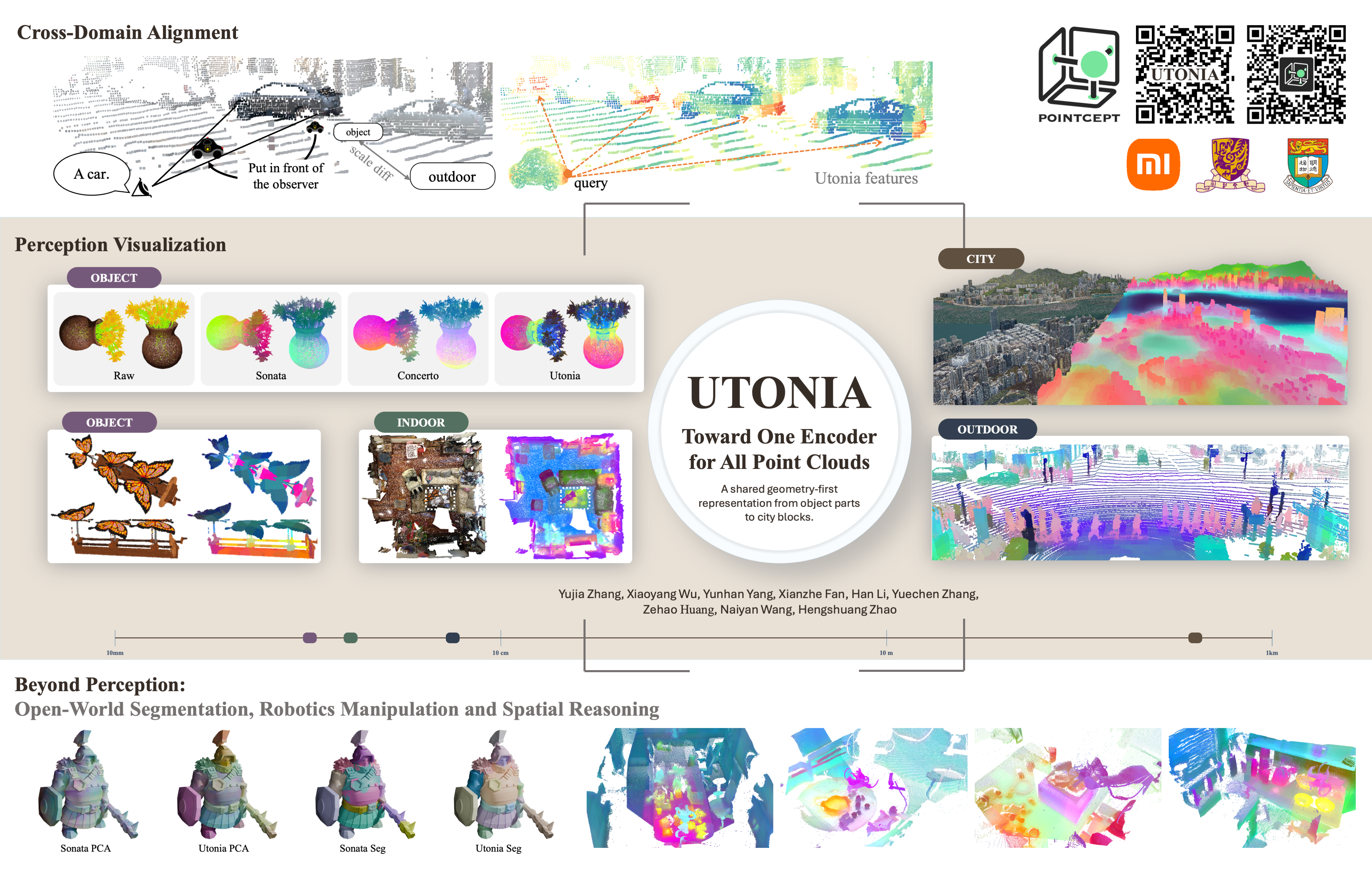
We dream of a future where point clouds from all domains can come together to shape a single model that benefits them all. Toward this goal, we present Utonia, a first step toward training a single self-supervised point transformer encoder across heterogeneous domains, spanning remote sensing, outdoor LiDAR, indoor RGB-D sequences, object-centric CAD models, and point clouds lifted from RGB-only videos. Despite their distinct sensing geometries, densities, and priors, Utonia learns a consistent representation space that transfers across domains. This unification improves perception capability while revealing intriguing emergent behaviors that arise only when domains are trained jointly. Beyond perception, we observe that Utonia representations can also benefit embodied and multimodal reasoning: conditioning vision-language-action policies on Utonia features improves robotic manipulation, and integrating them into vision-language models yields gains on spatial reasoning. We hope Utonia can serve as a step toward foundation models for sparse 3D data, and support downstream applications in AR/VR, robotics, and autonomous driving.
Lay Summary
Point clouds are used to represent the physical 3D world, including object models, indoor scans, self-driving car LiDAR, city-scale scenes, and video-reconstructed 3D scenes. Although they all consist of points in 3D space, they can look very different because they are captured by different sensors or produced by different processing pipelines: some are clean and compact, some are sparse and sensor-specific, some cover very large areas, and some can be noisy or dynamic. How can one model learn a shared representation from such diverse 3D data? Existing 3D models often pick up domain-specific shortcuts, such as particular scales, sensor patterns, or optional input signals like colors and surface normals, which makes them less reliable when transferred to new environments or tasks. We introduce Utonia, a unified point-cloud encoder that learns from diverse 3D data with one shared model. Utonia improves cross-domain learning by making spatial scales more comparable and modeling geometric interactions among points with continuous positional cues, while reducing dependence on optional input signals. This leads to more robust 3D representations for perception, robotics, and general spatial understanding.