
Rel-MOSS: Towards Imbalanced Relational Deep Learning on Relational Databases
Abstract
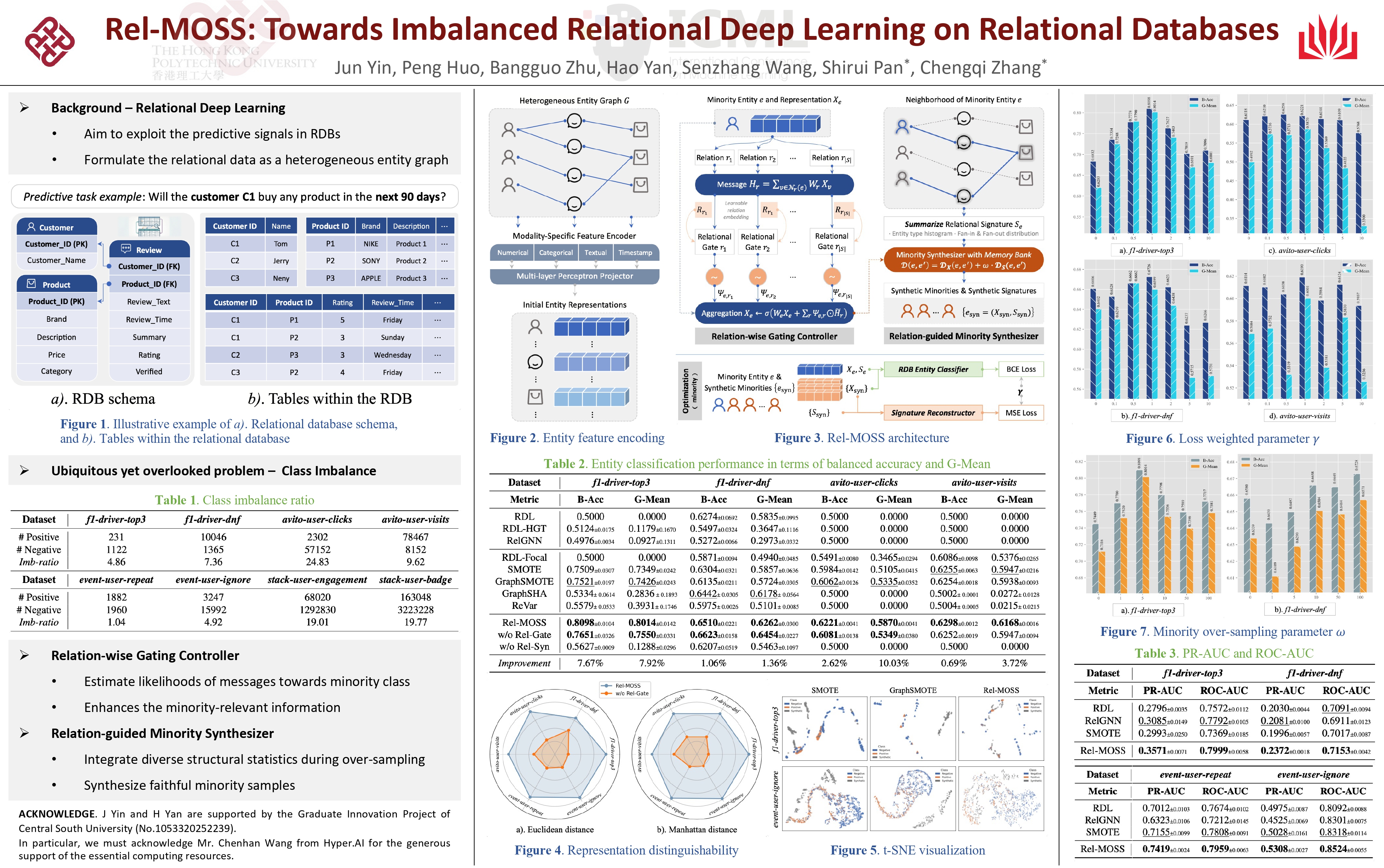
In recent advances, to enable a fully data-driven learning paradigm on relational databases (RDB), relational deep learning (RDL) is proposed to structure the RDB as a heterogeneous entity graph and adopt the graph neural network (GNN) as the predictive model. However, existing RDL methods neglect the imbalance problem of relational data in RDBs and risk under-representing the minority entities, leading to an unusable model in practice. In this work, we investigate, for the first time, class imbalance problem in RDB entity classification and design the relation-centric minority synthetic over-sampling GNN (Rel-MOSS), in order to fill a critical void in the current literature. Specifically, to mitigate the issue of minority-related information being submerged by majority counterparts, we design the relation-wise gating controller to modulate neighborhood messages from each individual relation type. Based on the relational-gated representations, we further propose the relation-guided minority synthesizer for over-sampling, which integrates the entity relational signatures to maintain relational consistency. Extensive experiments on 12 entity classification datasets provide compelling evidence for the superiority of Rel-MOSS, yielding an average improvement of up to 2.46% and 4.00% in terms of Balanced Accuracy and G-Mean, compared with SOTA RDL methods and classic methods for handling class imbalance.
Lay Summary
In this paper, we address a major flaw in how artificial intelligence makes predictions directly from standard relational databases: the inability to handle highly imbalanced data, where critical events, such as fraudulent accounts or rare medical outcomes, are vastly outnumbered by normal, everyday records. Because standard AI models are overwhelmed by the sheer volume of this majority data, they often completely ignore the rare but vital instances, rendering the models useless in practice. To solve this, we introduce a new system called Rel-MOSS, which first acts as a smart filter to tune out the overwhelming noise of the majority data and amplify the faint, unique patterns of the rare events. Furthermore, Rel-MOSS generates realistic, synthetic examples of these minority cases to give the AI enough data to properly learn, carefully ensuring that the new artificial examples make logical sense and respect the complex web of relationships within the database. When tested across 12 real-world datasets, our approach significantly outperformed existing methods.