
Unveiling the Entropy Dynamics of Chain-of-Thought Reasoning
Abstract
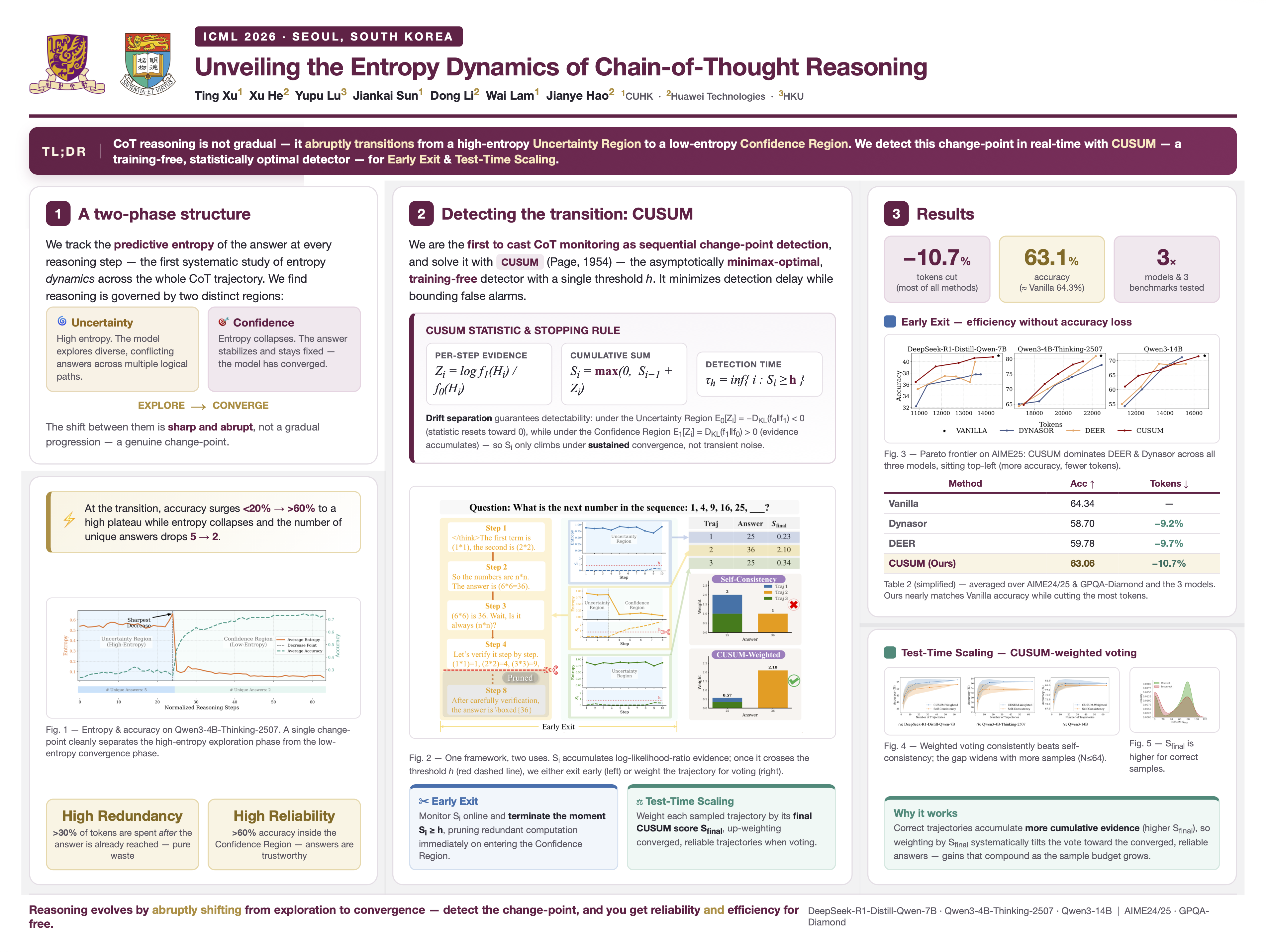
This paper investigates the entropy dynamics of Chain-of-Thought (CoT) and uncovers a consistent two-phase structure: an Uncertainty Region of exploration transitioning sharply to a Confidence Region of convergence. We demonstrate that the Confidence Region possesses two critical properties: 1) High Reliability—answers in confidence region become highly accurate and stable, and 2) High Redundancy—models generate unnecessary tokens long after reaching the correct answer. These properties unlock more efficient and reliable inference strategies: 1) Early Exit leverages reliability and redundancy to terminate computation safely when returns diminish, and 2) Test-Time Scaling uses the Confidence Region signal to prioritize converged trajectories. To operationalize these insights, we formulate Confidence Region detection as a sequential change-point detection problem, being the first to apply classical change-point methods to monitor CoT reasoning. Using the Cumulative Sum (CUSUM) algorithm, a statistically optimal change-point detector, we develop a training-free framework for real-time inference control. Experiments show our approach establishes a superior Pareto-frontier for early exit. CUSUM achieves 63.06% accuracy with 11.1% token reduction, outperforming DEER and Dynasor by 3.28% and 4.36% in accuracy respectively. For test-time scaling, CUSUM-weighted voting consistently outperforms self-consistency.
Lay Summary
When AI systems solve math or science problems, they often "think out loud" by generating a long chain of reasoning steps before giving a final answer. But these reasoning chains can be wasteful—models frequently keep generating text long after they've already committed to a correct answer. How can we tell when a model has genuinely converged, and make use of that signal? We discovered that a model's internal uncertainty follows a consistent two-phase pattern: an early exploration phase of high uncertainty, followed by a sharp transition into a stable convergence phase. We detect this transition in real time using a classical statistical tool—originally designed for industrial quality control in the 1950s—that pinpoints the exact moment the shift occurs. This signal unlocks two practical strategies. First, we can stop generation early once convergence is detected, saving computation without sacrificing accuracy. Second, when generating multiple candidate answers, we can prioritize those that converged earlier and more decisively—leading to better final answers. Together, our approach reduces reasoning length by over 10% while improving accuracy compared to existing methods.