
Efficient Prediction of SO(3)-Equivariant Hamiltonian Matrices via SO(2) Local Frames
Abstract
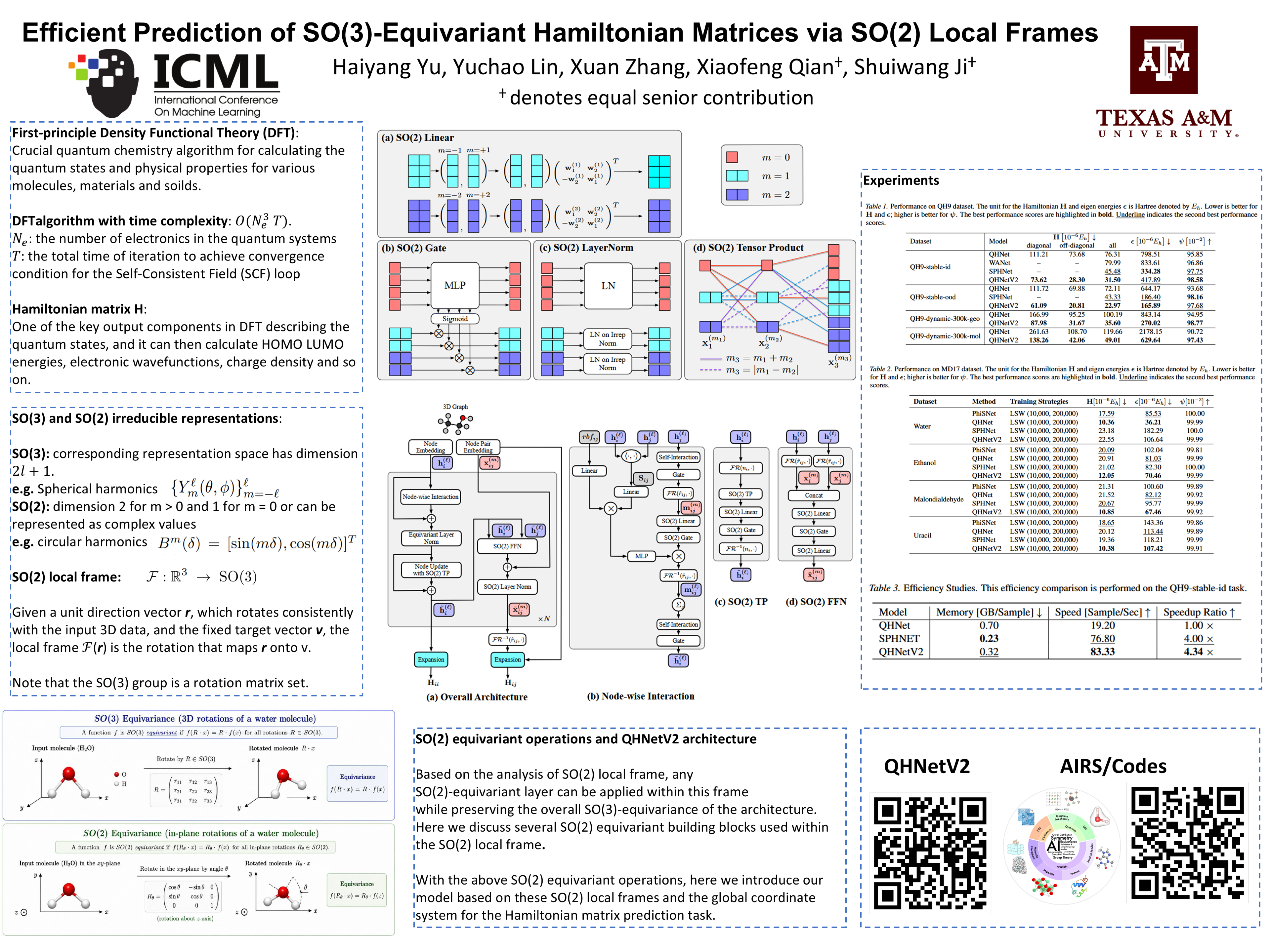
We consider the task of predicting Hamiltonian matrices to accelerate electronic structure calculations, which plays an important role in physics, chemistry, and materials science. Motivated by the inherent relationship between the off-diagonal blocks of the Hamiltonian matrix and the SO(2) local frame, we propose a novel and efficient network, called QHNetV2, that achieves global SO(3) equivariance without the costly SO(3) Clebsch–Gordan tensor products. This is achieved by introducing a set of new efficient and powerful SO(2)-equivariant operations and performing all off-diagonal feature updates and message passing within SO(2) local frames, thereby eliminating the need of SO(3) tensor products. Moreover, a continuous SO(2) tensor product is performed within the SO(2) local frame at each node to fuse node features. Extensive experiments on the large QH9 and MD17 datasets demonstrate that our model achieves superior performance across a wide range of molecular structures and trajectories, highlighting its strong generalization capability. The proposed SO(2) operations on SO(2) local frames offer a promising direction for scalable and symmetry-aware learning of electronic structures. Our code is publicly available as part of the AIRS library (https://github.com/divelab/AIRS/).
Lay Summary
Deep learning has achieved significant progress in computational quantum chemistry in recent years, enabling efficient and accurate simulations of complex quantum systems. Predicting Hamiltonian matrices can accelerate density functional theory calculations and is essential for studying chemical reactions, designing new materials, and understanding molecular properties, highlighting the broad impact of this field on scientific research and discovery. In this work, we propose QHNetV2, a new deep learning model for predicting Hamiltonian matrices. By introducing efficient symmetry-aware operations within local coordinate frames, our method avoids the expensive computations used in previous approaches while maintaining high accuracy and scalability. Experiments on large molecular datasets demonstrate strong performance and generalization across diverse molecular structures and molecular dynamics trajectories.