
REAL: Resolving Knowledge Conflicts in Knowledge-Intensive Visual Question Answering via Reasoning-Pivot Alignment
Abstract
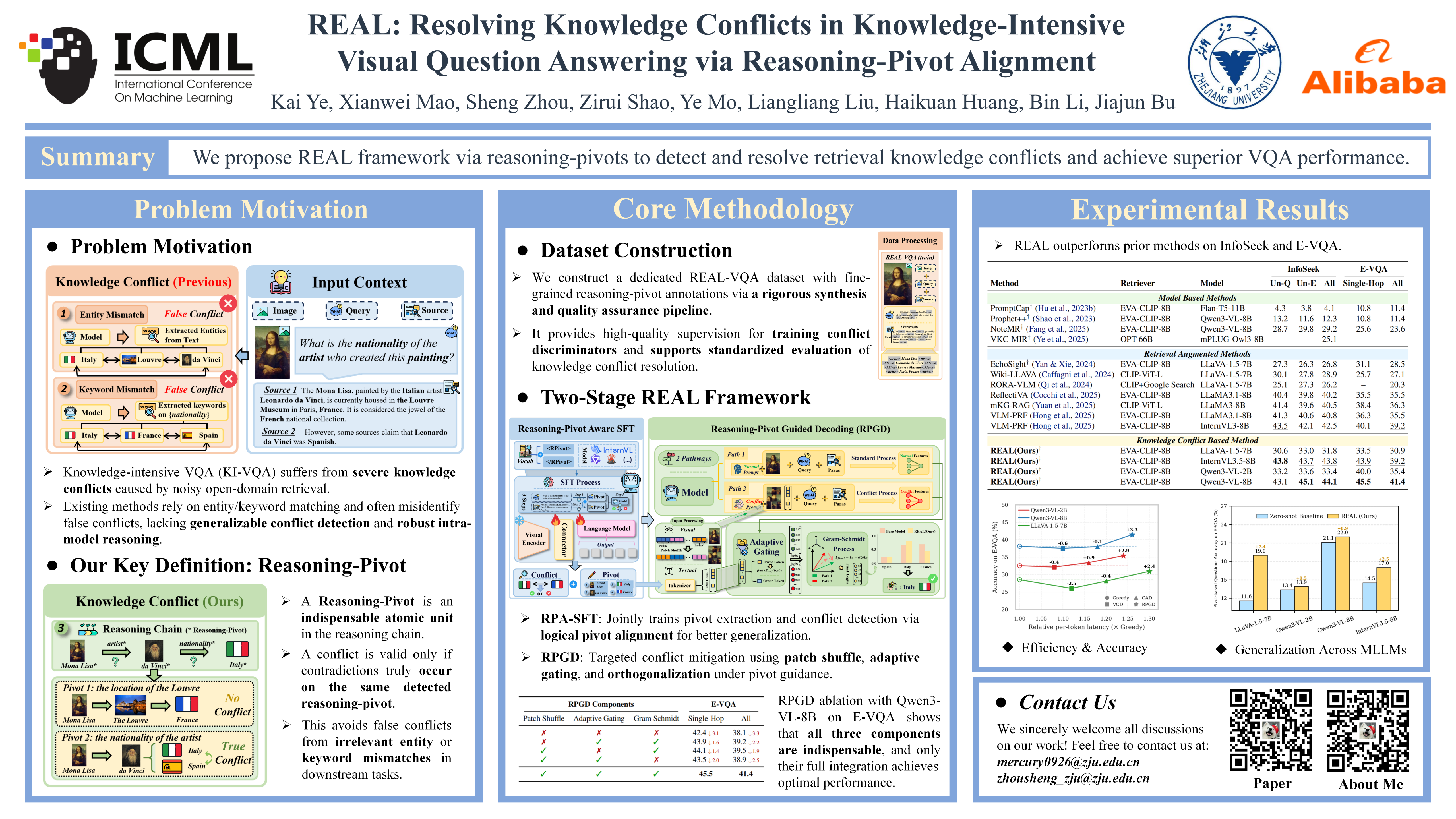
Knowledge-intensive Visual Question Answering (KI-VQA) frequently suffers from severe knowledge conflicts caused by the inherent limitations of open-domain retrieval. However, existing paradigms face critical limitations, including the lack of generalizable conflict detection and intra-model constraint mechanisms to handle conflicting evidence. To address these challenges, we propose the REAL (Reasoning-Pivot Alignment) framework centered on the novel concept of the Reasoning-Pivot. Distinct from reasoning steps that prioritize internal self-derivation, a reasoning-pivot serves as an atomic unit (node or edge) in the reasoning chain that emphasizes knowledge linkage, and it typically relies on external evidence to complete the reasoning. Supported by our constructed REAL-VQA dataset, our approach integrates Reasoning-Pivot Aware SFT (RPA-SFT) to train a generalizable discriminator by aligning conflicts with pivot extraction, and employs Reasoning-Pivot Guided Decoding (RPGD), an intra-model decoding strategy that leverages these pivots for targeted conflict mitigation. Extensive experiments on diverse datasets demonstrate that REAL significantly enhances discrimination accuracy and achieves superior performance, validating our pivot-driven resolution paradigm.
Lay Summary
When Multimodal Large Language Models (MLLMs) answer complex questions about images, they often search databases for extra facts. However, if the retrieved texts contradict each other, this knowledge conflict confuses the model and causes mistakes. We solved this by enabling MLLMs to identify reasoning-pivots, which serve as critical connections linking external facts and visual evidence. By pinpointing exactly where text conflicts happen, our internal safety mechanism helps the model catch misleading information and correct its thinking in real time. This approach significantly improves accuracy when facing conflicting data. Ultimately, our work builds more reliable MLLMs that handle complex reasoning without being fooled by flawed search results.