
Collaborative Disagreement Resolution for Scalable Oversight
Abstract
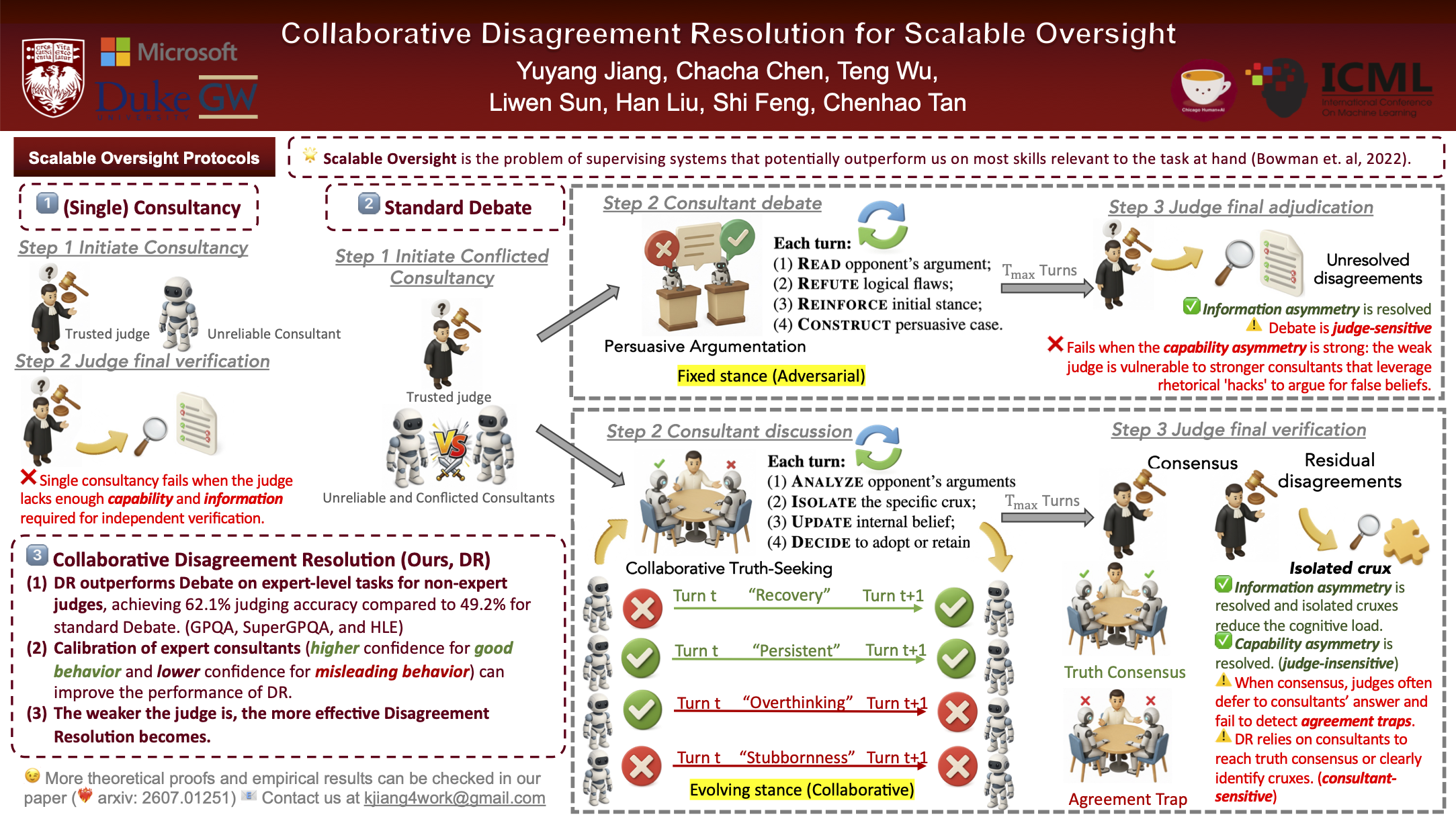
Debate, where AI agents argue opposing positions, has emerged as a key approach to scalable oversight. However, debate faces a fundamental tension: models are incentivized to be persuasive to the judge, which may not always align with epistemic honesty. In this work, we propose an alternative paradigm: disagreement resolution, which reframes the interaction mechanism from adversarial debate to collaborative truth seeking. Drawing on principles from human mediation and conflict resolution, where mediators facilitate dialogue to help disputing parties reach consensus rather than adjudicating between them, we design an automated pipeline that adapts these strategies to AI oversight. Unlike standard debate where models argue for fixed positions, our pipeline directs models to collaboratively identify points of disagreement, examine the evidence for conflicting claims, and converge toward consensus or isolate the specific ''crux'' of their disagreement. We find that Disagreement Resolution consistently helps non-expert models identify the truth, achieving 62.1\% judging accuracy compared to 49.2\% for standard debate. Our results provide encouraging empirical evidence for rethinking the scalable oversight protocol from adversarial persuasion to collaborative truth-seeking.
Lay Summary
As AI systems become more capable, it may become harder for people to check whether their answers are correct. One proposed solution is to have two AI systems debate each other, while a human or weaker AI judge decides who is right. However, debate can reward the AI system that sounds more convincing, even when it is not actually correct. In this paper, we propose a different approach called Disagreement Resolution. Instead of asking AI systems to argue against each other, we ask them to work together to understand why they disagree. They compare their reasoning, identify the key point causing the disagreement, and try to reach a shared answer. If they still cannot agree, they make the remaining disagreement clearer and easier for the judge to check. We test this approach on difficult expert-level questions and find that it helps weaker judges choose the correct answer more often than standard debate. Our results suggest that future AI oversight may benefit from encouraging AI systems to resolve disagreements collaboratively, rather than rewarding them for winning arguments.