
Stochastic Neural Ray Tracing for Radio Frequency Channel Modeling
Abstract
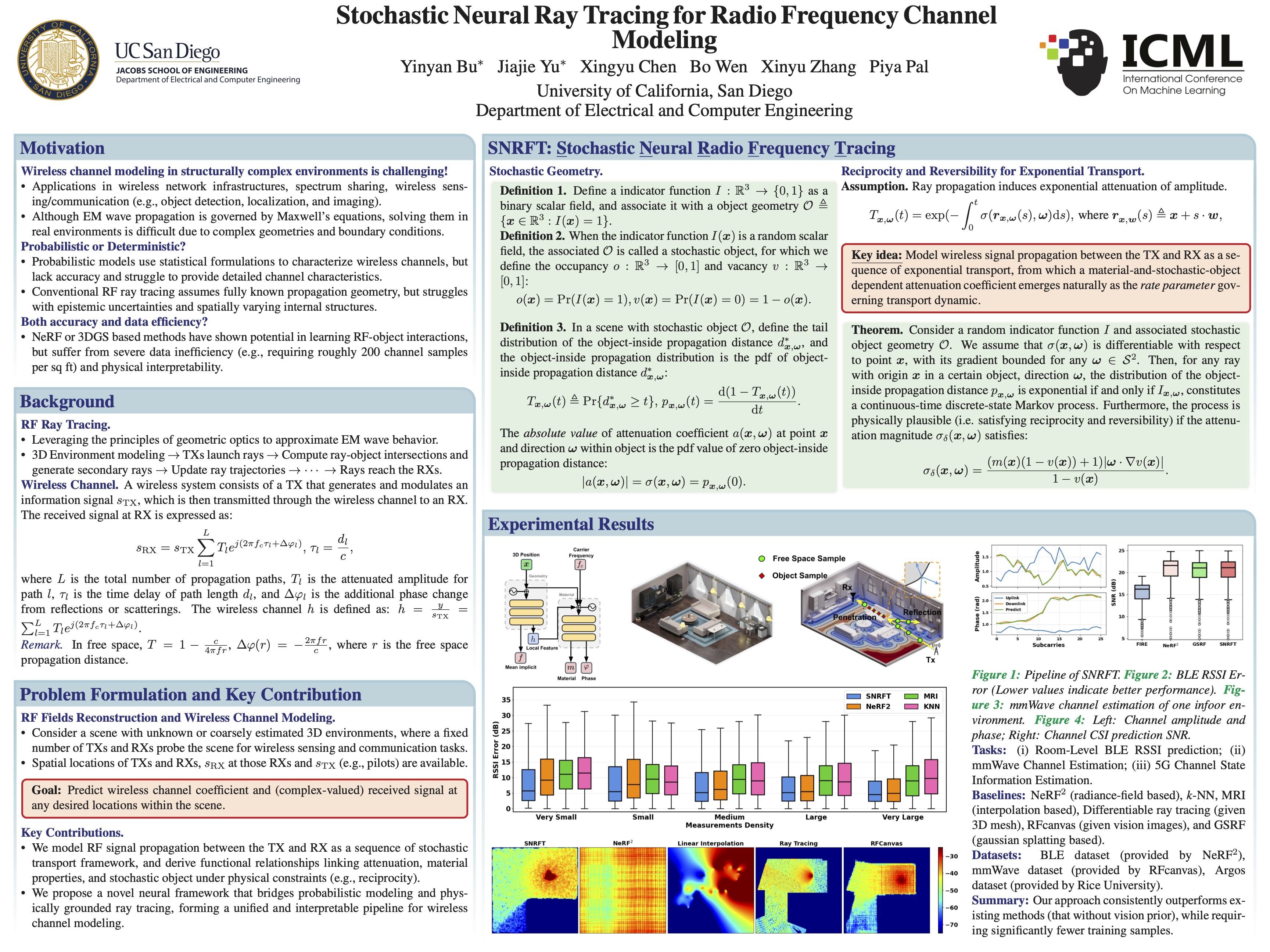
Wireless channel modeling is essential for the design, analysis, and optimization of modern wireless sensing and communication systems. However, accurately modeling wireless channels in electrically large and complex environments remains a long-standing challenge, owing to the intricate interactions between radio-frequency (RF) signals and surrounding objects (e.g., reflection, diffraction, and scattering). Unlike conventional ray-tracing pipelines that rely on hand-engineer interaction rules, or black-box neural surrogates that do not explicitly model physical structure, we introduce SNRFT, a novel framework that integrates neural representations with physics-based RF propagation modeling. Our key idea is to view RF transport as a stochastic propagation process, from which a material-dependent attenuation coefficient emerges naturally as the rate parameter governing transport dynamics. This formulation inherently satisfies key physical constraints such as reciprocity and reversibility. Building on this foundation, we employ implicit neural representations to capture complex RF-object interactions while preserving the composability of traditional ray tracing. Extensive evaluations on real-world wireless communication and sensing testbeds demonstrate that SNRFT consistently outperforms existing methods, while requiring significantly fewer training samples.
Lay Summary
Wireless channel modeling is important for designing, analyzing, and optimizing modern wireless communication and sensing systems. However, accurately modeling radio-frequency (RF) signals in complex environments is challenging because signals can reflect, scatter, diffract, or be attenuated by surrounding objects. This paper introduces SNRFT, a framework that combines neural representations with physics-based RF propagation modeling. The main idea is to view RF transport as a stochastic propagation process, where material-dependent attenuation naturally appears as a parameter that governs how signals weaken as they travel. This formulation incorporates physical structure such as reciprocity and reversibility, while neural representations are used to capture complex interactions between RF signals and objects. By combining these ingredients, SNRFT aims to retain the interpretability and compositional structure of ray tracing while using learned representations to model RF-object interactions that are difficult to specify by hand. Experiments on real-world wireless communication and sensing testbeds show that SNRFT improves over the evaluated baselines and can require fewer training samples in the studied settings.