
GICDM: Mitigating Hubness for Reliable Distance-Based Generative Model Evaluation
Abstract
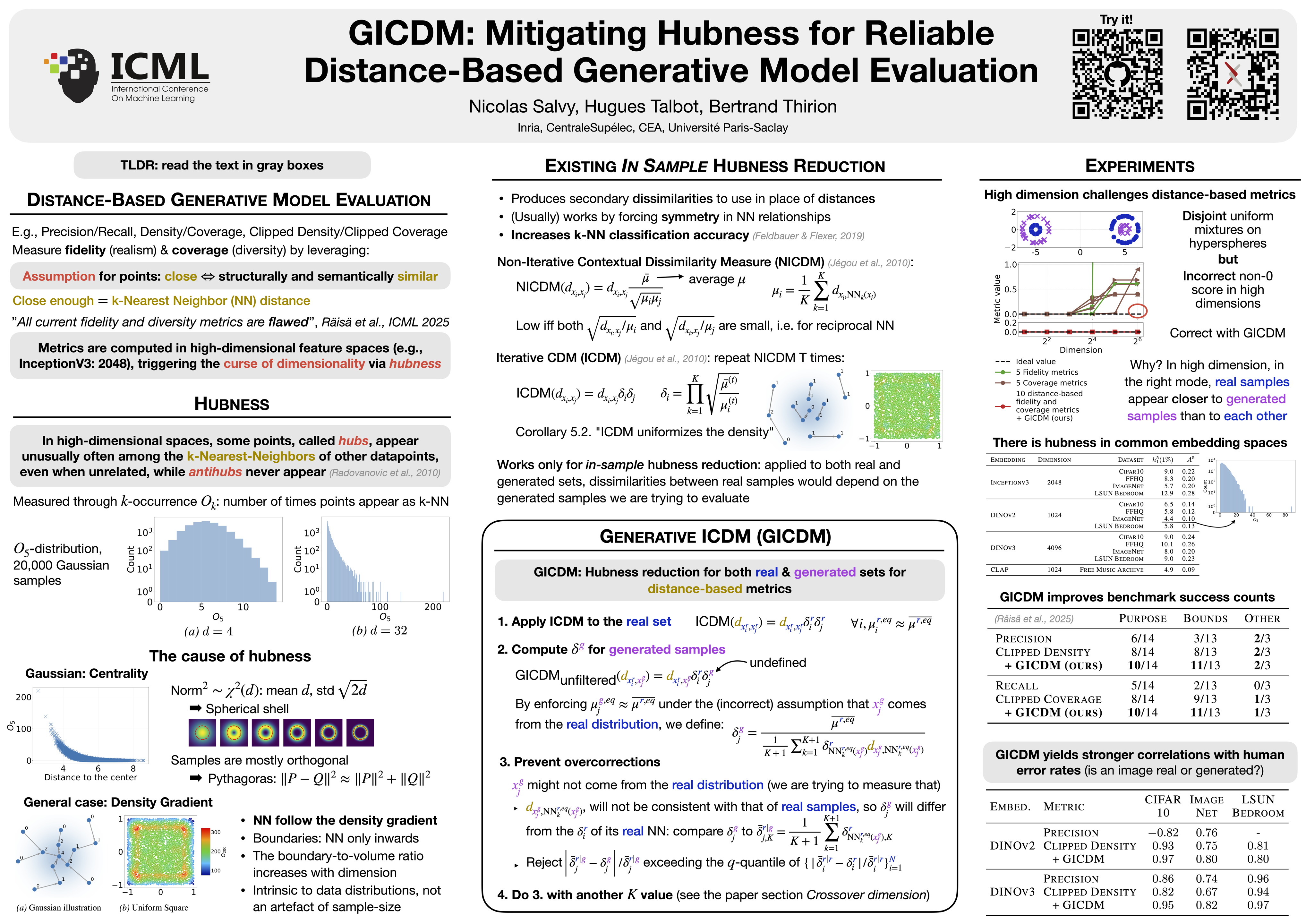
Generative model evaluation commonly relies on high-dimensional embedding spaces to compute distances between samples. We show that dataset representations in these spaces are affected by the hubness phenomenon, which distorts nearest-neighbor relationships and biases distance-based metrics. Building on the classical Iterative Contextual Dissimilarity Measure (ICDM), we introduce Generative ICDM (GICDM), a method to correct neighborhood estimation for both real and generated data. We introduce a multi-scale extension to improve empirical behavior. Extensive experiments on synthetic and real benchmarks demonstrate that GICDM resolves hubness-induced failures, restores reliable metric behavior, and improves alignment with human assessment.
Lay Summary
AI models can now generate highly realistic images and data, but accurately measuring how good they are is surprisingly difficult. Systems can typically be evaluated by calculating the mathematical "distance" between AI-generated samples and real data. However, this calculation happens in complex environments that suffer from a geometric quirk called "hubness". Hubness distorts the distance measurements so that a few generic examples artificially appear closely related to many others. We demonstrated that this phenomenon makes current evaluation metrics fail. To solve this, we developed a new method called GICDM to correct these distorted distances. Our approach mathematically adjusts distances, to restore honest, balanced comparisons between real and generated examples. Ultimately, GICDM improves the reliability and trustworthiness of generative AI evaluation.