
Nonparametric Distribution Regression Re-calibration
Abstract
Lay Summary
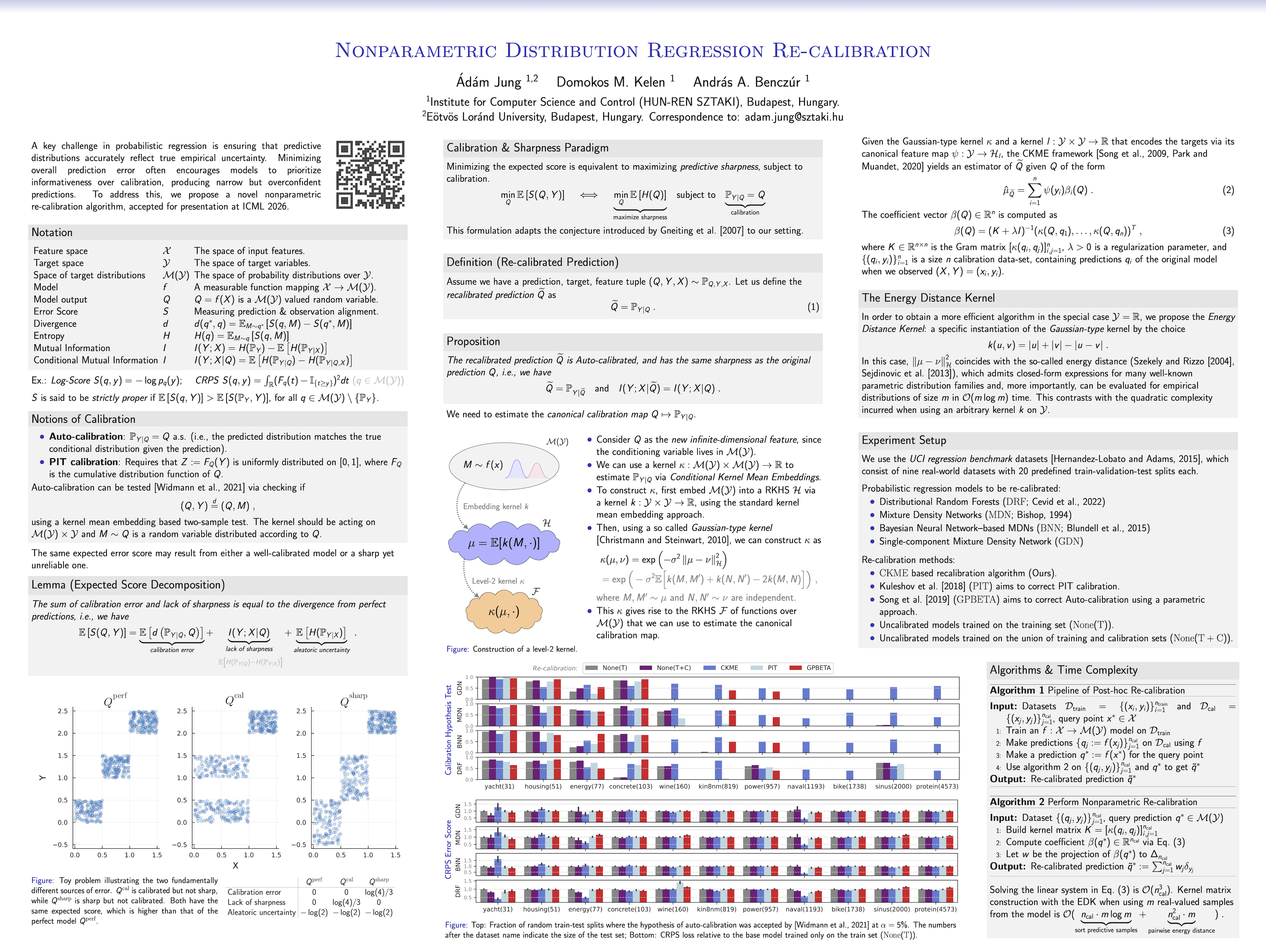
When machine learning models make predictions, they also need to tell us how certain they are. Often, these models are trained to be as precise as possible, which can encourage overconfidence. In high-stakes situations—such as autonomous driving or healthcare—an overconfident model is dangerous; trustworthy estimates of uncertainty are far more valuable than narrow, incorrect predictions. Researchers have tried to fix this "calibration" issue after the models are already trained. While reliable solutions exist for models that sort data into simple categories (classification), fixing models that predict continuous, real-world numbers (regression)—like forecasting exact temperatures—is much harder. Existing fixes for regression either use weak evaluation tests that hide dangerous errors (by letting overconfident and underconfident mistakes cancel each other out) or rely on strict assumptions about the exact shape of the model's errors. To address these limitations, we created a new algorithm that fine-tunes a model's uncertainty without forcing the data to fit a predefined mathematical shape. Think of it as a flexible method that smoothly adjusts the model's confidence to match the complex reality of continuous data. We also developed a fast computational shortcut to ensure this runs quickly and efficiently on real-world datasets.