
StormInsight: Hierarchical Environmental Forcing and Vertical Coupling for Weather System Evolution
Abstract
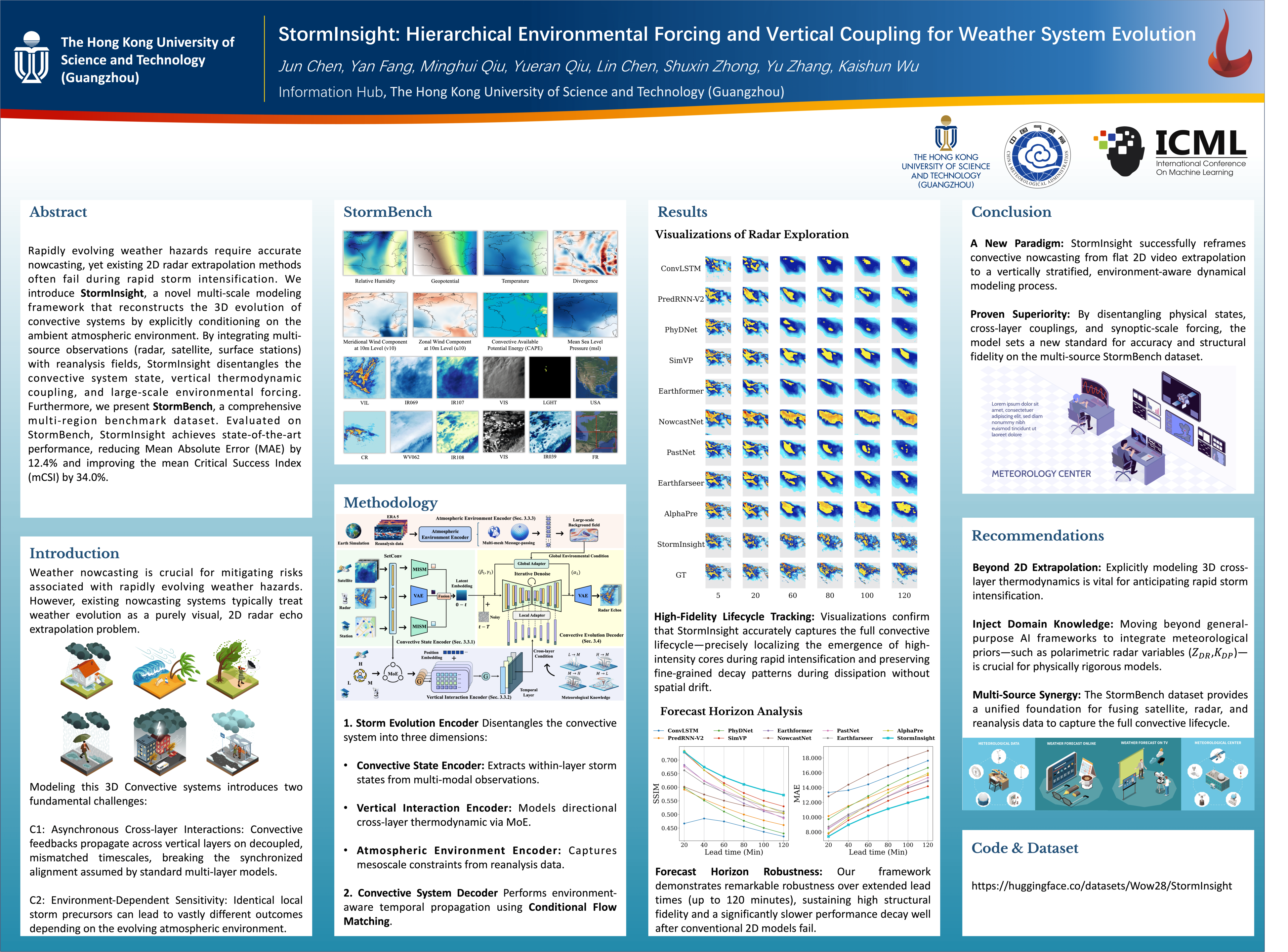
Nowcasting forms the first line of defense against rapidly evolving weather hazards, where even minutes of delay can lead to severe societal impacts. However, existing systems predominantly extrapolate 2D radar reflectivity, which struggles under rapid intensification regimes. We introduce StormInsight, a multi-scale modeling framework that enables coherent reconstruction of the three-dimensional evolution of convective systems while explicitly conditioning on the ambient environment. StormInsight integrates multi-source observations—including radar, satellite, and station—with reanalysis fields through two components: (i) Storm Evolution Encoder that explicitly disentangles convective system state form vertical thermodynamic coupling and large-scale environmental forcing; (ii) Convective System Decoder that predicts future echos by adaptively aggregating cross-layer interactions conditioned on evolving environmental conditions. To support comprehensive evaluation, we build a new benchmark StormBench that integrates observational and reanalysis data across regions. On this benchmark, StormInsight consistently achieves the best performance, reducing MAE by 12.4% and improving the mCSI by 34.0%.
Lay Summary
When severe weather strikes, accurate short-term forecasts can save lives by giving people time to prepare for sudden hazards like flash floods. However, most current forecasting tools try to predict the weather by looking at flat, two-dimensional radar images and simply tracking where the storm will move next. This approach often fails when storms suddenly grow stronger, because real storms are complex, three-dimensional structures that are deeply affected by their surrounding atmosphere. To solve this problem, we created StormInsight, a new system that models storms in 3D. Instead of relying on just one flat view, StormInsight combines information from ground weather stations, radar, and satellites. This allows the system to look at the bottom, middle, and top of a storm, while also considering the overall background atmospheric conditions. By understanding how these different layers interact with each other and their environment, StormInsight can accurately predict how a storm will change, intensify, or fade. We also built a new comprehensive testing dataset, StormBench, to thoroughly evaluate weather prediction models. In our tests, StormInsight was significantly more accurate than existing methods, reducing prediction errors by 12.4% and improving storm detection capabilities by 34.0%.