
Learning to Rank by Directly Optimizing Full-Order Probabilities
Abstract
Lay Summary
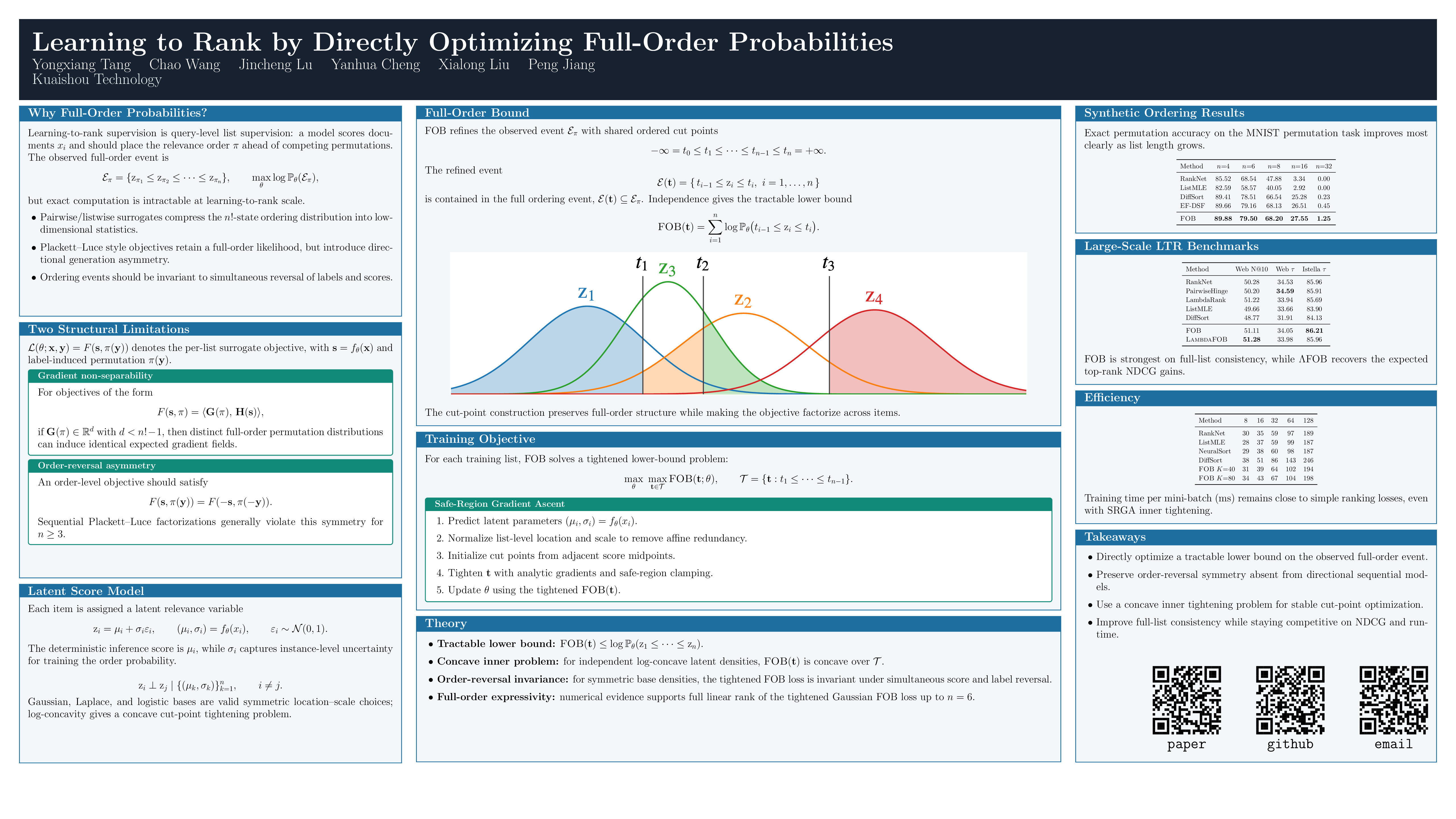
Many everyday systems must put things in a sensible order: search engines rank web pages, online stores arrange products, and apps line up videos or songs by how well they match your interests. Teaching a computer to produce a good ordering is hard, in part because the number of ways to order even a short list is astronomically large, so the most natural way to score "how good is this ordering" cannot be computed directly. To cope, existing methods usually optimize simpler stand-in goals, such as only comparing items two at a time. These shortcuts are fast but can pull the system away from the ordering we actually care about. We propose a method that stays much closer to the true goal while remaining fast enough for practical use. It provides a reliable, easy-to-optimize estimate of how good a complete ordering is, treats forward and backward orderings consistently, and comes with an efficient training procedure. Across controlled tests and large real-world ranking benchmarks, it produces consistently better orderings than widely used alternatives, with the advantage growing as the lists get longer.