
RoboFlow4D: A Lightweight Flow World Model Toward Real-Time Flow-Guided Robotic Manipulation
Abstract
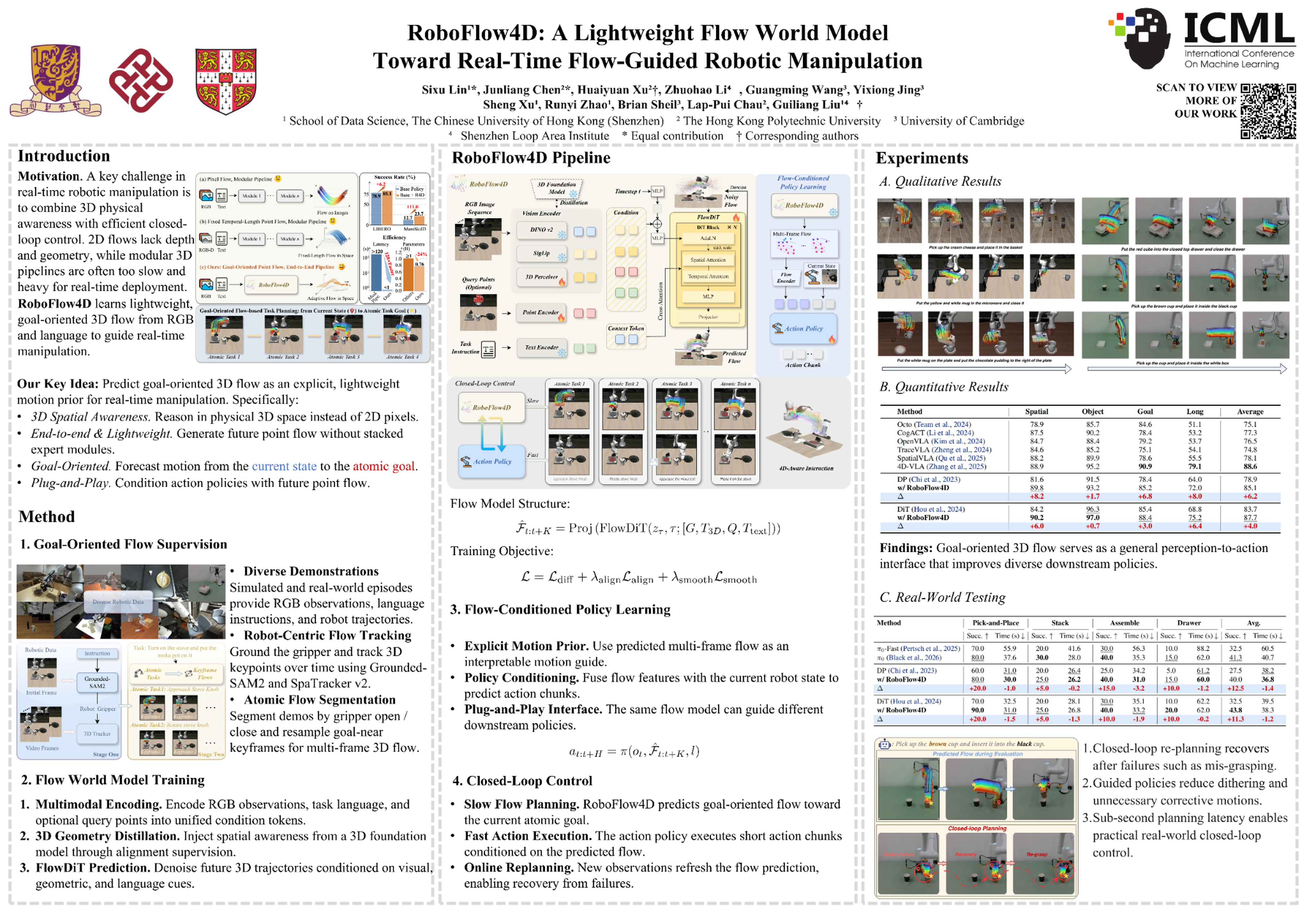
Planning and acting in 3D environments is a fundamental capability for robotic manipulation in the real world. Although prior work has explored predictive flow planners to guide 3D manipulation, existing approaches often rely on modular pipelines stacking multiple submodels, resulting in high computational overhead and limited real-time performance. To address these challenges, we introduce RoboFlow4D, a lightweight flow world model that unifies perception and planning by estimating temporal motion in physical 3D space. As an end-to-end framework, RoboFlow4D directly predicts multi-frame 3D flows from visual observations and textual instructions, providing explicit flow-based planning to guide action generation. This design allows seamless integration with general action policies, forming an efficient observation–planning–execution closed loop. Through slow–fast collaboration between flow prediction and action control, RoboFlow4D enables real-time and resource-efficient manipulation. Extensive experiments in both simulation and real-world settings demonstrate that RoboFlow4D consistently improves manipulation success rates and computational efficiency, advancing flow-guided planning for embodied intelligence. Our project page is available at RoboFlow4D.
Lay Summary
Robots need to understand how objects and their own bodies move in 3D space to complete everyday manipulation tasks, such as picking up, stacking, placing, or opening objects. However, many existing planning systems rely on multiple large models, which makes them slow and difficult to use in real time. This paper presents RoboFlow4D, a lightweight model that predicts future robot motion in 3D space from camera images and language instructions. Its predicted motion guides the robot’s action policy, helping the robot move more directly and recover from mistakes during execution. Experiments in both simulation and real-world tasks show that RoboFlow4D improves task success rates while keeping planning fast and efficient. These results suggest that lightweight 3D motion planning can make robot manipulation more reliable and practical.